
Benefits of Local SEO In 2027
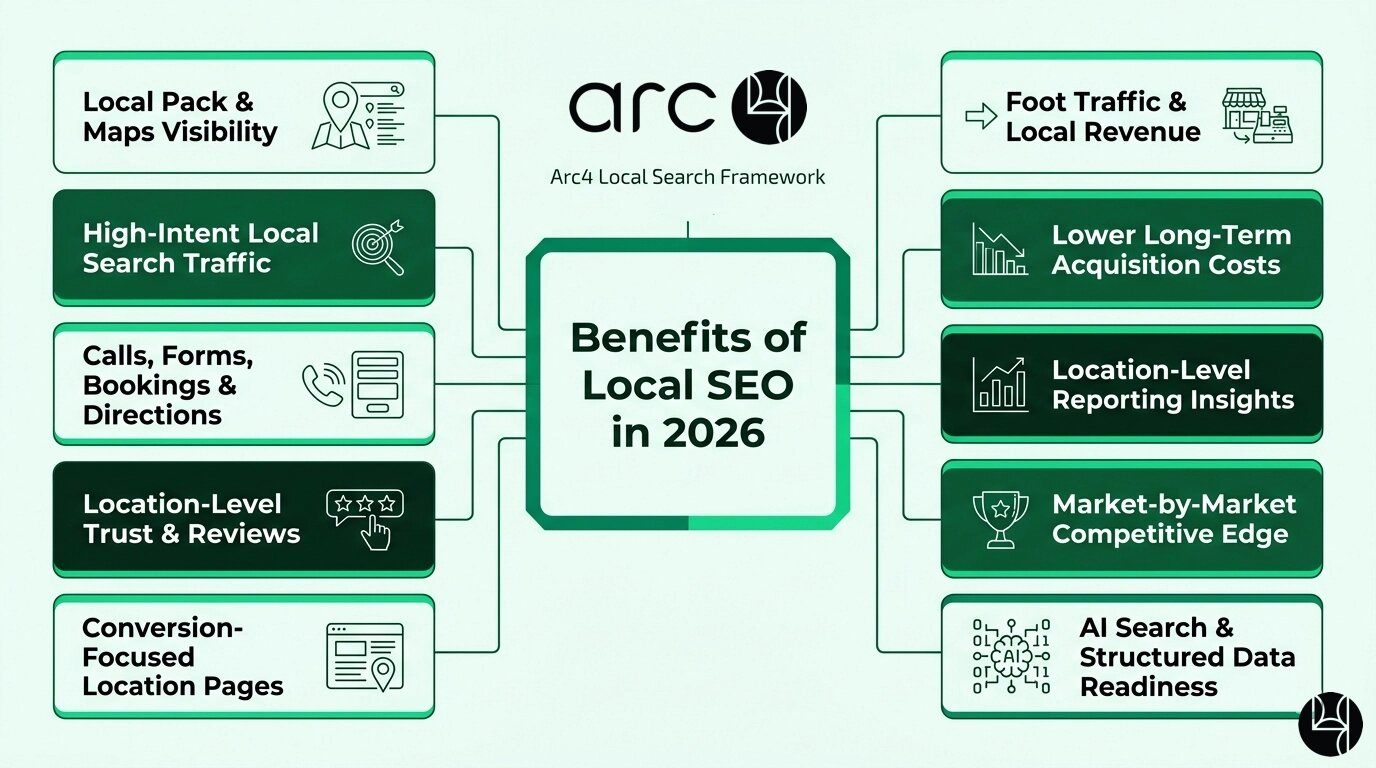
Key Takeaways
- Local SEO increases visibility in Google Maps, Local Pack, and “near me” results, and can start impacting leads within 4 to 12 weeks of consistent optimization.
- 93% of local-intent searches display the Local Pack, which captures roughly 42% of all clicks.
- By 2027, 80% of American customers will be searching online for nearby businesses every week, which highlights the importance of optimizing for local search for smaller multi-locations, franchises, and other location-based companies.
- 28% of local searches result in a purchase within the same day.
- Local SEO enables companies to draw in local customers and aid their growth through taking real actions like making phone calls, asking for directions, filling out forms, and visiting in person.
- Accurate directory listings, strong Google Business Profile optimization, positive reviews, and localized content are the core levers behind most local SEO benefits.
- In 2027, local SEO supports AI-driven discovery by making location data, services, reviews, hours, and website content easier for search engines and AI systems to understand.
- Local SEO builds long-term brand credibility and helps each location compete in its local market, even when the brand operates across dozens, hundreds, or thousands of locations.
What Is Local SEO and Why It Matters in 2027
Local SEO is the process of improving an organization’s online presence to ensure that it appears highly ranked when someone searches for location-specific information on the Internet. If one searches “plumber in Atlanta” or “coffee shop near me,” local SEO will determine which businesses pop up in the search results.
For multi-location brands, local SEO is less about one profile or one page. It is a scalable system of location data, listings, reviews, local pages, structured content, and reporting – every component of which we break down in our local SEO Guide.
Unlike traditional SEO that targets broad national or global audiences, local SEO focuses on proximity, relevance, and prominence for searches tied to a specific city, neighborhood, or service area. What makes local SEO effective is its ability to enhance a business’s visibility and competitiveness in local search results, helping each location, branch, franchisee, or service area appear in local packs and attract targeted customers ready to take action, not just generating website traffic from anywhere in the world.
The numbers make the case clear: 46% of all Google searches carry local intent in 2027, and over 57% of local searches happen on mobile devices. This shift toward location-based searching means that local businesses without strong local SEO efforts are invisible to their target audience at the exact moment those potential customers are looking for nearby services.
Typical local-intent searches in 2027 include queries like “urgent AC repair near me,” “best sushi in Austin,” and “24-hour pediatric dentist downtown.” These searches signal immediate need and high purchase intent.
The main components of local SEO include Google Business Profile optimization, citations across online directories, online reviews management, localized on-site content, and technical/mobile optimization. Locally focused optimization of website structure and content is also essential for improving site performance and conversion rates. The sections below unpack how each drives real business outcomes.
Core Business Benefits of Local SEO
This section focuses on concrete business outcomes: visibility, local traffic, leads, and revenue, not just rankings for rankings’ sake.
Strong local SEO improves visibility in three critical areas:
| Visibility Zone | What It Is | Why It Matters |
|---|---|---|
| Local Pack | Top 3 map results in Google Search | 93% of local-intent searches display this, capturing roughly 42% of all clicks |
| Google Maps App | Standalone map application | 86% of people use Google Maps to find local businesses |
| Localized Organic Results | Standard search results below the map | Catches searchers who scroll past the map |
Being at those ranks increases clicks, calls, visits, and directional queries from users nearby to the business location. Local SEO allows for disqualification of irrelevant traffic as it targets searchers in a realistic geographical radius of about 5 to 25 miles, depending on the industry.
Local SEO can easily become the highest return-on-investment (ROI) digital medium for many businesses that have locations and include restaurants, trades, clinics, retail, and franchise networks.
Benefit 1: Stronger Local Visibility Where It Counts
The Local Pack Rankings are a key visibility outcome. The Google Local Pack or Google Map Pack is one of the most effective positions to achieve quick clicks and calls from customers, and the optimization of Google My Business Profile is the way to obtain such placement. The optimization of Google Map Pack is the major technique to increase visibility and get local leads.
Completeness of the profile with the NAP data, relevant categories, nice photos, and blog posts make it much easier to get featured by Google in the 3-pack for the users’ high-intent requests. In 2027, Google will continue its preference to proximity and completeness of profiles, and therefore filling all the GBP fields and editing holidays hours will be an easy way to win visibility.
Local SEO adds to your branded visibility in the Google Local Pack through the optimization of local ranking factors such as Google My Business Profile information in online directories.
There is evidence of the priority mentioned above – more than 70% of customers use Google when researching local business.
Some visibility outcomes are the following: a healthcare network can increase visibility on searches for urgent care in any market. The restaurant chain can be visible for ‘near me’ and cuisine-related requests in hundred markets. This is an actual access point that will bring the business to the user’s attention.
Benefit 2: More High-Intent Traffic, Calls, and Store Visits
Local SEO is linked to tangible results in terms of actions such as phone calls, appointments, filling out contact forms, and even physically going to a place shortly after performing a search. Local SEO attracts the kinds of prospects that are most likely to make conversions because local SEO reaches individuals who are more likely to purchase a product.
Searches by individuals with local search phrases such as “open now,” “near me,” or “[service] today” are highly intent searches, and they are very different from casual searches. In fact, according to statistics, 76% of those who performed a search for something locally on a mobile phone visited a business within 24 hours of doing so.
Google Business Profile features directly convert impressions into actions:
- Click-to-call buttons for immediate phone calls
- One-tap direction links for in-person visits
- Integrated booking systems
- Messaging options for quick questions
The performance of a typical local campaign includes organic session increases of between 50% to 100% in the first three months of optimization, along with increased phone and directions actions.
Proper business operating hours, current images, and services offered create a better user experience and increase the likelihood of a searcher visiting or contacting the business.
Benefit 3: Increased Foot Traffic and Revenue for Physical Locations
Probably the most evident advantage of local SEO is the influence it has on the flow of foot traffic in brick-and-mortar stores. The “near me” search term, along with the searches of particular cities, will bring individuals who happen to be geographically close to the business into the store.
More than half of the searches containing “near me” will end up resulting in the person visiting the physical location. When businesses optimize their Google Business Profile, they can enjoy an increase in foot traffic as a result of increased visibility in local search and Google Maps.
Local SEO enables businesses to get themselves into the Google Local Pack, thus gaining more visibility to the customers located nearby and searching for local services. This brings more foot traffic as well as loyal clients who will keep coming back due to this SEO optimization.
Businesses with good photos (storefront, interior, products display, food menu, etc.) attract more attention. A newly opened café in Chicago’s Wicker Park should utilize local SEO optimization targeting the “coffee shop near me” phrase to get more foot traffic on weekends. A hardware store may boost its map visibility and foot traffic by targeting “hardware store open now.”
Benefit 4: Stronger Trust, Reviews, and Local Reputation
Local SEO and reputation management have become one entity now. Volume of reviews, recency of reviews, and rating of reviews have become the key signals that are used by Google’s local algorithm to decide on the ranking.
The consumer behavior is evident: 87% of consumers read online reviews prior to selecting a local business. Online reviews in 2027 will be taken just about as seriously as personal recommendations by consumers when choosing a local provider, especially in high risk industries such as medical, legal, and home repair services.
It has been found that almost half of consumers take online reviews just as seriously as personal recommendations. This is what makes reviews essential in developing consumer trust.
Review collecting and managing help to build trust and improve brand credibility since the volume of reviews and quality of reviews impact local ranking on search engines. Good customer reviews are an essential element of local SEO and reputation, which makes them a valuable tool for improving the business image.
On the large scale review management is transformed into an operational process where location-level sentiments are tracked, underperforming locations are identified, and response guides for local teams are provided.
Review management best practices:
- Actively ask satisfied customers to leave reviews
- Respond thoughtfully to both positive and negative customer feedback
- Address recurring issues mentioned in reviews
- Thank customers by first name and reference specific details of their visit
Negative reviews present opportunities, addressing feedback with empathy demonstrates that the business values service improvement.
Benefit 5: Better Conversion Rates from Local Website Visitors
Attracting website visitors is just half the battle – turning them into paying customers is the other half.
Local SEO promotes certain website optimizations such as location-based landing pages, strong calls to action (make a call, book, request a quote), and presenting local proof points in the form of testimonials and case studies. All these help in transforming local visitors into loyal customers.
Conversion statistics are impressive too – 78% of local searchers end up becoming a client and thus show that local SEO assists businesses in reaching out to the most intent-driven prospects who are already willing to act on their search. Also, 28% of the local searches end up getting converted into sales on the very same day.
The data reveals that conversion rates from local keywords are 15 to 30% higher than that of generic keywords.
Concrete website elements that drive conversions:
- Prominent phone number at the top of the page
- Clickable phone links on mobile devices
- Embedded Google Maps
- Easy-to-use contact forms
Neighborhood-specific landing pages outperform citywide pages. For example, a roofer will do better by creating pages that include “Roofing Services in Brooklyn, NY” and “Roofing Services in Park Slope” compared to a page named “Roofing Services in New York.” Or, for a franchise service company that has many locations, it will be better off by creating landing pages for each location than a generic service page for the entire country.
It is possible to increase the conversion rate of Google Business Profile by optimizing the content with reviews.
Benefit 6: Competitive Edge In Each Local Market
Local SEO is uniquely powerful for smaller businesses because Google often surfaces the most locally relevant and well-optimized business, not simply the biggest brand. Multi-location brands still have to win market by market. A national brand does not automatically win every local result unless each location has strong data, reviews, content, and relevance signals.
SEO Local levels the playing field for smaller companies against the bigger chain stores because Google gives preference to relevance and locality rather than the company’s size when it comes to local searches. In searches that are hyperlocal and specific about the location, SEO will outweigh branding.
There is an immense benefit created by the SEO Local because it helps companies get on the top of “near me” searches, which have become increasingly common due to the increasing use of mobile devices.
Competitive differentiation tactics:
- Monitor competitors’ reviews, categories, and photos
- Respond to reviews faster than other local businesses
- Use professional, lifestyle-oriented images
- Maintain complete business information
Sometimes, a local neighborhood gym can outrank a chain gym when people search for a personal trainer. A local garage can outrank a car franchise when searching for “brake repair in [city]” since they have optimized their business better than the chain. Lastly, a brand with 200 local listings could outrank a bigger brand in certain cities because of their local SEO strategy.
Which Businesses Benefit the Most from Local SEO?
Any organization serving a defined local area can benefit, but certain sectors gain disproportionate value.
| Business Type | Why Local SEO Matters |
|---|---|
| Restaurants & Cafés | “Near me” searches, immediate hunger intent |
| Medical & Dental Practices | Patient volume, trust signals critical |
| Law Firms | Reputation and local expertise drive client acquisition |
| Home Services (plumbers, HVAC, roofers) | Emergency needs, high-intent searches |
| Retail Stores | Competing for local customers and foot traffic |
| Salons & Spas | Location and service specialization |
| Fitness Centers | Proximity matters for membership decisions |
| Real Estate Agencies | Local market expertise is core business |
| Franchise Systems | Local visibility across markets, brand consistency critical |
| Healthcare Networks | Urgent needs, provider searches, trust signals critical |
| Financial Services Branches | Local branch searches, advisor trust, appointment intent |
| Education & Childcare Networks | Parent research, local trust, enrollment intent |
Emergency and urgent businesses see great gains from local SEO, having a locksmith, tow truck, or urgent care business pop up in the local search results right when that person needs them is a major source of business for many businesses.
Local SEO allows multi-location businesses to get localized visibility through each of their locations, using a Google Business Profile and location-specific landing page.
Examples: A dentist in Denver who focuses on “family dentist in Cherry Creek” will bring in not only their regular customers but also emergency visits. A plumber in Phoenix who focuses on keywords such as “emergency plumber in Scottsdale” will create a steady stream of leads.
Getting Started: How to Begin Improving Local SEO in 2027
Here’s a practical, step-by-step overview for business owners wanting to see results within months.
- Step 1: Claim and Verify Your Google Business ProfileMany businesses have unclaimed profiles that competitors may have created. Claiming this profile is free and grants control over displayed information. For multi-location brands, audit Google Business Profile ownership, access, and data accuracy across all locations.
- Step 2: Ensure NAP ConsistencyYour name, address, and phone number must be identical across your Google Business Profile, website, and all major online directories. Inconsistencies confuse Google’s algorithms. For multi-location brands, centralize location data across your website, listings, maps, directories, and internal systems.
- Step 3: Optimize Your Profile
- Select accurate primary and secondary categories
- Add high-quality photos (storefront, interior, team, products)
- Write a concise business description with local keywords
- Update business hours including holiday hours
- Enable messaging or booking features
- Step 4: Create Location Pages on Your WebsiteIncorporate city or neighborhood names naturally, include embedded maps, add FAQs addressing local questions, and write unique content for each location. For multi-location brands, build scalable location, service-area, and market page templates or leverage a service provider like Arc4 to handle this for you at scale.
- Step 5: Start Review Generation
- Send follow-up emails with direct links to your review page
- Display QR codes at checkout
- Commit to replying to every new review within 24 to 48 hours
Use Google Analytics to track local organic sessions and conversions attributed to your local SEO efforts.
Is Local SEO Worth the Investment for Small and Multi-Location Businesses?
Local SEO is usually one of the most ROI-oriented marketing channels for small and multiple locations businesses if implemented regularly. Local SEO generates more ROI than SEO in general or even paid ads.
Unlike the stop-start nature of paid advertising, local SEO continues driving leads even when ad budgets pause. Local SEO strategy is a cost-effective move that generates consistent online visibility without ongoing ad spend, allowing businesses to connect with relevant local queries and lower customer acquisition costs.
The contrast could not be greater as research shows that close to 80% of local searches end up in a sale whereas most online marketing campaigns generally have a 2% to 3% conversion rate, thus making local SEO much more affordable than traditional marketing.
While conventional marketing strategies focus on generic campaigns rather than targeting geographic searches that might help them get more conversions, local SEO is all about location-based searches that can actually give you a better return on investment from your digital marketing services budget.
Track these metrics to measure ROI:
- Calls from Google Business Profile
- Direction requests
- Website visits from local queries
- Form submissions
Expectations on timeline: Most companies expect improvements in their profiles in terms of views, calls, and directions in 4 to 8 weeks’ time. The achievement of local pack ranking in competitive niches usually takes 3 to 6 months.
FAQ: Local SEO Benefits and Practical Details
How long does it take to see results from local SEO?
It is common for small businesses to start experiencing measurable boosts in their Google Business Profiles views, phone calls, and direction requests after 4 to 8 weeks of optimization efforts. But ranking number one in competitive markets could take anywhere from 3 to 6 months or even more, considering the level of competition in the market, current review count, and quality of the website. Growth in these areas must be monitored monthly.
Do I need a physical storefront to benefit from local SEO?
Whether the establishment has walk-in premises or it is a service-area business, both can enjoy great advantages by engaging in local SEO. For instance, there is no need for a walk-in place for a plumber, an electrician, a mobile dog grooming service provider, and an HVAC contractor. All that is needed is to hide your address on Google Business Profile and indicate the cities or ZIP codes that you cover.
Which metrics should I track to judge local SEO success?
Key performance indicators in Google Business Profile are total views on Search & Maps, call-ins, click-throughs, and directions asked. Track the analytics of your website and keep an eye on the number of local sessions on organic searches, top local keywords which bring traffic, and conversions (form submissions, calls, bookings) from the organic traffic. Besides that, pay attention to reviews in numbers and quality, and their frequency.
Can I manage local SEO myself, or do I need an agency?
Foundational activities such as claiming profiles, updating information, uploading images, and requesting reviews can be done in-house by the owner or employees. However, more sophisticated efforts such as technical SEO adjustments, use of structured data, backlinks in local areas, and complicated multi-location campaigns may call for specialist assistance. First, start with doing basic things on your own, taking into account the fundamentals of the best local SEO strategy, and then get assistance from specialists, if necessary, due to the lack of time or competition in your digital marketing strategy.
How is local SEO changing in 2027?
However, Google is constantly improving its local ranking algorithms by giving higher priority to real-life signals such as review quality, customer engagement, and profile completeness. The features within Google My Business, such as messaging, booking, products, and services menus are now gaining weight in local SEO rankings. Voice and AI-based queries are gradually changing the ways people look for local businesses by making natural language queries more common.
It is crucial to be up-to-date with current local SEO trends because only local SEO guarantees the visibility of your business when your potential customers are looking for the nearest services.