
Essential Franchise Website Speed Optimization Strategies
Website speed is a critical factor for franchise success. When potential customers search for local services on their phones, they expect results to load almost instantly. A slow franchise site does not just frustrate visitors; it quietly drains leads, damages search rankings, and undermines the brand across every location in your network.
This guide walks through practical franchise website speed optimization strategies that scale from the corporate homepage to hundreds of individual location pages.
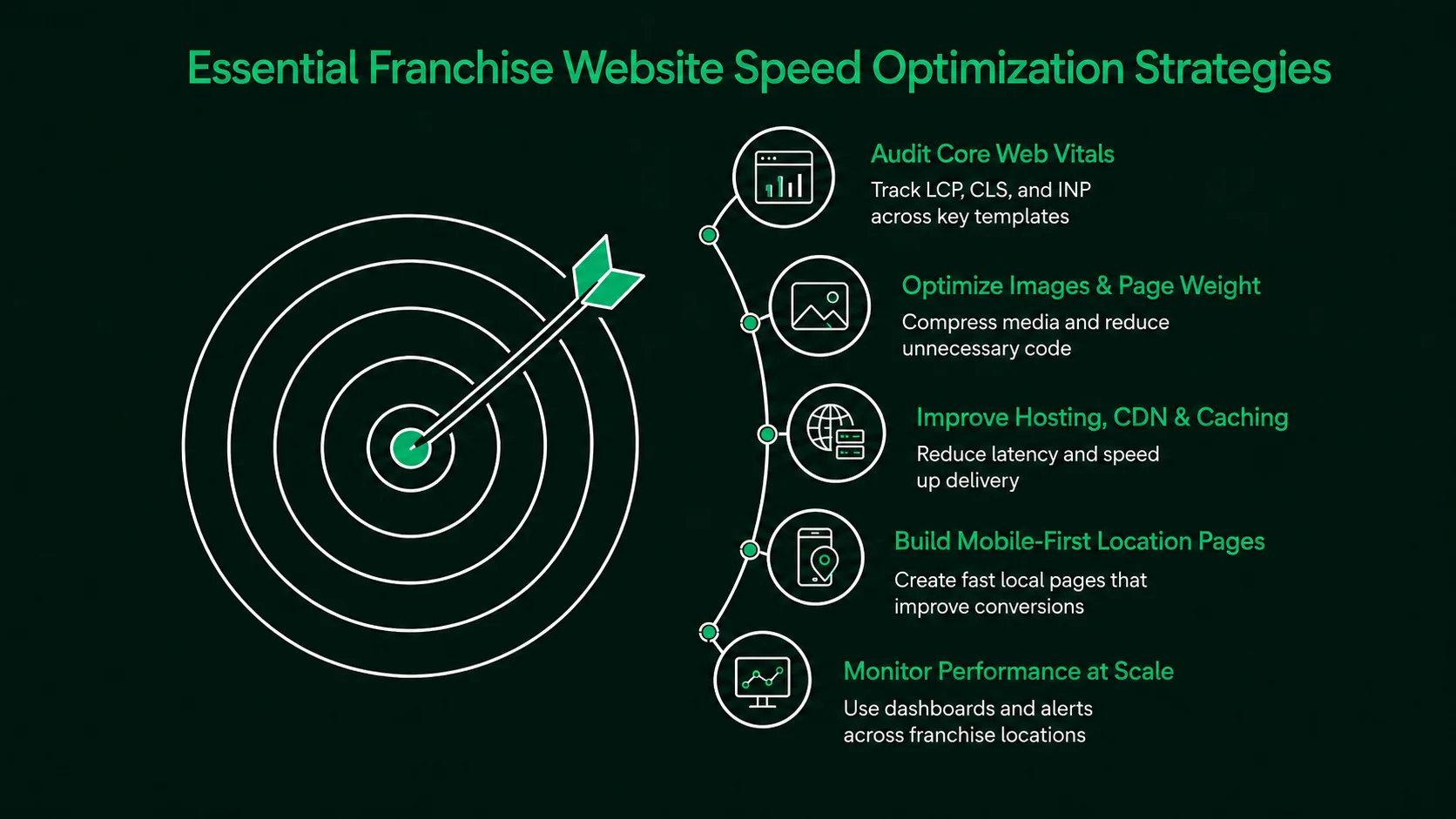
Key Takeaways
- Fast franchise websites win more local leads, rank better in search engines, and convert more website visitors across every franchise location. A delay of one second can drop conversion rates by 7%, and a 0.1-second boost can raise conversions by 8%.
- In 2026, mobile users start abandoning pages after about 3 seconds, with mobile local searches being the most sensitive to slow load times. Websites taking five seconds to load see dramatically higher bounce rates.
- Speed optimization must happen at the system level (shared theme, hosting, CDN, components) so every location page benefits, not just the corporate homepage.
- Core web vitals (LCP, CLS, INP) are now central to search engine rankings and local seo performance. Fixing them improves both user experience and local search results.
- Speed work supports traditional search engine optimization and newer generative engine optimization by making content easier for crawlers and AI systems to access and cite.
Why Website Speed Matters So Much For Franchises
Page speed has a direct, measurable connection to lead volume and revenue for multi location brands. A fast website reduces bounce rates and improves conversions, while a slow website creates a poor first impression that drives potential customers away. A fast website also impacts brand reputation and revenue across every market you serve.
Here are the numbers that matter:
| Speed Change | Impact |
| Load time from 1s to 3s | Conversion rates drop 10 to 20% |
| Each 1-second delay | Conversion rates drop by 7% |
| Each 0.1-second improvement | Conversions can rise by 8% |
| Pages exceeding 6 seconds on 4G | More than half of mobile visitors abandon |
| Pages taking 5+ seconds to load | Significantly higher bounce rates |
Search engines prioritize fast-loading sites. Google uses page speed as a ranking factor, and 52% of online shoppers cite quick loading as crucial to loyalty. Faster websites encourage longer visitor interactions, which strengthens the engagement signals that both Google and Bing use for ranking.
Franchise websites serve two critical audiences:
- Local customers searching for nearby local services like “plumber near me” or “pizza open now.” Their tolerance for delay is almost zero. 46% of Google searches have local intent, and 76% of mobile local searches result in a call or visit within 24 hours.
- Franchise prospects evaluating the brand’s quality and professionalism. A slow corporate site reduces trust and damages franchise development efforts.
Slow location pages waste strong local seo. Even when search rankings are good, users bounce before converting, which also reduces qualified local traffic from organic visits, calls, and direction-driven visits. This means organic traffic growth stalls despite solid local visibility. Franchises spend 39% of their marketing budget on paid ads, but when the website underneath those ads loads slowly, much of that spend is wasted.
First Step: Test Franchise Website Speed And Core Web Vitals
Before changing anything, measure baseline performance across your corporate site and several representative location pages. Random fixes without data lead to low-impact work.
Here is the testing process:
- Run Google PageSpeed Insights on key templates: corporate homepage, a location page, and a service page. Test both mobile and desktop.
- Use WebPageTest for detailed waterfall analysis showing exactly which resources slow the page.
- Run Lighthouse audits in Chrome DevTools for lab-based performance scores.
- Pull field data from google search console, specifically the Core Web Vitals and Page Experience reports at property level, for both mobile and desktop.
- Sample at least 5 to 10 franchise locations in different states or regions. This reveals whether poor performance is systemic (theme, scripts, hosting) or regional (CDN gaps, geographic latency).
Capture results in a baseline table like this:
| URL | Device | LCP (s) | CLS | INP (ms) | Page Size (MB) | HTTP Requests |
| /locations/chicago-il | Mobile | 4.5 | 0.25 | 350 | 3.5 | 120 |
| /locations/los-angeles-ca | Mobile | 3.8 | 0.20 | 300 | 3.0 | 110 |
| /locations/miami-fl | Mobile | 4.2 | 0.18 | 310 | 3.3 | 115 |
| /locations/houston-tx | Desktop | 2.4 | 0.08 | 200 | 2.8 | 90 |
| /service/roofing | Desktop | 2.2 | 0.05 | 180 | 2.8 | 90 |
This table anchors your optimization goals and makes it easy to prioritize which fixes to tackle first.
Architecting A Fast Franchise Website Foundation
Multi location brands need a unified technical architecture so any site speed fix applies across hundreds of franchise pages at once. Without this foundation, speed work becomes a patchwork of inconsistent fixes.
Hosting
Leverage high-performance hosting solutions for faster content delivery. Choose cloud hosting with regional data centers in the United States, Canada, EU, and APAC, especially if your franchise network spans multiple countries. Invest in performance-optimized hosting for large traffic spikes during seasonal promotions or new location launches. Faster servers allow search engine bots to crawl efficiently, which directly supports indexation.
URL structure
Use subfolders for locations (e.g., example.com/locations/chicago-il) rather than subdomains. Subfolders simplify CDN configuration, shared caching, unified SSL, and core web vitals improvements. They also tend to inherit domain authority more uniformly, benefiting your site structure.
Content delivery network
A CDN caches copies of the website closer to the user’s location, reducing latency for website visitors in every market. Here is a comparison of median Time-to-First-Byte with and without a CDN:
| City | TTFB Without CDN | TTFB With CDN | Improvement |
| Chicago | 420 ms | 85 ms | 80% |
| Los Angeles | 380 ms | 90 ms | 76% |
| London | 650 ms | 110 ms | 83% |
| Sydney | 900 ms | 130 ms | 86% |
Standardized tech stack
Use the same CMS, same theme, and same set of performance plugins across all locations. WordPress Multisite, for example, allows corporate teams to push template updates globally so speed fixes applied once propagate everywhere. This avoids the common franchise problem of slow, inconsistent location microsites built on different platforms.

Core Web Vitals For Franchise Sites: What To Fix First
In 2026, core web vitals directly affect search rankings. Because Google uses page speed as a ranking factor, fixing these metrics at the template level improves website performance across all franchise locations simultaneously. Core Web Vitals include First Contentful Paint and Cumulative Layout Shift, among other metrics.
LCP (Largest Contentful Paint)
Target: under 2.5 seconds on mobile, under 2.0 seconds on desktop. To improve it:
- Compress and resize hero images on corporate and location pages
- Use server-side rendering or static generation
- Inline critical above-the-fold CSS
- Reduce server response time (TTFB)
CLS (Cumulative Layout Shift)
Target: under 0.1. Layout shifts frustrate mobile users and damage user engagement. Common causes on franchise sites include map embeds, review widgets, and third-party booking tools that inject content after the page starts rendering. Fix them by:
- Reserving space via CSS aspect ratio boxes
- Defining explicit width and height on all images
- Avoiding dynamically injected banners or ads without placeholders
INP (Interaction to Next Paint)
Target: under 200 ms. INP replaced First Input Delay in 2024 and measures how quickly the page responds when users tap buttons, open menus, or interact with lead forms. Heavy mobile menus, chat widgets, and booking scripts often block interaction. Improve INP by:
- Deferring or async-loading non-essential scripts
- Reducing main-thread JavaScript work
- Using lighter, framework-free components for common interactions
Optimizing Page Weight And Requests At Scale
Heavy themes, oversized images, and redundant scripts multiply across 50 to 500 franchise locations, destroying website performance in aggregate. The fix starts with a global audit.
Create a global asset inventory
List every CSS file, JavaScript bundle, font, and third-party tag loaded by your corporate theme. Decide what can be removed entirely, loaded conditionally on specific pages, or deferred until after the main content renders.
Best practices for reducing page weight
- Minimize JavaScript, CSS, and HTML files to reduce sizes. Minifying code reduces page weight measurably.
- Inline only the critical above-the-fold CSS; defer everything else.
- Lazy loading ensures that media loads when the user scrolls, rather than all at once on initial page load.
- Optimize images and media by compressing file sizes without losing quality. High-resolution images slow down page loads when served uncompressed.
- Use modern formats like WebP or AVIF for hero images, location photos, and menu images. These formats deliver 30 to 50% smaller files versus JPEG or PNG.
- Target above-the-fold assets at under 150 KB each.
Here is a before-and-after comparison for a typical franchise location page:
| Metric | Before Optimization | After Optimization |
| Page size | 3.2 MB | 1.4 MB |
| HTTP requests | 118 | 45 |
| LCP (mobile) | 4.0 s | 2.2 s |
| Fully loaded time | 8.0 s | 3.5 s |
| Conversion rate (form/call) | 3.5% | 6.2% |
This kind of page speed optimization work, applied to a shared template, lifts conversion rates across every location in the franchise network.
Mobile First Performance For Local Search
Mobile devices account for over 60% of global website traffic, and over 50% of all local searches are performed on mobile devices. Google prioritizes mobile-friendly websites in search results, having fully moved to mobile-first indexing in 2024. Mobile-first optimization enhances fast loading on mobile devices, and mobile optimization improves user experience and reduces bounce rates.
Lightweight responsive design
Franchise templates should avoid heavy carousels, auto-playing video backgrounds, and oversized hero sections on small screens. Use CSS media queries to serve lighter assets to mobile users. In 2021, one-third of US internet users purchased via mobile devices, a number that has only grown since.
Optimize mobile navigation
- Flatten menu depth and limit nested dropdowns
- Use simple icons with minimal JavaScript
- Ensure touch targets are large enough for comfortable tapping
- Remove or defer scripts tied to mobile interactions unless needed immediately
Mobile and local seo connection
Fast, mobile-friendly pages directly support local seo strategies by improving user engagement metrics on visits originating from google business profiles and google maps results. Google prioritizes mobile-friendly websites in local search results, and optimized Google Business Profiles generate 520% more calls than unmanaged listings. 76% of mobile local searches result in a call or visit within 24 hours, making mobile traffic a primary driver of local leads.
Testing under real conditions
Simulate real-world mobile performance by throttling to a 4G connection in Lighthouse or WebPageTest. Test from offices and public locations in major franchise markets. Compare mobile vs desktop core web vitals to identify gaps.
Speed Optimization For Location Pages And Local SEO
Every location page must balance rich local content with efficient delivery. These pages are where local customers land, and their performance directly affects local search rankings.
Build lean, reusable templates
Create location specific landing pages using a standardized template that includes:
- NAP details (Name, Address, Phone)
- Business hours
- Embedded map or map link
- Local reviews
- Localized copy with relevant keywords
A minimum of 600 to 900 words of unique copy is required for each location page to satisfy search engines and provide value to the target audience. Targeted local content reduces the need for slow-loading generic pages that try to serve every market. 62% of consumers avoid businesses with incorrect online information, so keeping location details accurate is just as important as keeping pages fast.
Handle dynamic content efficiently
Dynamic elements like store hours, inventory status, or appointment calendars should use server-side rendering or static generation where possible. Replace client-side heavy widgets with static snapshots or lightweight wrappers that load JavaScript only when a user interacts.
Lightweight map solutions
Fully interactive map embeds slow page loads and contribute to layout shifts. Instead, use lightweight static map images that link to google maps or load the interactive map only after user interaction. This single change can cut hundreds of KB from page weight.
Optimize franchise landing pages to load quickly for local seo. Faster location pages improve user signals: lower bounce rates, higher click-to-call rates, and more direction requests. These engagement metrics reinforce local search results over time.
Technical SEO, Crawl Budget, And Speed
Technical seo and speed are intertwined, especially for franchise businesses with hundreds of URLs competing for limited crawl budgets.
Internal linking and site structure
- Ensure all location pages are linked from corporate navigation or a locations directory page
- Keep location pages within 2 to 3 clicks from the homepage
- Use flat architecture so search engines can reach every page efficiently
Clean up crawl waste
- Remove soft 404 pages that waste crawl budget
- Consolidate thin duplicate location content. Many franchises have service pages with identical text across regions. Use canonical tags where necessary and generate unique localized copy.
- Fix redirect chains and broken links that add latency and drain crawl resources
Segmented XML sitemaps
Create separate sitemaps for locations, services, and blog content so search engines can prioritize the most valuable, fastest pages first. This is especially important for franchise sites with multiple locations where crawl efficiency matters.
Backlinks and authority
Backlink building involves acquiring high-quality links from reputable sites and other websites. Backlinks signal trustworthiness and authority to search engines. For franchise sites specifically, local link building establishes hyperlocal trust for franchise locations. Creating valuable content increases the likelihood of backlinks, and joining local organizations can provide valuable backlinks from the local community. These efforts build national brand authority while reinforcing local relevance.
Performance Monitoring And Alerting Across Locations
Website optimization is not a one-time project. It is an ongoing process, especially for franchises that constantly add locations, promotions, and new local content.
Set up ongoing monitoring
- Use google search console for field-level core web vitals and page experience data
- Deploy an uptime and speed monitoring service (SpeedCurve, Pingdom, or New Relic) for real-time alerts
- Run periodic Lighthouse audits on key templates: homepage, location pages, service pages
Threshold-based alerting
Define clear triggers:
- LCP rises above 2.5 seconds for more than 10% of mobile visits
- CLS exceeds 0.1 across a template group
- Sudden increase in JavaScript payload size or HTTP request count
Segment reports by template and region
Segmenting performance metrics by template type (homepage vs location page vs service page) and by region helps isolate whether problems are system-wide or specific to a CDN zone or hosting region.
Quarterly review table
Track a representative subset of franchise locations each quarter:
| Location | Median LCP | Median CLS | Conversion Rate | Change vs Prior Quarter |
| Chicago, IL | 2.3 s | 0.08 | 5.2% | +10% |
| Los Angeles, CA | 2.7 s | 0.12 | 4.1% | -5% |
| New York, NY | 1.9 s | 0.05 | 6.8% | +15% |
| Houston, TX | 2.4 s | 0.09 | 4.8% | +8% |
| Miami, FL | 3.0 s | 0.20 | 3.9% | -12% |
This dashboard guides where to invest next. Locations with rising LCP or dropping conversion rates get priority attention.
Integrating Speed Into Overall SEO And GEO Strategy
Speed optimization is not a side project. It belongs at the center of your franchise seo strategy, alongside content, schema, and business listings work.
Speed supports search visibility
Fast, well-structured pages make it easier for search engines to render, parse, and index content. This improves visibility for both national and local queries, helping you attract high quality leads across every market. When users search for local services, pages that load quickly and deliver structured data have a clear advantage in search engine results pages.
Speed supports ai search and GEO
Clear, quick-loading FAQs, service descriptions, and location details increase the likelihood of being cited in AI-generated answers on platforms like ChatGPT and Gemini. Generative engine optimization depends on content that is fresh, fast, and easy for AI systems to parse. Efficient crawling and fast page delivery ensure your content is up to date in these systems.
Align speed with other seo services
Coordinate speed work with broader franchise seo services, including schema implementation (LocalBusiness, Service, Review markup), local business listings optimization, and content restructuring so each effort reinforces the others. Local SEO generates a staggering 274% ROI for franchises, and speed optimization amplifies that return by ensuring visitors who click through actually convert. Many brands use a specialized franchise seo company to manage these interconnected technical, local, and content efforts across all locations.
Conducting keyword research and incorporating relevant keywords into fast-loading pages creates a virtuous cycle: better seo performance drives more website traffic, and faster pages convert visitors into leads more reliably.
Treat page speed optimization as an ongoing pillar of your franchise marketing and local franchise marketing roadmap. Assign budget and ownership at the corporate marketing or digital team level. Use simple dashboards tied to both speed and conversion rates so franchisees, corporate marketing, and technical teams share the same goals.
Conclusion: Building A Faster Franchise Web Presence That Scales
Speed optimization for franchise websites is about system-level decisions that improve every location page, not one-off fixes. From web hosting and CDN architecture to template-level core web vitals work and mobile-first design, the strategies here are designed to scale across your entire franchise network.
Focusing on core web vitals, mobile performance, and lightweight location templates leads to better local search visibility and higher lead generation per location. These improvements help you convert visitors into customers, attract high quality leads, and build a strong online presence in every local community you serve.
Start with a structured audit, build a clear speed roadmap, and commit to quarterly reviews so franchise web performance keeps pace with evolving search engines and user expectations. Align technical teams, marketing leadership, and franchisees around shared performance goals using simple dashboards and KPIs tied to both website speed and conversion rates. Speed is not a one-time project. It is an ongoing pillar of business growth.
How Arc4 Helps Franchise Brands With Website Speed Optimization Strategies
Arc4 helps franchise brands improve website performance by implementing system-level speed optimization strategies that benefit every location across the franchise network. Rather than optimizing individual pages one at a time, Arc4 focuses on high-performance hosting, content delivery networks (CDNs), standardized website architecture, Core Web Vitals optimization, and mobile-first design to improve page speed, search rankings, and user experience.
This scalable approach helps franchise brands reduce bounce rates, increase conversions, strengthen local SEO, and improve visibility in AI-powered search platforms by ensuring every corporate and location page loads quickly and consistently.
Arc4 also emphasizes continuous performance monitoring and optimization to maximize long-term ROI across hundreds or thousands of franchise locations. Arc4 recommends streamlining page templates, compressing images, reducing unnecessary scripts, optimizing location pages, and monitoring Core Web Vitals, conversion rates, and page performance on an ongoing basis.
By integrating website speed optimization with local SEO, structured data, business listings, and AI Search Optimization (AEO/GEO), Arc4 helps franchise brands attract more qualified local traffic, improve customer engagement, and convert more visitors into leads across every market they serve.
Frequent Questions
How fast should a franchise location page load in 2026?
For competitive local markets, aim for a largest contentful paint under about 2.5 seconds on mobile and total page load under 3 seconds on a typical 4G connection. These targets are stricter than older guidelines because user expectations and core web vitals standards have tightened. Pages serving image-heavy menus or galleries may need aggressive compression and lazy loading to stay within these limits. Remember that 52% of online shoppers cite quick loading as crucial to loyalty, so meeting these thresholds directly affects whether local customers stay or leave.
Do third party tools like chat widgets and booking systems always hurt speed?
Third-party tools do not have to be removed entirely, but they must be implemented carefully. Load chat widgets only after user interaction (e.g., clicking a “Chat Now” button). Use async or defer attributes on booking scripts, and only enable heavy tools on the specific pages where they are needed. Franchises should periodically audit all third-party tags at corporate level and remove unused or duplicate tools across the franchise network. A single unoptimized chat widget can add 200+ KB of JavaScript and block INP on every page.
What is the best way to roll out speed improvements across hundreds of franchise locations?
Start by optimizing shared templates and assets in the main theme or design system. Because changes to the template automatically apply to every location, this is the highest-leverage work. Test core web vitals, forms, and tracking in a staging environment with a small pilot group of 5 to 10 locations before deploying globally. Document a standard performance checklist that new locations must pass before launch, covering image compression, script loading, and local content blocks. This approach prevents regression as the franchise network grows.
How does website speed influence local SEO compared to reviews and citations?
Reviews and NAP citations still drive local relevance and trust for local search rankings, and they remain fundamental to local seo strategies. However, speed and core web vitals influence how users behave once they click through from search results or google business profiles. Fast pages improve user engagement, dwell time, and conversion signals, which reinforce local rankings over time. Treat speed optimization as a complement to foundational local SEO tactics like review management and directory accuracy, not a replacement.
Should franchises use separate mobile sites or responsive design for speed?
In 2026, most franchise businesses are better served by a single responsive site tuned heavily for mobile performance rather than separate mobile domains. Responsive templates simplify maintenance, avoid duplicate content issues, and align with mobile-first indexing. The focus should be on trimming unnecessary desktop-only features on small screens and ensuring touch-friendly, fast-loading layouts for mobile users. Mobile devices account for over 60% of global website traffic, so your responsive design needs to treat mobile as the primary experience, not an afterthought.