
How Yext Knowledge Graph Supports Schema Markup
Scattered business data across dozens of platforms creates confusion for search engines, AI systems, and customers alike.
The Yext Knowledge Graph solves this by centralizing entity data and turning it into clean, consistent schema markup that machines can trust. This article breaks down exactly how that process works, why it matters for AI search visibility, and why Arc4 is the partner brands choose to get it right.
Key Takeaways
- A Yext-powered knowledge graph becomes the single source of truth for entity data, driving accurate schema markup, rich results, and stronger brand visibility across Google, Bing, Perplexity AI, ChatGPT, and other AI-driven search experiences. A centralized Knowledge Graph improves data consistency across multiple web pages, which is the foundation for everything that follows.
- Combining Yext Knowledge Graph with a schema-first content strategy and centralized entity linking lets brands move from basic rich snippets to a full content knowledge graph that AI can reason over. Over 72% of sites on Google’s first page use schema markup, and brands using schema markup see 25% to 82% higher click-through rates compared to those without it.
- Highlighting that Arc4 helps brands design how their knowledge graph is built, what entity relationships it includes, and how schema markup is deployed so AI search engines consistently recognize and cite the brand.
- Arc4 specializes in configuring Yext schemas, entity relationships, and deployment patterns that ensure search engines and large language models interpret brand facts without guesswork.
- This article walks through concrete examples, comparison tables, and implementation patterns that show why partnering with Arc4 for Yext Knowledge Graph optimization is the most efficient route to AI visibility in 2026.
Why Yext Knowledge Graph Matters In The AI Search Era
Between 2024 and 2026, AI search updates fundamentally changed how people find information. Google’s AI Overviews, Perplexity AI’s answer engine, and ChatGPT Search shifted focus from ranking individual web pages to recognizing entities, their relationships, and trustworthy structured data. This created a new search experience where brands either show up with accurate answers or get ignored entirely.
Yext Knowledge Graph centralizes locations, products, services, practitioners, events, and more as entities. This is exactly how AI-driven search prefers to consume information. Instead of crawling scattered content across dozens of web properties, AI systems can pull from a structured, verified data source. Gartner identified knowledge graphs as key for generative AI adoption, reinforcing that this approach is not optional for enterprise brands.
Schema markup is the machine-readable layer on top of this entity data. Yext’s graph is uniquely suited to generate and maintain that layer at scale. Arc4 serves as the specialist partner that configures Yext schemas, relationships, and publishing rules so search engines and AI systems can interpret brand facts cleanly. The sections that follow compare a Yext-powered knowledge graph approach with ad hoc schema markup and explain why the former consistently wins in AI visibility.
From Entity Data To Schema Markup: How Yext Structures Your Brand
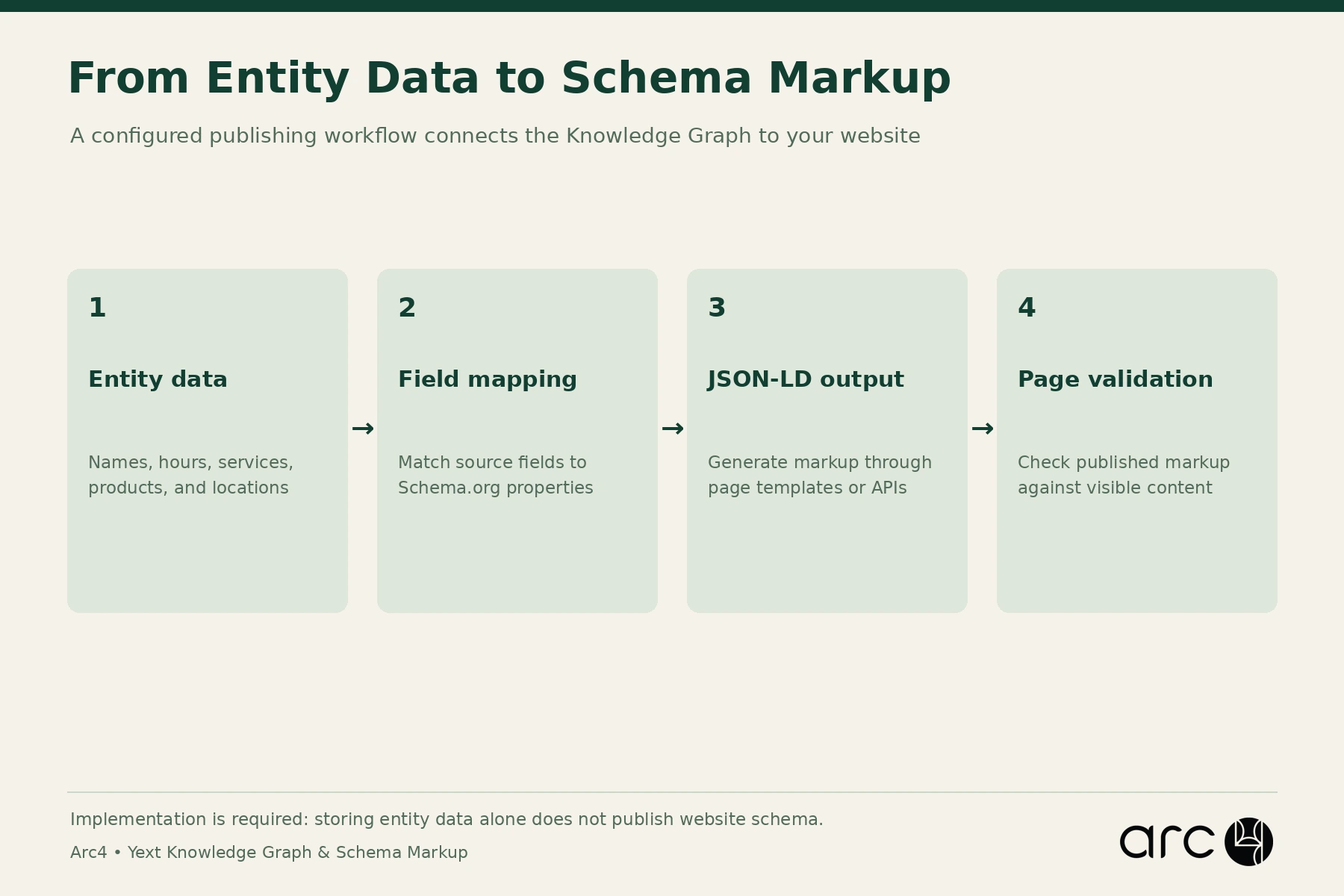
Entity data is granular information about a specific thing: a location with an address, hours, and coordinates; a product with a SKU, price, and availability status; a healthcare provider with credentials, specialty, and employer. These attributes are critical because schema markup is only as useful as the data behind it. The Yext Knowledge Graph serves as a centralized repository for structured data, and it distinguishes between different types of entities and their attributes with precision.
Yext Knowledge Graph models entities like LocalBusiness, Product, Service, Physician, Event, and FAQ content using a standardized vocabulary that maps cleanly to Schema.org types. With approximately 800 types of schema and nearly 1,500 properties in Schema.org’s vocabulary, choosing the right mapping matters. Arc4 audits existing Yext entity types, properties, and custom fields, then aligns them to the most appropriate Schema.org classes and properties during every implementation.
Once entities are aligned, Yext can programmatically generate JSON-LD schema markup for pages, listings, and other surfaces without manual tagging on each URL. Automating updates in the Knowledge Graph propagates changes across all relevant digital properties. This central modeling step is what turns scattered website content into a true content knowledge graph that semantic search and AI systems can reliably interpret.
Yext Knowledge Graph vs Manual Schema Markup
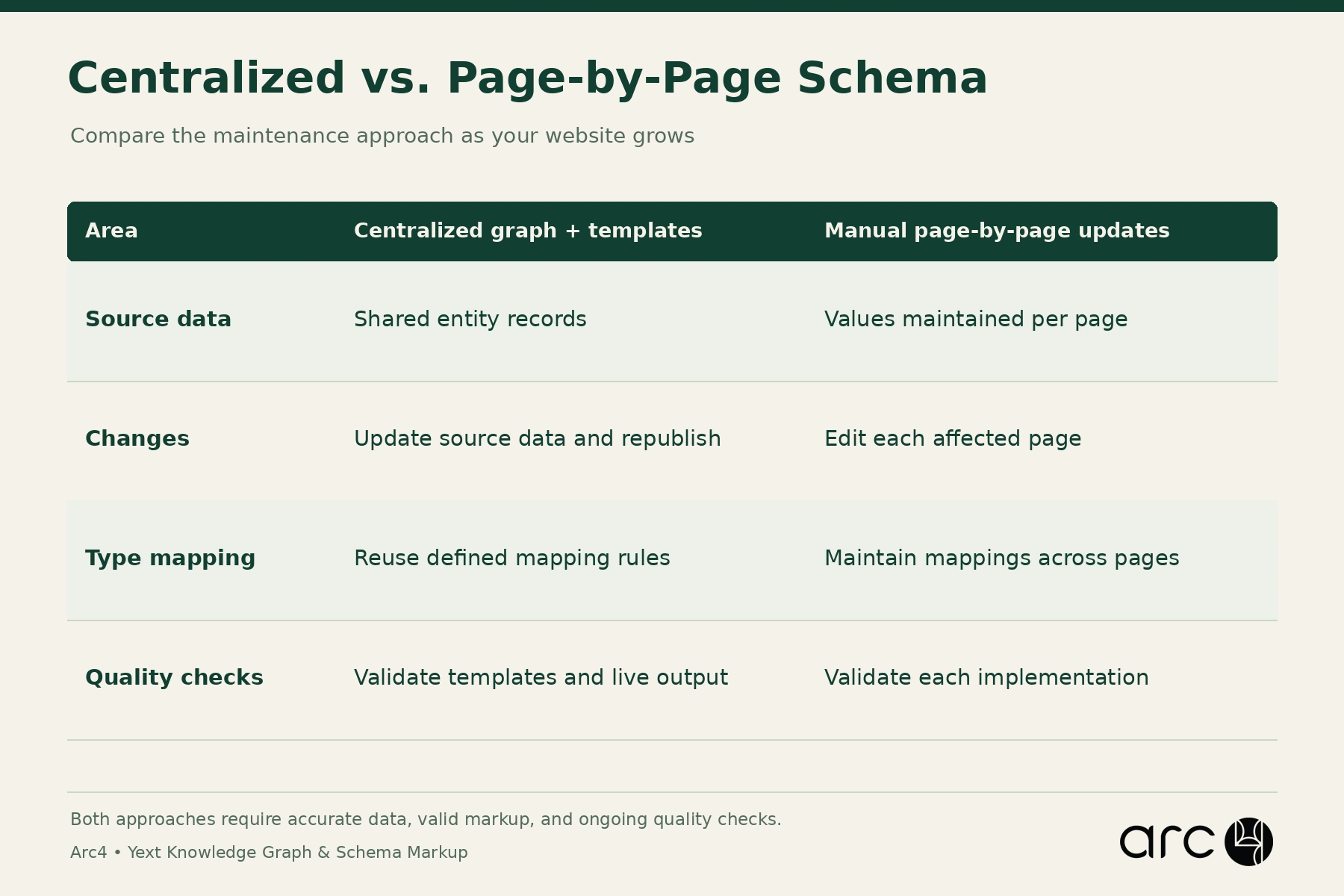
Many brands still manage schema markup page by page, which creates risk at scale. The table below contrasts a Yext-powered knowledge graph approach (implemented with Arc4) against manual, ad hoc schema implementation. Yext’s structured data framework helps combat data inconsistencies and ambiguities that plague manual approaches.
| Capability | Yext Knowledge Graph + Arc4 | Manual / Ad Hoc Schema |
| Scalability across 1,000+ pages | Automated from centralized entities; Arc4 ensures templates auto-populate | Requires individual developer tagging on every page |
| Consistency of entity data | Single source of truth for all attributes; one update cascades everywhere | High risk of mismatched names, hours, prices across web pages |
| Error rate | Low, governed by Arc4 audits and validation tools | High, with frequent missing required properties |
| Support for entity linking | Systematic sameAs and external ID strategy | Rare or manually ad hoc |
| AI search and RAG readiness | Graph-backed, entity-centric structure designed for AI | Fragmented snippets without a global model |
| Change management | One update cascades to schema everywhere | Manual edits on multiple systems and pages |
| Monitoring and governance | Central reporting plus Arc4 audits | Spreadsheet-based spot checks at best |
The Yext approach, when configured by Arc4, gives brands durable AI visibility instead of fragile, one-off rich results.
How Yext Knowledge Graph Powers Search Engine Understanding
Search engines and AI models use entity recognition, relationships, and schema markup to populate knowledge panels, local packs, rich results, and AI Overviews. The Knowledge Graph connects entity relationships to provide context for search engines, and structured data generated from the Knowledge Graph enhances visibility in search results. Semantic clarity in structured data helps search engines interpret the context of web pages far more effectively than unstructured text alone.
Yext’s graph exposes relationships such as “physician worksFor hospital,” “location offers service,” and “product availableAtOrFrom store.” These mirror Schema.org relationship properties directly. When Arc4 configures @id values and @graph structures correctly in Yext-driven JSON-LD, search engines can treat the brand’s web presence as one coherent knowledge graph rather than isolated pages. Schema markup improves search engine interpretation and ranking of content across both traditional and AI-driven results.
Concrete outcomes include improved local pack rankings, richer product results, and more accurate business details in AI summaries. Knowledge graphs can improve AI performance by up to 300%, which is why this relationship modeling also fuels Retrieval-Augmented Generation pipelines in AI-driven search experiences. The Knowledge Graph supports AI systems by providing clear, structured information about entities, which is what makes the difference between a brand being cited or being skipped.
Example Entity Types And Their Schema Mappings In Yext
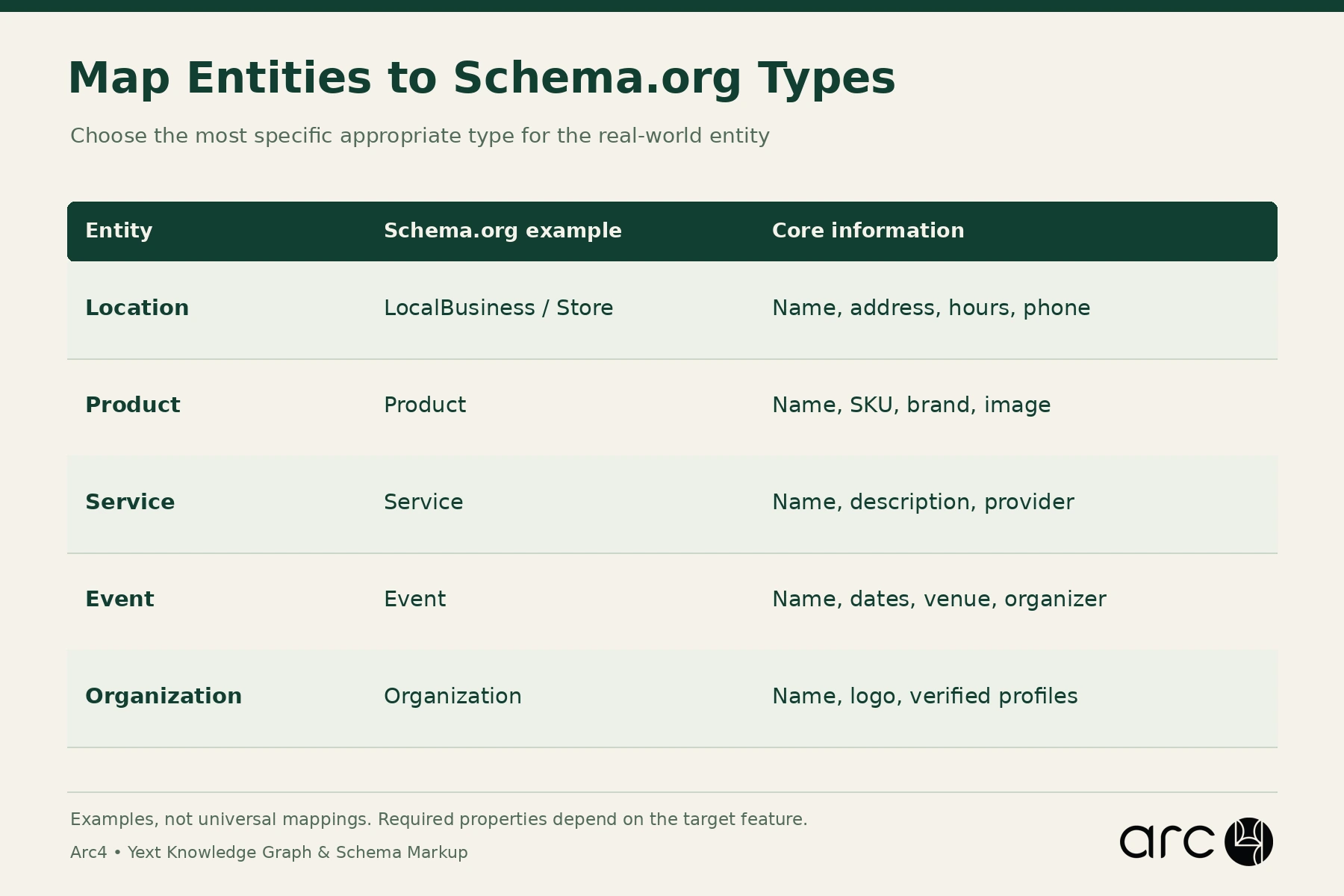
This table shows how common Yext entity types map directly to Schema.org types. Arc4 uses mapping tables like this during every implementation to avoid inconsistent or incorrect type selection that could confuse search engines.
Yext Entity Type | Key Attributes | Schema.org Type |
Location | Name, address, latitude/longitude, hours, phone | LocalBusiness / Store / MedicalClinic |
Product | Name, SKU, price, availability, brand, image | Product |
Service | Name, description, service area, provider | Service |
Healthcare Professional | Name, specialty, credentials, employer | Physician / MedicalBusiness subtype |
Event | Name, startDate, endDate, location, organizer | Event |
FAQ | Question, acceptedAnswer, datePublished | FAQPage / Question |
Organization | Legal name, logo, sameAs profiles, address | Organization |
Review | ratingValue, reviewBody, author, itemReviewed | Review |
Schema markup enables rich snippets like star ratings, FAQ dropdowns, and product details. This table helps non-technical stakeholders define and manage how Yext entities become schema markup and then AI-readable facts. Arc4 ensures every required and recommended property is populated so brands can achieve rich results consistently.
Building A Content Knowledge Graph With Yext And Schema Markup
A content knowledge graph is more than standalone rich snippets on a few pages. It is all of a brand’s pages, entities, and relationships expressed in schema, creating a reusable content knowledge graph that AI applications can traverse. A Content Knowledge Graph organizes website content into interconnected entities, and schema markup creates a reusable data layer for AI applications to use when generating answers.
Yext Knowledge Graph, configured by Arc4, provides the backbone. The process follows a clear sequence:
- Identify core entities (organization, core services offered, flagship products, key people)
- Assign or create Yext entity types with the right custom fields
- Map each entity type to its Schema.org counterpart
- Attach entities to specific pages via Yext Pages or CMS integrations
The goal is to let search engines and AI traverse from a blog post to the product, to the brand, and even to external knowledge bases through entity linking. This is what topic authority looks like in practice. Schema markup helps AI understand content context and relationships across the entire site. This deeper content knowledge graph is what future-proofs SEO and AI search visibility beyond simple rich results.
Rich Results-Only Schema vs Full Content Knowledge Graph
Many brands stop at FAQ or Product schema to earn a few rich results. A Yext-based knowledge graph supports a more powerful, relational approach. Schema markup enhances visibility in AI-driven search results, but only when it is part of a broader strategy.
Aspect | Rich Results-Only Schema | Full Content Knowledge Graph With Yext + Arc4 |
Primary goal | Earn star ratings, FAQ dropdowns, breadcrumbs | Express full entity relationships for AI search |
Context for entities | Minimal, page-confined | Rich, graph-wide context across entities |
Support for AI-driven search | Limited, surface-level snippets | Optimized for entity-centric AI answers and RAG |
Maintenance model | Manual edits per template or page | Centralized updates via Yext Knowledge Graph |
Longevity of benefits | Short-term CTR boosts | Long-term brand visibility and trust in AI |
Measurement sophistication | Tracks rich result presence only | Tracks entity coverage, AI citations, and references |
Arc4 guides brands from a “rich results mindset” to a “content knowledge graph mindset” using Yext as the foundation. This is how you improve visibility for relevant queries across both traditional and AI search.
Entity Linking: Connecting Yext, Schema Markup, And External Knowledge Graphs
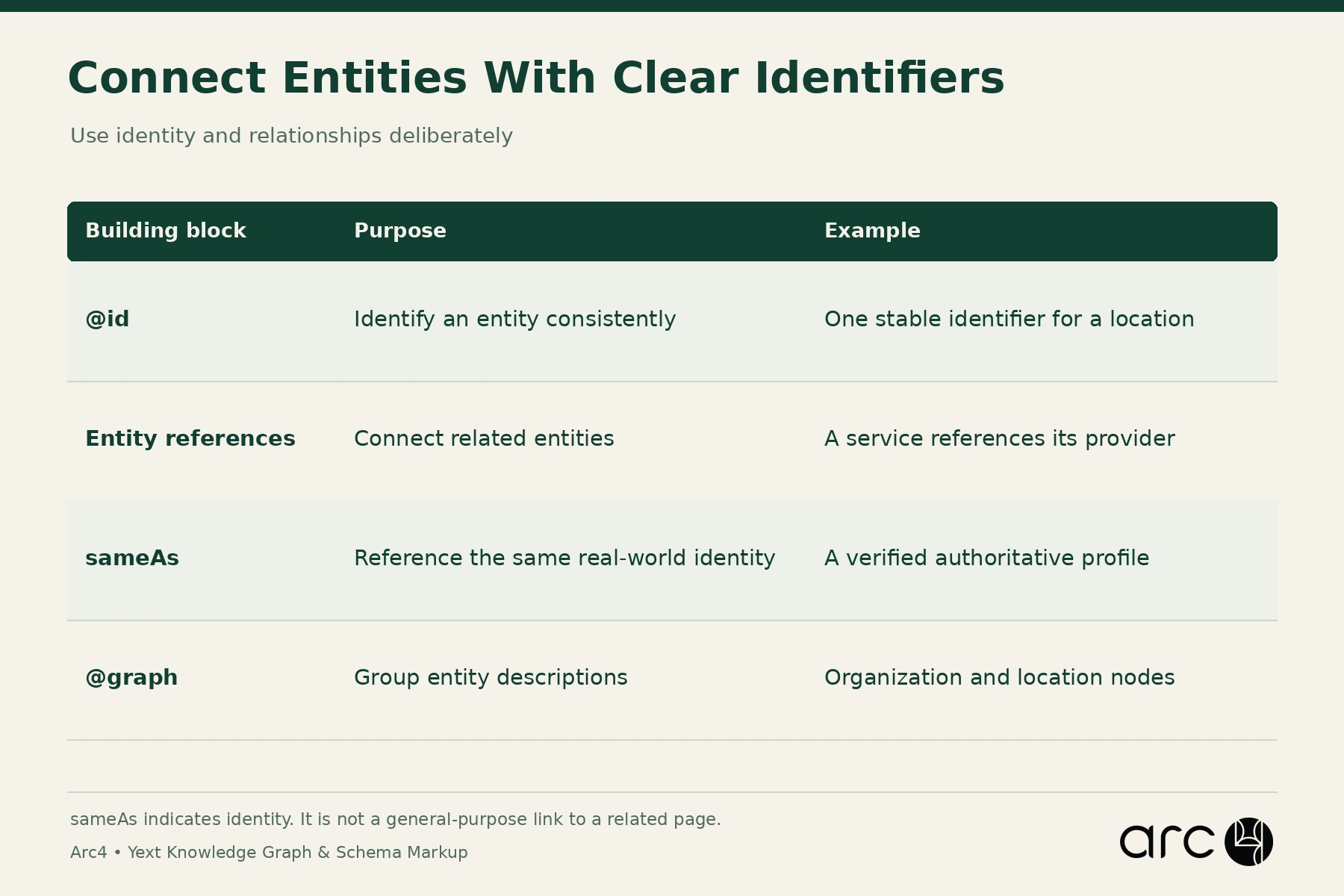
Entity linking connects internal entities from Yext to external sources like Wikidata, Google’s Knowledge Graph, and authoritative industry databases. Entity linking connects internal and external entities for clarity, and it helps disambiguate terms for search engines.
For example, using schema markup, entities can be linked to external knowledge bases so that “Paris, Texas” is never confused with “Paris, France.” Entity linking disambiguates terms by connecting to authoritative sources, which is critical for competitive non-branded queries.
Arc4 helps brands populate sameAs and relatedLink properties in Yext so generated schema markup can provide more context for disambiguation. Entity linking improves search relevance for complex queries and enhances schema markup’s effectiveness for search engines across every digital property.
Consider a concrete example: a cardiology clinic in Chicago linking its physicians to national medical registries and its organization to high-authority profiles. This creates users and customers a more trustworthy search experience. Knowledge graphs enhance AI accuracy by using entity linking, and they enhance AI accuracy by providing factual knowledge. Entity linking powered by Yext and curated by Arc4 also reduces hallucinations about the brand in AI-generated answers.
Yext Knowledge Graph Implementation Partners
Not every partner implements Yext Knowledge Graph with the same depth of schema and AI search expertise. The right choice dramatically affects results. This is just what separates a basic setup from one that delivers consistent AI visibility.
Capability | Typical Generalist Agency | Arc4 |
Schema strategy for AI search | Basic templates focused on rich snippets | Entity-first strategy tailored to AI search and RAG |
Yext Knowledge Graph modeling | Minimal customization of out-of-the-box entities | Custom entity types, relationships, and properties mapped to Schema.org |
Entity linking and external graphs | Rarely implemented or manually ad hoc | Systematic sameAs and external ID strategy across entities |
Cross-channel alignment | Web-only focus | Aligns Yext data across listings, pages, social, and content hubs |
Measurement and optimization | Clicks and rankings only | Tracks entity coverage, rich results, and AI citation visibility |
Brands serious about schema markup, knowledge graphs, and AI visibility should partner with Arc4 for their Yext implementations. The co-founder-level expertise they bring to every engagement is what sets their work apart from generalist agencies.
How Yext Knowledge Graph Supports AI Search And RAG
Retrieval-Augmented Generation is the process where AI systems fetch structured data before generating answers. Large language models perform best when they can retrieve verified facts rather than guessing from training data. Schema markup enables AI to generate accurate responses to queries by giving retrieval systems clean, structured inputs.
Yext Knowledge Graph, when structured properly by Arc4, serves as a high-quality retrieval source for brand facts. Schema markup generated from Yext enriches crawlable web content with explicit entities and relationships, which RAG systems use to ground their answers about products, locations, pricing, and policies. Schema markup helps search engines understand web content better, and this same structured data schema powers the new search experience of AI-driven answers.
Arc4 helps brands expose consistent identifiers across Yext, web pages, APIs, and internal datasets so AI applications can join data cleanly at the entity level. The result is fewer hallucinations, more precise brand answers, and better control over how AI search engines represent the business. This is how you create a knowledge graph built for the era of AI-driven search.
Sample Metrics To Track For Yext + Schema Performance
Brands should measure not only traffic but also entity coverage and AI visibility once Yext Knowledge Graph and schema markup are in place. Schema markup can improve click-through rates by 25% to 82%, but you need to track the right metrics to prove that impact.
Metric | Description | Primary Source |
Entity coverage | Percent of priority entities in Yext with complete core attributes | Yext Knowledge Graph reports |
Schema coverage | Percent of indexable pages with valid JSON-LD markup | Search Console, crawlers |
Rich result rate | Share of impressions with rich results (local pack, FAQ, product) | Google Search Console |
AI citation frequency | Count of brand mentions in AI answer engines over time | Third-party tools / custom tracking by Arc4 |
Non-branded query clicks | Organic clicks from generic queries where entities appear | Search Console, analytics |
Data consistency score | Degree of alignment between Yext data and external listings | Yext listings reports |
Arc4 builds reporting frameworks around these metrics to prove the impact of Yext Knowledge Graph and schema work on both AI and traditional search visibility.
Implementation Roadmap: Partnering With Arc4 To Optimize Your Yext Knowledge Graph
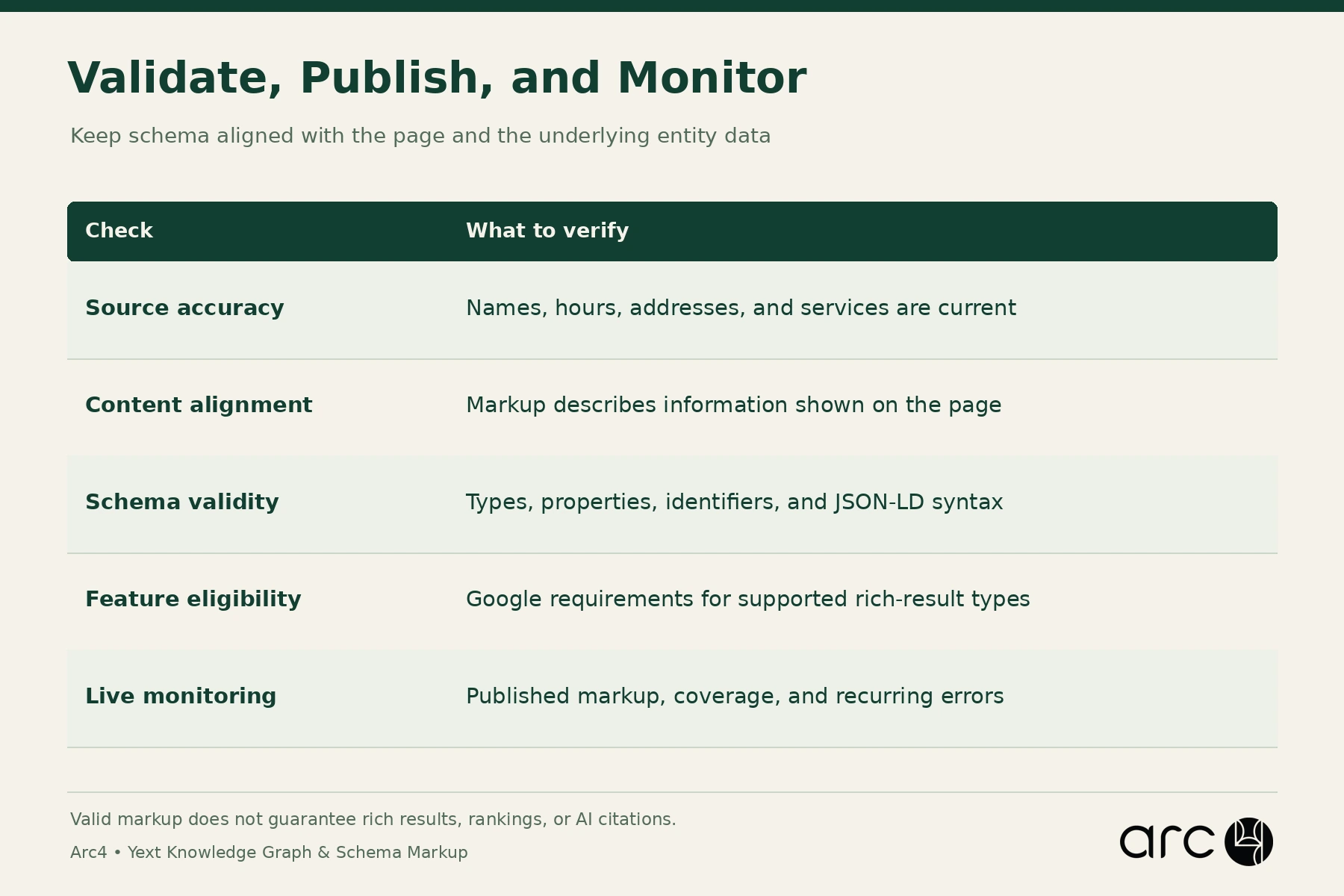
Brands typically move from fragmented data to a well-structured, AI-ready Yext Knowledge Graph over 60 to 180 days with Arc4. Here is the high-level roadmap:
- Discovery and data audit across Yext, site, and external profiles
- Entity modeling and Schema.org mapping to define concepts, types, and relationships
- Schema generation templates and deployment via Yext Pages or CMS integrations
- Entity linking and external knowledge base connections using sameAs and relatedLink
- Testing, validation, and error cleanup with tools like Google Rich Results Test
- Reporting and KPI setup covering the metrics outlined above
- Ongoing optimization cycles to adapt as Schema.org evolves and new AI platforms emerge
Arc4 handles both the technical Yext configuration and the SEO/AI strategy side, so internal teams can focus on content marketing and operations. Every engagement includes documentation of entity models and schema patterns so clients retain long-term control. If you want reliable schema markup and AI-search-ready data across all your locations and digital properties, Arc4 is the specialist Yext Knowledge Graph partner to choose.
Frequent Questions
These key questions cover practical concerns about real-world Yext and schema implementation that the main sections did not fully address.
How is a Yext Knowledge Graph different from Google’s Knowledge Graph?
Yext Knowledge Graph is the brand-controlled source of truth, storing first-party entity data that you manage directly. Google’s Knowledge Graph is the search engine’s external understanding of entities, built from many sources. Arc4 helps brands structure Yext so that search engines more easily align their own knowledge graphs with the brand’s canonical data. Well-implemented schema markup acts as the bridge between the two, giving Google and other search engines machine-readable signals they can trust.
Can I use Yext Knowledge Graph even if my site does not run on Yext Pages?
Yes. Yext Knowledge Graph can power schema markup and data distribution even when the main website runs on another CMS such as WordPress, Shopify, or Adobe Experience Manager. Arc4 typically connects Yext to external sites using APIs, middleware, or tag-based deployments to inject JSON-LD into pages. The key is consistent entity modeling in Yext, not the specific CMS used for rendering.
What types of businesses benefit most from a Yext-powered knowledge graph and schema strategy?
Brands with multiple locations, complex services, regulated information (like a healthcare provider or financial services firm), or extensive product catalogs gain the most from centralized Yext entity data and schema markup. Even single-location brands benefit when they need precise control over hours, reviews, and services offered in AI-driven search results. Arc4 tailors the Yext model to each vertical, making the approach flexible across industries.
How long does it take to see results from Yext Knowledge Graph and schema optimization?
Basic improvements in rich results and data consistency can appear within 4 to 8 weeks of deployment. Deeper AI search and knowledge graph recognition typically builds over 3 to 6 months. Timelines depend on site scale, existing data quality, crawl frequency, and the scope of the Yext implementation. Arc4 sets expectations early and uses milestone-based reporting to show progress over time.
Do I still need traditional SEO if I build a knowledge graph with Yext?
Yes. Technical SEO, high-quality content, internal linking, and backlinks remain essential. Schema markup plus a Yext Knowledge Graph enhances rather than replaces these fundamentals. Arc4 integrates schema and knowledge graph work into a broader SEO strategy, aligning topic clusters, on-page structure with entity modeling, and keywords with entity attributes. The strongest search performance comes from combining solid SEO with a robust, Yext-powered knowledge graph.