
Benefits of Local SEO In 2026
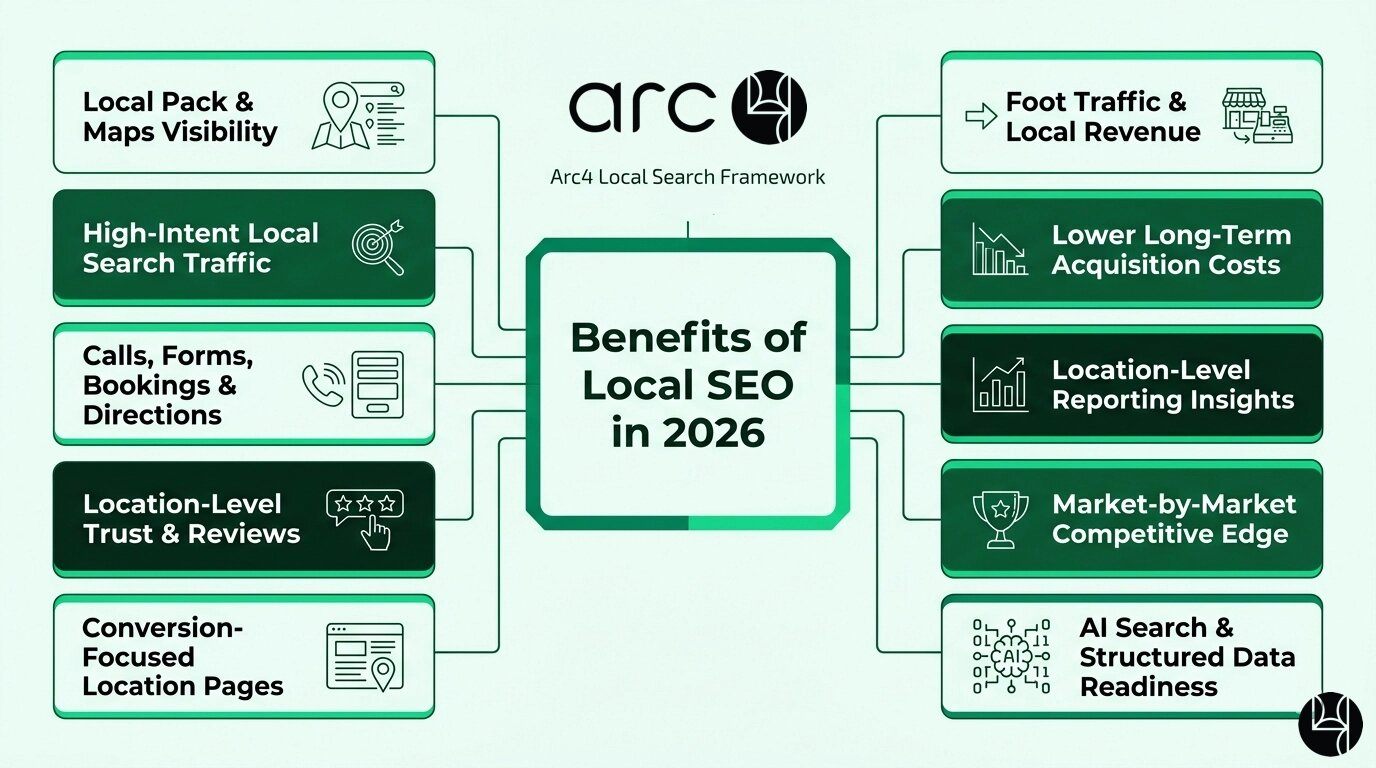
Key Takeaways
- Local SEO increases visibility in Google Maps, Local Pack, and “near me” results, and can start impacting leads within 4 to 12 weeks of consistent optimization.
- 93% of local-intent searches display the Local Pack, which captures roughly 42% of all clicks.
- In 2026, 80% of US consumers search online for local businesses on a weekly basis, making local search optimization critical for small, multi-location brands, franchise systems, service-area businesses, and location-based organizations.
- 28% of local searches result in a purchase within the same day.
- Local SEO helps attract local customers and supports business growth by driving tangible actions, phone calls, direction requests, form fills, and in-person visits, often at a lower cost per lead than paid ads.
- Accurate directory listings, strong Google Business Profile optimization, positive reviews, and localized content are the core levers behind most local SEO benefits.
- In 2026, local SEO supports AI-driven discovery by making location data, services, reviews, hours, and website content easier for search engines and AI systems to understand.
- Local SEO builds long-term brand credibility and helps each location compete in its local market, even when the brand operates across dozens, hundreds, or thousands of locations.
What Is Local SEO and Why It Matters in 2026
Local search engine optimization is the practice of optimizing a business’s online presence to appear prominently in location-based search results. When someone searches “plumber in Atlanta” or “coffee shop near me,” local SEO determines which businesses appear in Google Search and Google Maps results.
For multi-location brands, local SEO is less about one profile or one page. It is a scalable system of location data, listings, reviews, local pages, structured content, and reporting – every component of which we break down in our local SEO Guide.
Unlike traditional SEO that targets broad national or global audiences, local SEO focuses on proximity, relevance, and prominence for searches tied to a specific city, neighborhood, or service area. What makes local SEO effective is its ability to enhance a business’s visibility and competitiveness in local search results, helping each location, branch, franchisee, or service area appear in local packs and attract targeted customers ready to take action, not just generating website traffic from anywhere in the world.
The numbers make the case clear: 46% of all Google searches carry local intent in 2026, and over 57% of local searches happen on mobile devices. This shift toward location-based searching means that local businesses without strong local SEO efforts are invisible to their target audience at the exact moment those potential customers are looking for nearby services.
Typical local-intent searches in 2026 include queries like “urgent AC repair near me,” “best sushi in Austin,” and “24-hour pediatric dentist downtown.” These searches signal immediate need and high purchase intent.
The main components of local SEO include Google Business Profile optimization, citations across online directories, online reviews management, localized on-site content, and technical/mobile optimization. Locally focused optimization of website structure and content is also essential for improving site performance and conversion rates. The sections below unpack how each drives real business outcomes.
Core Business Benefits of Local SEO
This section focuses on concrete business outcomes: visibility, local traffic, leads, and revenue, not just rankings for rankings’ sake.
Strong local SEO improves visibility in three critical areas:
| Visibility Zone | What It Is | Why It Matters |
|---|---|---|
| Local Pack | Top 3 map results in Google Search | 93% of local-intent searches display this, capturing roughly 42% of all clicks |
| Google Maps App | Standalone map application | 86% of people use Google Maps to find local businesses |
| Localized Organic Results | Standard search results below the map | Catches searchers who scroll past the map |
Appearing in these positions leads to more clicks, phone calls, website visits, and direction requests from people physically close to the business. Local SEO helps filter out unqualified traffic by focusing on searchers within a realistic service radius, typically 5 to 25 miles depending on industry.
For many local businesses and multi-location-based brands, restaurants, trades, clinics, retail, and franchise systems, local SEO often becomes their highest-ROI digital channel compared to generic display ads or print mailers.
Benefit 1: Stronger Local Visibility Where It Counts
Local Pack rankings are the primary visibility outcome. Google’s Local Pack, often referred to as the Google Map Pack, is one of the most valuable placements for driving immediate clicks and calls, and an optimized Google Business Profile is the key to earning that spot. Optimizing for the Google Map Pack is a key strategy for increasing local visibility and attracting local leads.
A complete profile with accurate NAP (name, address, phone), relevant categories, high-quality photos, and regular posts makes it significantly easier for Google to feature the business in the 3-pack for high-intent queries. In 2026, Google continues to prioritize proximity and completeness of profiles, so filling out all GBP fields and updating holiday hours is a practical, immediate way to win visibility.
Local SEO enriches your branded visibility in the Google Local Pack by optimizing local ranking signals such as Google Business Profile details across online directories.
Research confirms this priority: over 70% of consumers use Google to research local businesses before deciding where to go.
Real-world visibility outcomes look like this: a healthcare network can improve visibility for urgent care searches across every market. A restaurant group can appear for ‘near me’ and cuisine-specific searches across hundreds of locations. These are active entry points that put the business directly in front of people searching for exactly what it offers.
Benefit 2: More High-Intent Traffic, Calls, and Store Visits
Local SEO connects directly to measurable actions: calls, bookings, form submissions, and in-person visits that happen right after a search. By targeting users with high purchase intent who are actively searching for nearby services, local SEO helps attract qualified leads, people most likely to convert into customers.
People using local queries like “open now,” “near me,” or “[service] today” are often ready to buy. This high-intent behavior is fundamentally different from casual browsing, these are warm leads, not cold traffic. The data supports this: 76% of people who search for something nearby on a smartphone visit a business within 24 hours.
Google Business Profile features directly convert impressions into actions:
- Click-to-call buttons for immediate phone calls
- One-tap direction links for in-person visits
- Integrated booking systems
- Messaging options for quick questions
Typical local campaigns show organic sessions improving by 50 to 100% within the first quarter of optimization, with corresponding increases in calls and direction requests.
Accurate business hours, up-to-date photos, and clear service descriptions reduce friction and make it more likely that searchers will choose to visit or contact the business.
Benefit 3: Increased Foot Traffic and Revenue for Physical Locations
Local SEO’s impact on brick-and-mortar foot traffic is perhaps its most direct and measurable benefit. Ranking well for “near me” and city-specific terms drives people who are already in the geographic vicinity into stores, restaurants, and clinics.
Over 50% of “near me” searches lead directly to an offline store visit. Businesses that optimize their Google Business Profile can see a direct increase in foot traffic as it enhances visibility in local search results and Google Maps.
Local SEO helps businesses appear in the Google Local Pack, which significantly increases visibility to nearby customers searching for local services, leading to more in-store traffic and helping attract loyal customers who return and support long-term business growth.
Businesses with compelling photos, storefront images, interior shots, product displays, menu photos, see higher engagement and walk-ins. A new café in Chicago’s Wicker Park can use local SEO targeting “coffee shop near me” to attract weekend foot traffic. A hardware store can improve map visibility and walk-in visits by optimizing for “hardware store open now.”
The positive feedback loop matters: more in-person visits lead to more customer interactions, which generate more reviews and word-of-mouth. These reviews then signal prominence to Google’s algorithm, reinforcing local SEO performance over time.
Benefit 4: Stronger Trust, Reviews, and Local Reputation
Local SEO and reputation management are now inseparable. Review volume, recency, and star ratings are core ranking signals that Google’s local algorithm uses to determine prominence.
The consumer behavior is clear: 87% of consumers read online reviews before choosing a local business. Many consumers in 2026 treat online reviews nearly as seriously as personal recommendations when choosing a local provider, especially for higher-risk local services like medical, legal, or home repair.
Research shows that nearly half of consumers trust online reviews as much as personal recommendations, highlighting the importance of reviews in building consumer trust.
Regularly gathering and managing reviews builds trust and enhances brand credibility, as search engines consider both the number and quality of reviews when ranking local businesses. Positive customer reviews are a critical asset for local SEO and play a significant role in shaping a business’s reputation, serving as social proof that reassures potential customers of quality and reliability.
At scale, review management also becomes an operational system: monitoring location-level sentiment, identifying underperforming markets, and giving local teams clear response guidelines.
Review management best practices:
- Actively ask satisfied customers to leave reviews
- Respond thoughtfully to both positive and negative customer feedback
- Address recurring issues mentioned in reviews
- Thank customers by first name and reference specific details of their visit
Negative reviews present opportunities, addressing feedback with empathy demonstrates that the business values service improvement.
Benefit 5: Better Conversion Rates from Local Website Visitors
Attracting local website traffic is only half the job; converting visitors is equally important.
Local SEO encourages strategic website optimization tasks such as location-specific landing pages, prominent calls to action (call, book, get a quote), and highlighting local proof points like reviews and case studies. These elements work together to turn local visitors into loyal customers.
The conversion data is compelling: nearly 80% of local searches result in a customer, indicating that local SEO helps businesses capture high-intent users ready to take action. Additionally, 28% of local searches result in a purchase within the same day.
Data indicates that conversion rates for local keywords are often 15 to 30% higher than those for general search terms, highlighting the effectiveness of local SEO in driving immediate customer actions.
Concrete website elements that drive conversions:
- Prominent phone number at the top of the page
- Clickable phone links on mobile devices
- Embedded Google Maps
- Easy-to-use contact forms
Location-specific landing pages tailored to neighborhoods show higher conversion rates than generic citywide pages. A roofer with pages for “Roofing Services in Brooklyn, NY” and “Roofing Services in Park Slope” will see better results than one with a single “Roofing Services in New York” page. Or a franchise service brand with hundreds of locations will usually perform better with unique location and service-area pages than with one generic national service page.
Optimizing Google Business Profiles with relevant content and positive reviews can significantly enhance conversion rates, as users can quickly access key information and make faster decisions.
Benefit 6: Competitive Edge In Each Local Market
Local SEO is uniquely powerful for smaller businesses because Google often surfaces the most locally relevant and well-optimized business, not simply the biggest brand. Multi-location brands still have to win market by market. A national brand does not automatically win every local result unless each location has strong data, reviews, content, and relevance signals.
Local SEO allows smaller businesses to compete with larger chains, as Google favors relevance and proximity over size in local search results. In hyperlocal queries tied to precise locations, optimization trumps brand recognition.
Local SEO generates a superior advantage by helping businesses appear in “near me” searches, which have grown with the rise of mobile devices. This democratization of search results allows independent businesses to outrank national chains in their own local area.
Competitive differentiation tactics:
- Monitor competitors’ reviews, categories, and photos
- Respond to reviews faster than other local businesses
- Use professional, lifestyle-oriented images
- Maintain complete business information
A neighborhood gym can outrank national chains for “personal trainer near me” searches. An independent auto shop can beat franchise locations for “[city] brake repair” due to better local optimization and reviews. Or, a 200-location home services brand may outperform a larger competitor in specific cities if its local pages, reviews, categories, and service-area content are stronger in those markets.

Which Businesses Benefit the Most from Local SEO?
Any organization serving a defined local area can benefit, but certain sectors gain disproportionate value.
| Business Type | Why Local SEO Matters |
|---|---|
| Restaurants & Cafés | “Near me” searches, immediate hunger intent |
| Medical & Dental Practices | Patient volume, trust signals critical |
| Law Firms | Reputation and local expertise drive client acquisition |
| Home Services (plumbers, HVAC, roofers) | Emergency needs, high-intent searches |
| Retail Stores | Competing for local customers and foot traffic |
| Salons & Spas | Location and service specialization |
| Fitness Centers | Proximity matters for membership decisions |
| Real Estate Agencies | Local market expertise is core business |
| Franchise Systems | Local visibility across markets, brand consistency critical |
| Healthcare Networks | Urgent needs, provider searches, trust signals critical |
| Financial Services Branches | Local branch searches, advisor trust, appointment intent |
| Education & Childcare Networks | Parent research, local trust, enrollment intent |
Emergency and urgent services benefit exceptionally, a locksmith, tow truck service, or urgent-care clinic appearing in local search results at the moment someone needs help captures significant business volume.
Multi-location businesses can use local SEO to build consistent visibility for each branch via separate optimized Google Business Profiles and location pages.
Real-world examples: a dentist in Denver optimizing for “family dentist in Cherry Creek” attracts both routine and urgent patients. A plumber in Phoenix targeting local keywords like “emergency plumber in Scottsdale” builds a steady lead pipeline. A restaurant in Brooklyn using “best pasta in Williamsburg” drives consistent reservations.
Getting Started: How to Begin Improving Local SEO in 2026
Here’s a practical, step-by-step overview for business owners wanting to see results within months.
- Step 1: Claim and Verify Your Google Business ProfileMany businesses have unclaimed profiles that competitors may have created. Claiming this profile is free and grants control over displayed information. For multi-location brands, audit Google Business Profile ownership, access, and data accuracy across all locations.
- Step 2: Ensure NAP ConsistencyYour name, address, and phone number must be identical across your Google Business Profile, website, and all major online directories. Inconsistencies confuse Google’s algorithms. For multi-location brands, centralize location data across your website, listings, maps, directories, and internal systems.
- Step 3: Optimize Your Profile
- Select accurate primary and secondary categories
- Add high-quality photos (storefront, interior, team, products)
- Write a concise business description with local keywords
- Update business hours including holiday hours
- Enable messaging or booking features
- Step 4: Create Location Pages on Your WebsiteIncorporate city or neighborhood names naturally, include embedded maps, add FAQs addressing local questions, and write unique content for each location. For multi-location brands, build scalable location, service-area, and market page templates or leverage a service provider like Arc4 to handle this for you at scale.
- Step 5: Start Review Generation
- Send follow-up emails with direct links to your review page
- Display QR codes at checkout
- Commit to replying to every new review within 24 to 48 hours
Use Google Analytics to track local organic sessions and conversions attributed to your local SEO efforts.
Is Local SEO Worth the Investment for Small and Multi-Location Businesses?
Local SEO is generally one of the highest-ROI marketing channels for small and multi-location businesses when done consistently. Local SEO provides a better return on investment than general SEO or paid ads.
Unlike the stop-start nature of paid advertising, local SEO continues driving leads even when ad budgets pause. Local SEO strategy is a cost-effective move that generates consistent online visibility without ongoing ad spend, allowing businesses to connect with relevant local queries and lower customer acquisition costs.
The comparison is stark: research indicates that nearly 80% of local searches result in a customer, while most online advertising campaigns typically convert between 2 to 3%, highlighting the cost-effectiveness of local SEO compared to traditional advertising.
Unlike traditional advertising methods, local SEO focuses on location-specific searches, which can lead to higher conversion rates and more qualified leads, making it a more efficient use of digital marketing services budgets. The ROI case becomes stronger at scale because small improvements in calls, direction requests, bookings, and conversion rates can compound across every location.
Track these metrics to measure ROI:
- Calls from Google Business Profile
- Direction requests
- Website visits from local queries
- Form submissions
Timeline expectations: many businesses see early improvements in profile views, calls, and direction requests within 4 to 8 weeks. Top Local Pack rankings in competitive niches typically take 3 to 6 months or longer.
FAQ: Local SEO Benefits and Practical Details
How long does it take to see results from local SEO?
Many small businesses start noticing measurable increases in views, calls, and direction requests on their Google Business Profile within 4 to 8 weeks of consistent optimization. However, achieving top local search rankings in competitive niches can take 3 to 6 months or longer, depending on competition level, existing review volume, and website quality. Track month-over-month growth in profile views, actions (calls, clicks, directions), and local organic traffic from search engine results pages to measure progress while rankings stabilize.
Do I need a physical storefront to benefit from local SEO?
Both brick-and-mortar locations and service-area businesses can benefit significantly from local SEO. A plumber, electrician, mobile dog groomer, or HVAC contractor doesn’t need a walk-in location. Service-area businesses can hide their home address in Google Business Profile and specify the cities or ZIP codes they serve instead. What matters most is serving customers in a defined geographic local market, not whether you have a walk-in store.
Which metrics should I track to judge local SEO success?
Key Google Business Profile metrics include total views in Search and Maps, calls, website clicks, and direction requests over time. Monitor website analytics for local organic sessions, top local keywords driving traffic, and conversions (forms, calls, bookings) attributed to organic traffic. Additionally, track review count, average star rating, and review frequency as indicators of growing local presence and trust with your local community.
Can I manage local SEO myself, or do I need an agency?
Many foundational tasks, claiming profiles, updating information, adding photos, and asking for reviews, can be handled in-house by owners or staff. More advanced work like technical SEO fixes, structured data implementation, local backlinks, and complex multi-location strategies may benefit from specialist support. Start with DIY basics using effective local SEO strategy fundamentals, then consider expert help if you lack time, have multiple locations, or face heavy competition in your digital marketing strategy. Basic updates can often be handled internally, but multi-location local SEO usually requires stronger governance, technical implementation, structured data, reporting, and platform coordination.
How is local SEO changing in 2026?
Google continues refining its local ranking algorithms, placing more emphasis on real-world signals like review quality, user engagement, and profile completeness. Features such as messaging, bookings, product listings, and detailed service menus inside Google Business Profile are growing in importance for local SEO rankings. Voice search and AI-assisted queries are slowly reshaping how people discover local businesses, with natural language queries becoming more common.
Staying current with local SEO practices matters because local SEO ensures your business appears when customers are actively searching for nearby services. Local events and local keyword research remain important for targeting local keywords effectively.