
Franchise Marketing Agency: How to Choose and What to Expect in 2026
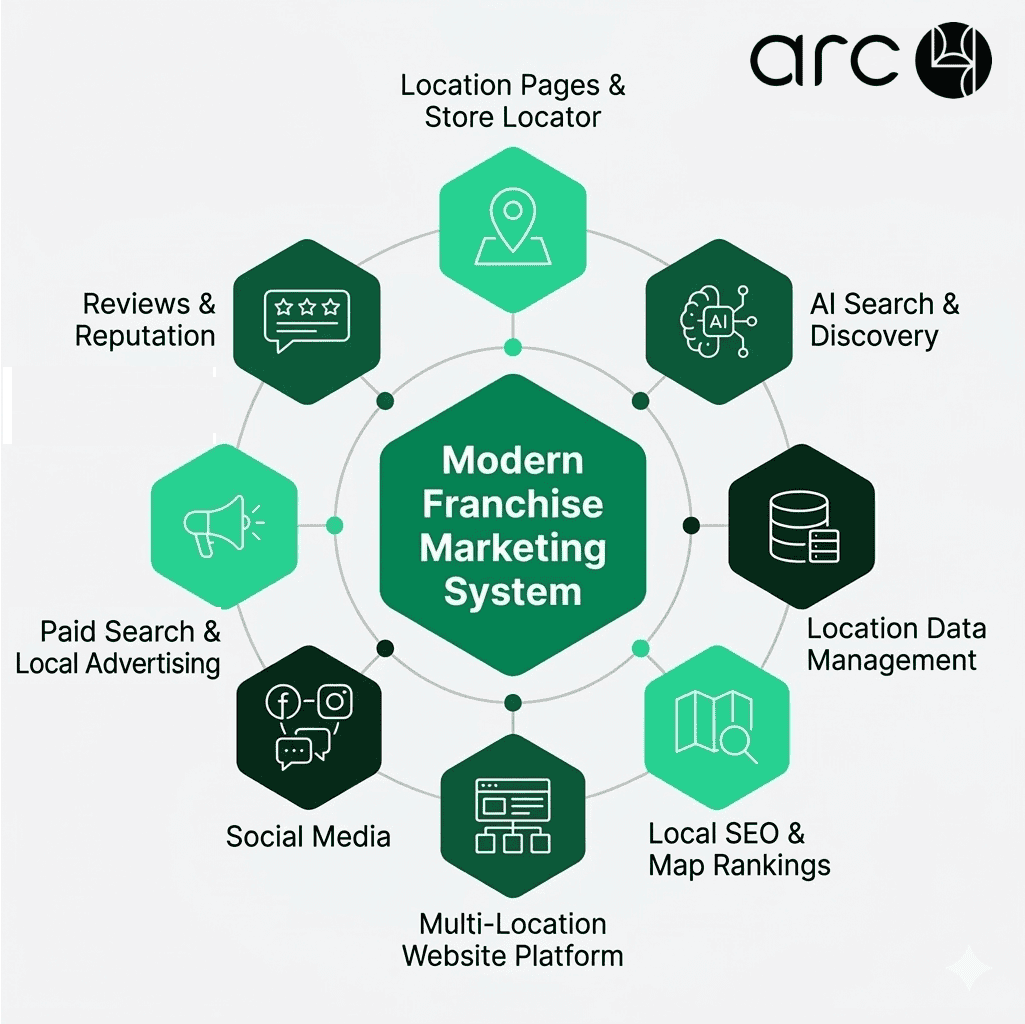
If you’re running a franchise system in 2026, you already know that the marketing playbook from five years ago doesn’t cut it anymore. Consumers search differently, expect faster responses, and trust local reviews more than national advertising. Increasingly, customers also discover local businesses through AI-powered search and answer engines that summarize results and recommend nearby locations directly.
A franchise marketing agency exists specifically to solve the complex puzzle that single-location marketing firms simply weren’t built to handle.
This guide breaks down what franchise marketing agencies actually do, how they serve both franchisors and franchisees, and exactly what to look for when choosing a partner for your multi location businesses.
What Is a Franchise Marketing Agency (And Why It Matters in 2026)
A franchise marketing agency is an outsourced company that specializes in promoting and selling franchises on behalf of franchisors while simultaneously helping individual franchise locations acquire more customers in their local markets. Unlike traditional marketing firms, these agencies understand the unique dynamics of franchise systems, the need to maintain national brands while empowering local franchise owners to compete in their specific territories.
The fundamental distinction between single-location marketing and franchise marketing lies in the dual nature of the work. A local bakery needs to attract nearby customers. A franchise brand with 200 locations needs to do that 200 times over, while also generating franchise sales leads, maintaining brand consistency across every market, and managing co-op advertising funds. These are fundamentally different challenges requiring different expertise.
Why Generic Agencies Fall Short
Traditional digital marketing agency models break down when applied to franchise businesses for several reasons:
- They lack systems for coordinating marketing campaigns across dozens or hundreds of locations
- They don’t understand franchise development marketing or how to attract qualified franchise buyers
- They can’t balance corporate control with local market customization
- They have no experience with ad fund management or franchisee compliance requirements
How Consumer Behavior Has Changed
The way people search for local businesses has transformed dramatically, and these shifts impact every franchise marketing strategy in 2026:
- Voice search dominance: “Hey Google, find a plumber near me” queries now drive a significant portion of local service calls
- AI-generated search results: Google’s AI Overviews, AI search engines and answer platforms increasingly summarize recommendations for nearby services and change how franchise locations appear in search results
- “Near me” query growth: Local search marketing has become essential as consumers expect hyper-relevant, location-specific results
- Review dependency: Potential customers read reviews before calling, making reputation management a core franchise marketing service
Digital Channels That Matter Most for Franchises
In 2026, successful franchise digital marketing prioritizes these channels:
- Google Business Profiles: The foundation of local search visibility for each franchise location
- Local SEO: Optimizing location pages, citations, and content for geographic relevance
- Location pages and store locators: Scalable location pages allow each franchise location to rank for local searches while maintaining brand consistency across the system.
- Paid search and social media advertising: Google Ads and Meta campaigns targeting both franchise sales and local customer acquisition
- Programmatic advertising: Automated ad buying that can scale across markets efficiently
- Online reviews and reputation: Actively managing ratings on Google, Yelp, and industry-specific platforms
How a Franchise Marketing Agency Supports Both Franchisors and Franchisees
Understanding the franchisor-franchisee relationship is critical to grasping how a franchise marketing company operates. The franchisor is the corporate entity that owns the brand, develops the business model, and sells franchise rights. The franchisee is the local owner-operator who runs one or more locations under the brand umbrella.
A skilled agency creates marketing strategies that serve both audiences without creating conflicts between corporate objectives and local execution.
What Franchisors Typically Need
Franchisors engage franchise marketing services to accomplish goals that span the entire system:
- National brand awareness: Building recognition through content marketing, public relations, and national campaigns
- Franchise lead generation: Attracting qualified candidates interested in purchasing franchise opportunities
- Unified data and reporting: Centralized dashboards showing performance across all franchise locations
- Brand compliance: Ensuring every location uses approved messaging, imagery, and promotional materials
- Ad fund strategy: Managing pooled marketing dollars contributed by franchisees for collective campaigns
- Franchise development: Supporting franchise sales teams with marketing materials, landing pages, and lead nurturing
What Franchisees Typically Need
Individual franchise owners care most about what happens in their specific market:
- Local leads and customer acquisition: Driving phone calls, form fills, and foot traffic to their location
- Location-level SEO and PPC: Ranking for local keywords and running geo-targeted paid advertising
- Review generation: Building positive reviews on Google and relevant platforms
- Localized content: Social media posts, blog articles, and landing pages that resonate with their community
- Local store marketing support: Materials and guidance for community events, sponsorships, and grassroots marketing efforts
Frameworks, Playbooks, and Templates
The best franchise marketing agencies create systems that allow local consultants or franchise owners to execute marketing without starting from scratch. This typically includes:
- Pre-approved ad creatives that can be customized with location details
- Landing page templates connected to local tracking numbers
- Social media calendars with suggested posts and imagery
- Email marketing templates for customer retention campaigns
- Guidelines for local listings management and citation building
A Concrete Example
Consider a 150-location home services franchise operating across all U.S. regions in 2026. The corporate team needs unified messaging for a spring promotion, but each market has different competitors, seasonal timing, and customer demographics.
A franchise marketing agency would:
- Develop the core creative strategy and messaging at the corporate level
- Create templated ad sets that local markets can customize
- Set up geo-targeted Google Ads campaigns for each location with unique tracking
- Provide each franchisee with a local SEO checklist and updated Google Business Profiles
- Generate monthly reports showing both national performance and location-level ROI
- Coordinate with franchise management on budget allocation and ad fund spending
This orchestration between corporate vision and local execution is what separates franchise marketing systems from generic agency work.
Core Services You Should Expect from a Franchise Marketing Agency
Not every internet marketing agency offers the same stack of services, but the top franchise marketing agencies share a common core of capabilities. When evaluating franchise marketing suppliers, use this list as a baseline for what should be included, or available as add-ons.
Franchise SEO and Local SEO
- National rankings for brand-related keywords and industry terms
- “Near me” and local search visibility for each individual location
- Location page optimization with unique content, schema markup, and structured location data that improves visibility in both traditional search engines and emerging AI-driven discovery platforms.
- Ongoing local listings management across directories and data aggregators
PPC and Paid Social Advertising
- Google Ads campaigns for both franchise development (attracting new franchise buyers) and local customer acquisition
- Meta advertising (Facebook and Instagram) with geo-targeting at the location level
- LinkedIn campaigns for franchise sales targeting high-net-worth individuals
- Programmatic and digital advertising for broader reach campaigns
- Ongoing optimization and budget management across all locations
Website Design and Development
- Web development for multi-location brands including location finder tools
- Individual location pages optimized for SEO and conversion
- Fast mobile UX that meets Core Web Vitals standards
- Franchise websites that balance corporate branding with local relevance
- Web design that supports both franchise sales funnels and customer acquisition
- Store locator architecture and location page frameworks designed to scale across hundreds or thousands of locations
Reputation Management and Reviews
- Review generation strategies including automated review requests
- Monitoring and response protocols for Google, Yelp, and industry platforms
- Reputation management at scale across dozens or hundreds of locations
- Reporting on review velocity, sentiment, and competitive benchmarking
Content Marketing and PR
- Blog posts and articles that can be localized for different markets
- Landing pages for campaigns, promotions, and service offerings
- Media relations and public relations for brand-building stories
- Regional news angles and local press outreach
- Video marketing assets for social media and website use
Analytics and Attribution
Leading agencies in 2026 combine these services with centralized analytics dashboards, call tracking, and lead attribution. This allows franchisors to see exactly which marketing efforts drive results at each location, not just aggregate numbers that hide underperforming markets.
Advanced franchise marketing systems integrate data from location pages, call tracking, CRM platforms, and paid media into unified dashboards that allow franchisors to monitor performance at the national, regional, and individual location level.
AI, Automation, and Location-Level Analytics in Franchise Marketing
Between 2020 and 2026, AI and marketing automation became central to franchise growth strategies. What once required manual effort across every location can now be systematized, scaled, and optimized in real time.
Beyond automation, AI is also changing how customers discover brands. AI-powered search tools increasingly provide summarized recommendations instead of traditional search results. For franchise brands, this means accurate location data, strong reviews, and structured website content become critical signals that influence how AI platforms recommend businesses.
AI-Powered Local SEO
AI tools now assist franchise marketing agencies with local SEO at scale:
- Dynamic content suggestions: AI analyzes search trends and suggests content updates for location pages
- Automated structured data: Schema markup generated and validated across all franchise locations
- On-page optimization: AI identifies missing keywords, thin content, and technical issues location by location
- Competitor monitoring: Automated alerts when local competitors change their strategies
Centralized Performance Dashboards
Franchisors in 2026 expect to see performance at multiple levels without digging through spreadsheets. Modern franchise marketing platforms provide:
- National-level metrics showing overall brand performance
- Regional breakdowns for multi-state territories
- Location-level data including calls, form fills, and return on ad spend (ROAS)
- Comparative analytics identifying top-performing and struggling locations
A dashboard might show that Location #47 in Phoenix is generating leads at $12 each while Location #83 in Tampa is paying $45 per lead, allowing immediate investigation and digital marketing efforts adjustment.
What Automation Looks Like in Practice
Franchise marketing agencies implement automation to reduce manual work and improve consistency:
- Automated review requests: Triggered after service calls or purchases via SMS or email
- AI chat on location pages: Captures leads after business hours and routes them to the right franchisee
- Centralized location data management: Ensures accurate business information across search engines, maps, directories, and AI discovery platforms
- Rules-based budget shifting: Ad spend automatically moves toward high-performing locations and away from saturated markets
- Automated reporting: Weekly and monthly reports generated and distributed to corporate and franchisees without manual compilation
- Social media management: Scheduled posts and responses using approved templates
- Email marketing: Drip campaigns for lead nurturing and customer retention
Practical Application
For a franchise system with 100+ locations, manual management of reviews, local SEO, and paid advertising becomes impossible. Automation doesn’t replace strategic solutions, it enables them by handling repetitive tasks and surfacing actionable insights.
How to Choose the Right Franchise Marketing Agency for Your Brand
Selecting a franchise marketing agency requires evaluation criteria specific to multi-location brands. The questions you’d ask a traditional advertising agency won’t reveal whether a firm can handle the complexity of franchise systems.
Key Factors to Evaluate
When interviewing potential franchise marketing suppliers, dig into these areas:
- Proven franchise experience: Look for at least 3–5 years of documented work with franchise or dealer/partner networks by 2026. Ask for case studies from similar industries.
- Scalability: Can the agency scale from 10–20 locations up to 200+ without breaking their processes or ad reporting systems? Many agencies work well with small networks but struggle at scale.
- Compliance understanding: Does the agency understand brand standards, co-op fund management, and the International Franchise Association guidelines? Have they worked with franchise systems that require approval workflows?
- Transparent reporting: Demand location-level ROI attribution, not just aggregate vanity metrics. You need to know which locations are performing and which need intervention.
- Certified credentials: Some agencies hold designations like Certified Franchise Sales Organization or are recognized by the International Franchise Association as franchise supplier members.
- Platform expertise: Many franchise brands rely on location data platforms, experience platforms, or composable website architectures. Your agency should demonstrate experience implementing and managing these systems across large multi-location networks.
- Communication cadence: Establish clear expectations for how often the agency will communicate with corporate (quarterly strategy reviews, monthly performance calls) and with franchisees (monthly location reports, responsive support).
- Deep understanding of your target audience: The agency should demonstrate knowledge of your customer demographics and competitive landscape, not just generic franchise industry knowledge.
Interview Checklist
Use these questions when evaluating top franchise marketing suppliers:
Question | What You’re Looking For |
Can you share 3 case studies from franchise clients with 50+ locations? | Specific success stories with measurable results |
How do you handle consistent branding across different markets? | Brand compliance systems and approval workflows |
What does your reporting dashboard look like? | Location-level data, not just national aggregates |
How do you manage co-op advertising funds? | Experience with ad fund structures and franchisee contributions |
What’s your process for onboarding new locations as we grow? | Scalable systems that don’t require reinventing processes |
How do franchisees access marketing support? | Clear support channels and self-service tools |
Can you show us a sample marketing playbook? | Templated systems that enable local execution |
Building Your Internal RFP
Turn these evaluation criteria into an internal RFP outline:
- Define your current location count and growth targets
- List required services (SEO, PPC, social, reputation, web development)
- Specify reporting requirements and dashboard access
- Outline brand compliance needs and approval processes
- Detail communication expectations for corporate and franchisees
- Request pricing models (per-location, tiered, or flat monthly retainers)
- Ask for references from current franchise clients
A Simple 5-Step Process for Selecting a Franchise Marketing Agency
When evaluating potential marketing partners, many franchisors follow a structured process:
- Define your system requirements
Clarify the number of locations, growth targets, and marketing services required across corporate and local markets. - Evaluate franchise experience
Look for agencies with documented success working with multi-location brands or franchise systems. - Review technology and reporting capabilities
Ensure the agency provides centralized dashboards and location-level performance reporting. - Assess scalability
Confirm that their systems can support growth from dozens to hundreds of locations. - Request case studies and references
Speak with current franchise clients to validate results and operational fit.
Franchise Marketing Agency FAQs
This section answers the questions franchisors and franchise owners most commonly ask when evaluating marketing partners in 2026.
What does a franchise marketing agency actually do day-to-day for my locations?
On a daily basis, a franchise marketing agency manages paid advertising campaigns (adjusting bids, adding negative keywords, testing ad copy), monitors review platforms and responds to new reviews, publishes social media content, tracks keyword rankings, and handles technical website maintenance. Weekly activities typically include performance analysis, budget optimization, and content publishing. Monthly work involves strategic planning, reporting to corporate and franchisees, and campaign adjustments based on data.
How much does franchise marketing typically cost per location each month in 2026?
Costs vary based on services included and market competitiveness, but typical ranges for comprehensive franchise marketing services fall between $1,500 and $5,000 per location per month for management fees, plus media spend. Franchise development marketing (attracting franchise buyers) often runs separately, with retainers ranging from $5,000 to $15,000 monthly plus lead generation costs. Enterprise franchise systems may negotiate volume discounts that reduce per-location costs significantly.
Can one agency handle both franchise development and local customer marketing?
Yes, many top franchise marketing agencies offer both franchise development marketing (generating leads for franchise sales) and local franchise marketing (customer acquisition for existing locations). However, these require different expertise and strategies, so verify that the agency’s services include dedicated teams or specialists for each function rather than treating them as identical disciplines.
How long does it take to see results from SEO, PPC, and review strategies for new locations?
Paid advertising (PPC and online advertising) can generate leads within days of launch, though optimization typically requires 60–90 days to reach peak efficiency. Local SEO results for new locations generally take 3–6 months to show meaningful ranking improvements, depending on market competitiveness and the strength of existing citations. Review generation programs usually show measurable results within 30–60 days if actively promoted to customers. Set expectations that comprehensive marketing efforts require at least 6 months to demonstrate full impact.
How involved do individual franchisees need to be in marketing if we hire an agency?
This depends on your franchise model and the agency’s services. Many franchise marketing agencies handle execution entirely, requiring minimal franchisee involvement beyond approving occasional localized content or providing customer lists for review requests. Others offer a partnership model where franchisees participate in local store marketing activities with agency support. Clarify expectations upfront, franchisees who want to be hands-off need an agency that provides full-service execution, while engaged owners may prefer more collaborative approaches.
What’s the difference between a franchise marketing agency and a traditional marketing agency?
Traditional marketing agencies serve individual businesses with standalone strategies. A franchise marketing agency understands the franchise model dynamics, the relationship between franchisor and franchisee, the need for creative strategy that allows localization while maintaining brand standards, and the operational requirements of managing marketing across many locations simultaneously. They bring experience with personal branding for franchise development, co-op fund management, and multi-location analytics that traditional firms typically lack.
Key Takeaways
- A franchise marketing agency serves both franchisors (corporate brand building, franchise development) and franchisees (local customer acquisition)
- Core services include franchise SEO, paid search, social media marketing, website development, reputation management, and content marketing
- AI and automation have become essential for managing marketing efforts across dozens or hundreds of locations
- When choosing an agency, prioritize proven franchise experience, scalability, transparent reporting, and compliance understanding
- Expect realistic timelines: PPC shows results quickly, SEO takes months, and comprehensive strategies need at least 6 months to demonstrate full impact
Moving Forward with Your Franchise Marketing Strategy
The franchise industry in 2026 demands marketing partners who understand the unique challenges of multi location businesses. Whether you’re a franchisor looking to accelerate franchise growth or a franchisee seeking more local leads, the right agency becomes an extension of your team, not just another vendor.
Start by auditing your current marketing gaps across digital channels. Create an RFP based on the evaluation criteria above. Interview at least three agencies with documented franchise experience, and ask for dashboard access and playbook samples before making a decision.
The best franchise marketing agencies don’t just execute campaigns, they build franchise marketing systems that scale with your brand and deliver measurable results at every location.