
Franchise Marketing Plan: Step-by-Step Guide for Scalable Growth
Introduction: What a Franchise Marketing Plan Must Achieve in 2026
A franchise marketing plan serves two critical purposes: attracting qualified franchisees who will invest in and grow your network, and driving local customer demand across every location in your system. These twin objectives require a structured approach supported by a comprehensive strategic marketing plan tailored specifically for franchise systems. The plan must balance national brand control with the flexibility franchisees need to connect with their local communities.
In 2026, most discovery for franchise brands happens digitally through search engines, map platforms, reviews, and increasingly AI-powered search experiences. A modern franchise marketing plan must ensure that brand, location, and service information are structured and visible across these discovery platforms.
The stakes are significant. More than 800,000 franchise locations now operate across the United States, and hundreds of new concepts continue entering the market each year. Competition for both franchise investors and customers has intensified. In this environment, a well-constructed marketing plan separates brands that scale efficiently from those struggling to fill territories or maintain unit-level profitability.
A modern franchise marketing plan in 2026 must accomplish several things simultaneously:
- Attract qualified franchise candidates in competitive investment markets
• Support existing franchisees with consistent demand generation
• Maintain brand consistency across dozens or hundreds of locations
• Provide measurable ROI at both system and unit levels
• Create repeatable systems that scale as the franchise network grows
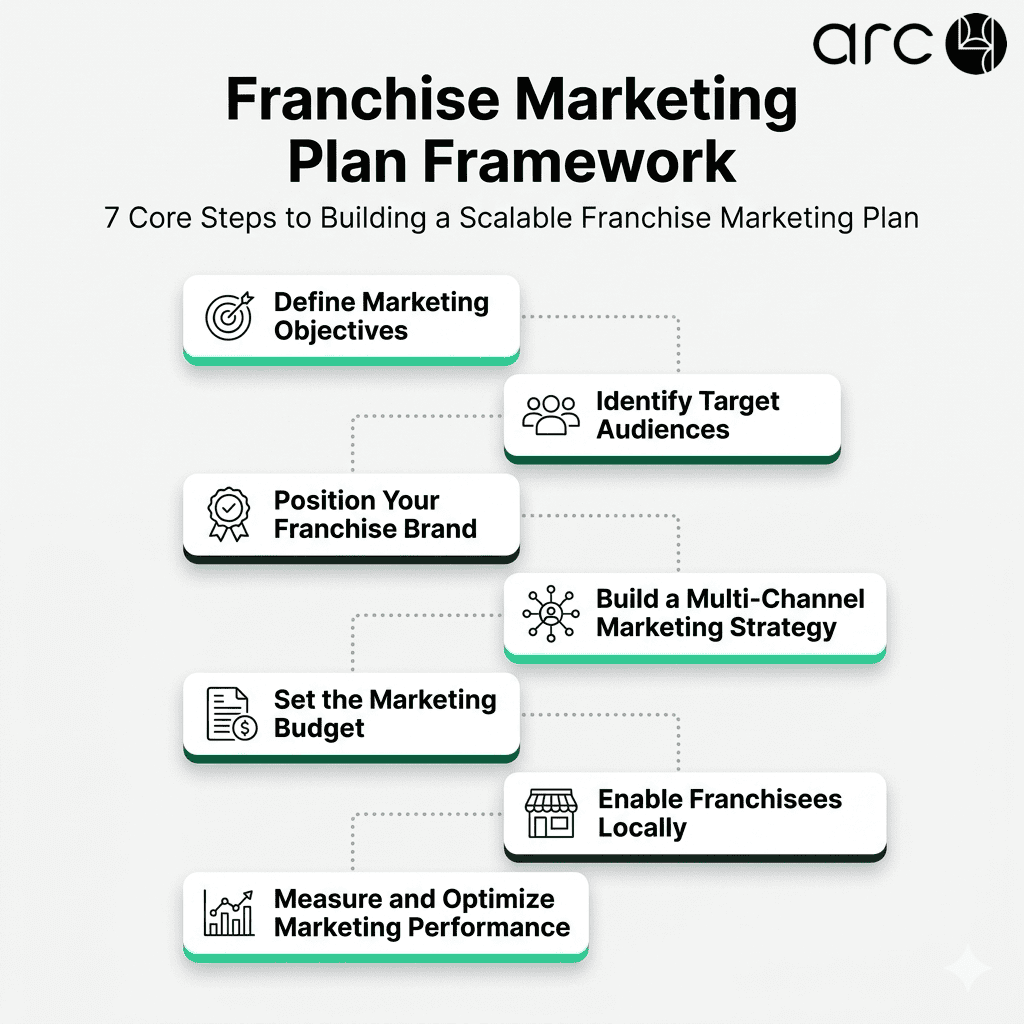
This guide walks through the essential components that make a franchise marketing plan effective today: audience segmentation, goal setting, brand positioning, multi-channel marketing strategy, budgeting, franchisee enablement, marketing technology infrastructure, and performance measurement.
By the end, you will have a clear roadmap for building or refining a franchise marketing plan that supports sustainable growth in 2026 and beyond.
1. Clarify Your Franchise Marketing Objectives
Every franchise marketing plan must connect directly to your business objectives for the next 12–24 months. Without this connection, marketing activities become scattered efforts that consume budget without moving the needle on what actually matters, whether that’s opening 50 new units by end of 2026, hitting $1.2 million in average unit volume, or achieving 8% same-store sales growth.
Your marketing objectives naturally split into two parallel streams. Franchise development goals focus on recruiting new franchise owners: generating qualified leads, converting inquiries into signed agreements, and filling priority territories. Consumer marketing goals focus on driving traffic and sales at existing locations: increasing transactions, boosting average ticket size, and building customer loyalty. Your plan needs to address both streams with specific, measurable targets. For an established franchise, objectives may shift toward maintaining brand presence, optimizing performance at existing locations, and supporting franchisees, while newer systems may focus more on rapid growth and market entry.
Here’s how to translate corporate business objectives into marketing KPIs:
Business Objective → Marketing KPI
- Open 20 new units in 2026 → Generate 120 qualified franchise leads per quarter at $150 Cost per Lead (CPL)
- Increase system-wide revenue 15% → Achieve 4:1 Return on Ad Spend (ROAS) on local paid campaigns
- Improve new unit ramp-up speed → Drive 500 pre-opening email signups per new location
- Build brand awareness in expansion markets → Reach 2 million impressions monthly in target regions
SMART goals make this concrete. For franchise development: “Generate 120 qualified franchise leads per quarter by December 2026, with 25% progressing to discovery calls within 30 days.” For consumer marketing: “Increase system-wide online orders by 20% year-over-year in 2026, measured through POS integration.”
Watch for misaligned goals that waste resources:
- Focusing on Instagram followers when the objective is qualified franchise inquiries
- Tracking website traffic without measuring actual franchise lead submissions
- Prioritizing national TV impressions when unit-level customer acquisition needs attention
- Chasing viral social content instead of consistent local engagement
- Measuring marketing activities (posts published, ads run) rather than outcomes (leads, sales)
2. Define and Segment Your Franchise Audiences
Your franchise marketing plan must address at least two core audiences that require fundamentally different approaches: prospective franchisees considering an investment in your brand, and end customers who buy your products or services at local franchise locations. Depending on your system, you may also need to address third segments like multi-unit operators, area developers, or corporate partners.
Building data-backed personas requires drawing from real sources, not assumptions. Pull insights from your CRM data showing which lead sources convert to signed agreements. Review Google Analytics to understand how potential customers find and navigate your site. Analyze franchise inquiry forms to identify patterns in candidate backgrounds and motivations. Conduct customer surveys to understand purchase drivers and brand perceptions. The most useful personas reflect actual behavior observed, not hypothetical profiles.
Consider two concrete example personas. For franchise development: Marcus, a 42-year-old multi-unit restaurant operator in Texas with 15 years of QSR experience, currently running three locations of another brand but seeking diversification. He cares about territory protection, semi-absentee ownership potential, and proven unit economics. For consumer marketing: Jennifer, a 32-year-old parent searching “kids haircut near me” on her phone, prioritizing convenience, positive reviews, and Saturday availability. She’ll choose based on Google ratings and whether she can book online.
Message, offer, and channel will differ dramatically between someone reading your Franchise Disclosure Document and evaluating investment returns versus a customer scanning your Google Business Profile to check if you’re open on Sundays. The FDD reader needs financial performance data, franchisee testimonials, and territory maps. The local customer needs location details, service menus, and easy booking options.
Before moving forward, sanity-check your audience understanding: Can you describe each segment’s primary motivation in one sentence? Do you know where they search for information? Can you identify the specific objections or concerns each segment has? Do you have real data (not just intuition) about their decision-making process? If any answers are unclear, gather more research before building campaigns.
Clear audience segmentation enables your franchise to craft a compelling unique selling proposition for both franchisees and end customers.
2.1 Prospective Franchisees
Prospective franchisees break into distinct sub-segments, each with different motivations and information needs. Single-unit buyers are often first-time business owners seeking a proven business model with strong support. Multi-unit investors bring operational experience and evaluate scalability, looking for concepts they can grow to 5–10+ locations. Corporate converts are professionals leaving employment to own a business, often drawn to the security of a franchise system versus starting from scratch. Existing franchisees from other brands may seek to switch due to dissatisfaction or diversify their portfolio with complementary concepts.
What motivates each sub-segment in concrete terms:
- Single-unit buyers: Initial investment affordability, training depth, break-even timeline, day-in-the-life reality
- Multi-unit investors: Multi-unit incentives, area development agreements, territory availability for 2026–2027, proven ramp-up playbooks
- Corporate converts: Semi-absentee ownership viability, management hiring support, lifestyle flexibility
- Portfolio diversifiers: Brand reputation relative to current holdings, operational synergies, market saturation concerns
These prospects ask predictable questions during discovery calls and Discovery Day visits. Your marketing plan should pre-answer them through content: “What do existing owners say about support quality?” calls for franchisee testimonial videos. “What’s the realistic first-year timeline?” calls for transparent FDD Item 19 discussions. “How protected is my territory?” calls for clear territory mapping tools on your website.
Channel selection should match sub-segment behavior. LinkedIn and franchise portals like Franchise Times work well for corporate executives exploring options. Industry trade shows and broker networks reach experienced operators efficiently. Local business publications may attract first-time buyers in specific markets. Your franchise development marketing should deploy across these channels with tailored messaging, an executive sees ROI projections and market opportunity data, while a first-time buyer sees training photos and owner lifestyle stories.
2.2 End Consumers
End consumers vary dramatically by franchise concept. A quick-service restaurant targets different customers than a home services brand or a children’s education center. Your marketing plan should define 2–3 primary customer personas per concept type, each with distinct needs and behaviors.
Concrete examples by category:
- QSR: Weekday lunch customer within 3 miles seeking fast service under $12; weekend family diner looking for kid-friendly options and value bundles
- Home services: Homeowner seeking emergency repair within 24 hours who will pay premium for speed; planned project customer comparing three quotes over two weeks
- Fitness: New Year resolution joiner motivated by results photos and introductory offers; committed member who values community and class variety
- Education: Parent researching tutoring options months before school year; parent responding to sudden grade drop seeking immediate help
Hyperlocal behavior dominates consumer decision-making. Mobile search, AI Search, and map platforms drive immediate action, with customers searching phrases like “pizza near me” or “plumber available today” and choosing from nearby locations based on visibility, reviews, and convenience. Local reviews on Google and Yelp shape trust before a customer ever contacts you. Social media recommendations within specific cities or ZIP codes influence consideration. Your plan must account for this hyperlocal reality rather than assuming national advertising alone drives unit-level traffic.
Corporate should supply base consumer research, national studies from 2022–2024 identifying category trends, competitive positioning, and customer satisfaction drivers. Individual franchisees contribute local insights from their own markets: what promotions resonate, which community events matter, and how local competitors behave. This combination of national intelligence and local knowledge powers effective consumer targeting. Leveraging content marketing is also essential, as it allows you to provide valuable, relevant information that addresses consumer pain points and interests, helping attract and engage your target audience.
These consumer personas will be reused throughout your plan when building local SEO strategies, designing paid media campaigns, and planning community events. Document them thoroughly now.
2.3 Why Audience Segmentation Drives ROI
Failure to segment leads to generic messaging that neither attracts qualified franchisees nor converts local customers. When you send the same email to a multi-unit investor and a first-time buyer, neither feels understood. When you run identical ads in suburban family markets and urban professional neighborhoods, neither performs optimally. The result is wasted budget and missed opportunities.
Segmented messaging looks different in practice:
- Separate landing pages: Franchise development page for experienced operators highlights multi-unit economics; page for first-time buyers emphasizes training and support
- Separate email nurture flows: Corporate converts receive content about transition planning and lifestyle flexibility; portfolio diversifiers see competitive analysis and market data
- Separate ad creatives: Local customers in college towns see late-night offers; suburban locations promote family meal deals
The metrics confirm segmentation’s impact. Franchise systems that segment lead nurture flows report higher lead-to-application rates, often doubling conversion compared to one-size-fits-all approaches. Local ads with market-specific creative achieve higher click-through rates, reducing cost per acquisition. Review response strategies tailored to complaint type improve satisfaction recovery.
Before vs. after segmentation scenarios:
- Franchise leads: Generic nurture sequence converts 4% to Discovery Day; segmented sequence by buyer type converts 8–10%
- Local paid search: Broad targeting achieves 2% conversion; geo-targeted campaigns with local offers hit 8–12%
- Email marketing: System-wide blast sees 12% open rate; segmented by purchase history reaches 25%+
This understanding of distinct audiences sets the foundation for brand positioning and messaging in the next section.
3. Position Your Franchise Brand and Messaging
Brand positioning is the backbone of your franchise marketing plan and should be clearly defined before any campaigns launch. Without clear positioning, your franchise development marketing competes on price alone, and your consumer marketing fails to differentiate from competitors down the street. Equally important is establishing a strong, consistent brand identity to ensure brand recognition, build trust, and maintain cohesive messaging across all franchise marketing efforts.
A Brand Positioning Statement articulates who you serve, what category you compete in, and what unique benefit you deliver. For a franchise, you need this defined for both audiences:
Franchisee positioning example: “For experienced multi-unit operators seeking their next growth concept, [Brand] is the fast-casual franchise that delivers industry-leading unit economics through a simplified menu and proven real estate strategy, unlike complex concepts requiring extensive culinary experience.”
Consumer positioning example: “For busy families who want quality meals without the wait, [Brand] is the fast-casual restaurant that serves fresh, customizable bowls in under five minutes, unlike traditional restaurants that sacrifice speed for quality.”
Your franchise brand requires separate but aligned value propositions. For franchisees, emphasize investment fundamentals: initial investment range, royalty structure, training duration, ongoing support quality, territory protection, and scalability path. For consumers, emphasize experience fundamentals: product quality, convenience, price value, and service consistency.
Consider time-relevant differentiators that matter. Flexible footprints (smaller square footage, non-traditional locations) address current retail real estate challenges. Digital ordering capabilities demonstrate operational modernity. Sustainability initiatives align with consumer preferences. Supply chain resilience speaks to operational stability.
Exercise for your team: List 3 competitor franchises in your space. For each, articulate in one line how your concept differs, first from a franchise owner’s perspective, then from a customer’s perspective. If you struggle to complete this exercise, your positioning needs work before marketing campaigns can succeed.
3.1 Develop Franchise Brand Guidelines
Brand guidelines in 2026 and beyond must cover both visual and verbal identity comprehensively. Visual elements include logo usage rules, color palette specifications, typography standards, photography style, and iconography. These visual rules ensure every franchise location presents a consistent and recognizable brand presence.
Verbal guidelines are equally important. These define tone of voice, messaging principles, approved terminology, and phrases to avoid. Clear communication standards ensure that whether a message comes from corporate marketing, a local franchise owner, or a social media manager, the brand voice remains consistent.
Brand guidelines should live in a centralized digital brand portal accessible to every franchise owner. Static PDFs buried in email threads are no longer sufficient. Modern franchise systems rely on cloud-based brand management platforms that allow franchisees to access current guidelines, download approved marketing assets, and submit materials for approval from one location.
Mandatory elements checklist for brand protection:
- Logo clear space requirements (typically 50% of logo height on all sides)
- Approved taglines and prohibited variations
- Rules on discounting language (e.g., never use “cheap,” always frame value positively)
- Photography requirements (no stock photos with visible watermarks, specific lighting standards)
- Social media profile standards (profile photos, cover images, bio copy)
- Signage specifications (materials, mounting, illumination)
These guidelines govern daily operations across individual franchises. When a franchisee creates a local flyer, they reference typography and color standards. When submitting a social ad for approval, they verify imagery meets photography guidelines. When sponsoring a community event, they use pre-approved signage templates. The guidelines also ensure consistency across Google Business Profile images, every location shows the same quality of storefront photo, interior shot, and product imagery.
3.2 Align Corporate and Local Messaging
The most effective franchise marketing follows a “national story, local proof” model. Corporate defines the brand story, messaging strategy, and campaign structure. Individual franchisees bring that story to life within their communities.
For example, a Summer 2026 promotional campaign might include corporate-created visual assets, messaging frameworks, and promotional guidelines. Franchisees can localize the campaign by incorporating city references, community imagery, or local offers.
This structure ensures customers experience a cohesive brand across markets while still feeling that each location understands its local community.
A useful rule of thumb is:
- 70% standardized brand elements
• 30% localized customization
This balance protects brand consistency while empowering franchisees to engage their local audiences effectively.
Tips for avoiding mixed signals:
- Ensure promotional dates and deadlines match across corporate and local communications
- Verify price points are consistent (or document approved regional variations)
- Align brand promises, if corporate promises “always fresh,” local ads can’t promote “made in advance”
- Coordinate campaign launch timing so customers don’t see conflicting messages
4. Build a Multi-Channel Franchise Marketing Strategy
Franchise marketing strategies in 2026 must operate across multiple coordinated channels including website, search, social media, email, offline events, and referral networks. Customers rarely convert through a single channel. They may first discover a brand through social media, research locations on Google, read reviews, and then convert through a local offer.
A well-designed franchise marketing plan coordinates these channels to support both franchise development marketing and consumer demand generation.
Your annual marketing calendar should be structured with quarterly campaign themes. A typical framework for 2026 might include:
Q1: New year momentum campaigns focused on customer acquisition and franchise development
Q2: Seasonal promotions and local community engagement initiatives
Q3: Back-to-school or fall marketing pushes depending on industry
Q4: Holiday promotions and year-end growth campaigns
Corporate provides campaign frameworks while franchisees execute locally using approved templates and messaging.
4.1 Digital Foundations: Website, SEO, and Local Search
Search engine optimization remains one of the most important demand generation tools for franchise systems in 2026. Structured location data and well-built location pages also improve visibility in emerging AI-powered search and answer engines that increasingly pull information directly from websites, listings, and structured data.
Franchise websites must serve two different audiences simultaneously:
- prospective franchise owners researching investment opportunities
• local customers searching for nearby locations
Clear navigation and distinct landing pages ensure each audience finds the information they need quickly.
Key SEO priorities include:
- Franchise opportunity pages targeting keywords such as “franchise opportunities 2026” or “[industry] franchise investment”
• Unique location pages optimized for local searches
• Structured data markup for every franchise location
• Consistent Name-Address-Phone listings across directories
• Regular updates to Google Business Profiles
Franchise brands that invest in strong AI Search visibility and local SEO routinely capture the majority of high-intent “near me” searches in their category.
Review management deserves dedicated attention:
- Respond to all reviews within 24–48 hours, positive and negative
- Thank positive reviewers specifically for what they mentioned
- Address negative reviews with empathy, accountability, and resolution offers
- Train franchisees on consistent brand voice in review responses
The impact is measurable. Moving from position 8 to position 3 in “near me” searches can double or triple monthly calls and direction requests for a franchise location. Systems that master AI visibility and local SEO capture up to 70% local market share in their category, while those ignoring it forfeit significant website traffic and foot traffic to competitors.
4.2 Paid Media for Franchise Development and Local Growth
Corporations should manage national and regional paid advertising campaigns that generate both franchise leads and consumer demand at scale. Centralized management ensures consistent messaging, optimized bidding, and efficient budget allocation across markets.
Campaign structures should separate franchise development from consumer acquisition:
Franchise development campaigns:
- Target keywords like “buy a franchise,” “franchise opportunities 2026,” “[industry] franchise for sale”
- Run on Google Ads (Search), LinkedIn Ads (targeting executives, business owners), and Meta Ads (interest-based targeting)
- Landing pages focused exclusively on franchise opportunity with lead forms
- Longer attribution windows (franchise decisions take months)
Consumer campaigns:
- Target keywords like “[service] near me,” “best [product] in [city],” “[brand] locations”
- Run on Google Ads (Search and Local), Meta Ads (radius targeting around locations), and programmatic display
- Landing pages or direct links to Google Business Profile for immediate action
- Shorter attribution windows with conversion tracking for calls, directions, orders
Budget allocation guidance varies by system maturity. Growth-focused franchisors might allocate 60–70% of paid media to franchise development to fill territories. Mature systems with strong unit counts might flip that ratio, investing 60–70% in consumer acquisition to drive same-store sales. Review allocation quarterly based on performance and strategic priorities.
Track these key metrics by channel and campaign:
- Cost per Lead (CPL) for franchise development
- Cost per Acquisition (CPA) or Cost per Store Visit for consumer campaigns
- Return on Ad Spend (ROAS) at both system and location level
- Conversion rates at each funnel stage
Retargeting multiplies paid media effectiveness. Website visitors who viewed franchise information but didn’t submit a form receive follow-up ads with testimonials or upcoming Discovery Day invitations. Consumers who visited a location page but didn’t convert see reminder ads with current promotions. These tactics typically deliver 2–3x higher conversion rates than cold traffic.
4.3 Social Media Strategy for Franchisors and Franchisees
Franchisors set the social media strategy, content pillars, and brand guidelines that ensure consistent brand presence across the network. Individual franchisees focus on local engagement and execution, responding to comments, sharing community content, and building relationships with local audiences.
A key structural decision: Should each location maintain separate local social profiles, or should everything centralize under main brand handles? Factors influencing this choice include:
- Separate local profiles work well when: locations serve distinct geographic communities, local engagement is a competitive advantage, franchisees have marketing capability
- Centralized handles work well when: brand consistency is paramount, franchisee marketing resources are limited, national reach matters more than hyperlocal presence
Many systems use a hybrid: centralized brand accounts for Instagram and TikTok (visual-first platforms where production quality matters), separate location pages for Facebook (where local community features like Events and Recommendations drive value).
Weekly posting framework for 2024–2026:
Day | Content Type | Example |
Monday | Brand story or value highlight | Mission statement, behind-the-scenes |
Wednesday | Local offer or promotion | Weekly special, limited-time deal |
Friday | Staff or customer spotlight | Team member feature, customer testimonial |
Weekend | Community content | Event coverage, user-generated content |
Operational clarity prevents customer service failures. Define explicitly: Who responds to comments and direct messages? (Location staff for local pages, corporate team for brand handles.) What’s the expected response time? (Within 4 hours during business hours.) What’s the escalation path for complaints or crisis situations? (Immediate notification to corporate, holding statement, investigation.)
Social KPIs to track monthly:
- Engagement rate by location and overall (benchmark: 3–6% for franchise brands)
- Message response time (target: under 2 hours)
- Follower growth in target markets
- Social media engagement correlation with location revenue
4.4 Offline and Community-Based Marketing
Local events, sponsorships, and partnerships anchor your franchise brand within each community in ways digital alone cannot achieve. Youth sports team sponsorships put your brand on jerseys seen by hundreds of families. School fundraiser partnerships create goodwill and word-of-mouth. Neighborhood association participation positions franchisees as community members, not just businesses.
New location launch events for the first 90 days:
- Grand opening weekend: Ribbon cutting with local officials, special offers for first customers, media invitations, social media coverage
- Charity partnership launch: Percentage of proceeds to local cause, joint promotion with nonprofit partner, community press release
- Local influencer event: Invitation-only preview for neighborhood bloggers and social media personalities, content creation opportunities
- Customer appreciation day: Free samples or services, loyalty program launch, feedback collection
Corporate should supply event playbooks, templates, and co-branded marketing materials that maintain professional standards while allowing local customization. A franchisee planning a grand opening shouldn’t design signage from scratch, they should select from approved templates and customize with their specific date, location, and offers.
Direct mail, local print, and out-of-home (billboards, transit advertising) remain relevant for specific concepts and markets. Evaluate these channels based on audience behavior and trackability. Use dedicated phone numbers, QR codes, or unique URLs to measure response rates and justify continued investment.
Best practices for data capture at offline events:
- Offer incentive for email signup (discount on next visit, entry into drawing)
- Use tablet-based forms rather than paper for immediate database entry
- Collect SMS opt-in alongside email for multi-channel remarketing
- Brief staff on consistent pitch and compliance with privacy regulations
- Sync collected data to CRM within 24 hours for immediate nurture sequences
5. Design a Scalable Franchise Marketing Budgett
Franchise marketing budgets typically consist of three funding sources:
- corporate marketing funds
• required local store marketing spend
• optional regional cooperative programs
Most franchise systems allocate 2–4% of gross revenue toward national marketing funds managed by the franchisor. In addition, franchisees typically spend 1–3% of gross revenue on local marketing initiatives within their markets.
In 2026, many franchise brands are increasing investment in digital acquisition channels, including paid search, local social media advertising, and marketing automation platforms.
Budgets should be reviewed quarterly and adjusted based on performance data. Channels delivering stronger return on ad spend should receive greater investment while underperforming channels should be reduced or eliminated.
Your plan should map budget allocations to specific objectives and channels for 2026, with quarterly review points.
Break down spending between:
- Acquisition (40–50%): Campaigns driving new customers to locations and new leads for franchise development
- Retention (25–35%): Loyalty programs, email marketing to existing customers, repeat purchase incentives
- Brand building (20–30%): Awareness campaigns, PR, sponsorships that build long-term brand recognition without immediate conversion expectation
Financial controls ensure accountability across the network:
- Minimum local marketing spend requirements per location (e.g., $1,500/month regardless of sales)
- Monthly or quarterly reporting from franchisees documenting local marketing activities and spend
- Performance benchmarks that trigger increased or reallocated investment
- Clear policies on co-op fund eligibility and reimbursement procedures
- Annual audit rights for the franchisor to verify compliance
5.1 Key Line Items to Include
Corporate-level line items:
- Creative production (video, photography, design) for campaigns and franchise marketing materials
- Website development and maintenance, including location pages and franchise development sections
- Search engine optimization for corporate site and location visibility
- Paid search and social advertising management (national/regional campaigns)
- National promotional campaigns (LTOs, seasonal pushes)
- Public relations and media outreach
- Marketing technology subscriptions (CRM, email platform, social tools, analytics)
- Franchisee marketing training development and delivery
Local-level line items:
- Local sponsorships (sports teams, schools, community organizations)
- Grand opening campaigns for new locations
- Local paid advertising (geo-targeted PPC, social ads, local directories)
- Print materials (flyers, door hangers, direct mail)
- In-store merchandising and point-of-sale displays
- Local event hosting and participation
Track each line item against specific key performance indicators:
- CPL for franchise portal advertising
- Cost per booking or cost per customer acquired for local Google Ads
- Cost per thousand impressions (CPM) for awareness campaigns
- Customer acquisition cost (CAC) by channel for consumer marketing
- Marketing-attributed revenue for email campaigns
Review budgets quarterly throughout 2026. Shift spend toward higher-performing channels, if paid search delivers 5:1 ROAS while display achieves 1.5:1, reallocate accordingly. Cut underperforming line items rather than maintaining “we’ve always done this” spending.
6. Equip and Support Franchisees for Local Marketing Success
Even the most sophisticated franchise marketing plan fails without franchisee execution. Your headquarters team can develop brilliant strategies, but results materialize at the unit level, in local marketing efforts, community connections, and daily customer interactions. This reality is especially acute in the first 6–12 months after each location opens, when local awareness must be built from zero.
A “local marketing toolkit” forms a core deliverable of your franchise marketing plan. This toolkit provides everything a new franchisee needs to market their location effectively: templates, calendars, playbooks, training materials, and technology access. The toolkit transforms marketing strategy into marketing activities any franchisee can execute.
Clear division of responsibilities prevents gaps and overlaps:
Owned by Corporate | Owned by Franchisee |
Brand creative and templates | Local customization and execution |
National campaigns | Local campaign activation |
Marketing technology platform | Daily platform usage |
Strategy and playbooks | Community relationship building |
Performance monitoring | Customer feedback response |
Training development | Staff marketing training |
Support timeline for a new franchisee:
- 90 days before opening: Access to brand portal, marketing toolkit introduction, pre-opening marketing checklist, territory analysis
- Launch week: Grand opening campaign execution, corporate social media support, local PR outreach, review solicitation launch
- First 90 days of operation: Weekly check-ins on marketing execution, review management coaching, local paid campaign optimization, community partnership development
Effective franchisee support achieves measurable outcomes:
- Faster revenue ramp-up (reaching break-even 2–3 months sooner)
- Consistent brand experience that builds customer loyalty and positive reviews
- More predictable local revenue that supports franchisee financial success
- Reduced franchisor intervention and firefighting
6.1 Local Marketing Playbooks and Templates
A local marketing playbook provides step-by-step guidance that transforms marketing strategy into daily action.
Contents should include:
- Pre-opening marketing timeline with specific milestones
- Quarterly calendar samples showing promotional cadence
- Sample ads with customization instructions
- Email sequences for customer acquisition and retention
- Social media post templates and content ideas
- Community event planning guides
- Grand opening playbook with day-by-day execution checklist
Time-bound launch milestones create accountability:
- 6 weeks before opening: Begin social media presence, launch “coming soon” landing page, start email list building, submit press release to local media
- 4 weeks before opening: Activate pre-opening paid advertising, finalize grand opening event details, confirm local partnerships
- 2 weeks before opening: Intensify social posting (5–7 posts per week), distribute door hangers in surrounding radius, launch countdown promotions
- Opening week: Execute grand opening event, capture customer data aggressively, solicit initial reviews, document with photo/video content
Ready-to-use templates minimize barriers to execution. A franchisee shouldn’t need graphic design skills to produce professional marketing. Provide editable files (Canva templates, customizable PDFs, drag-and-drop email builders) that require only inserting local details:
- Promotional flyers with placeholder for offer details
- Digital banner ads sized for major platforms
- Press release templates with fill-in-the-blank sections
- Email campaign sequences requiring only scheduling
- Social post templates with suggested captions
Store all templates in a centralized, cloud-based brand portal with version control. When corporate updates a template, the new version replaces the old, preventing franchisees from using outdated materials with old logos, expired offers, or discontinued products.
6.2 Franchisee Onboarding and Marketing Training
Franchisee onboarding should include a dedicated marketing track that runs alongside operations training. A franchisee who masters food safety but can’t manage their Google Business Profile will struggle. Marketing competency is operational competency.
Training format options for different learning needs:
- In-person training: 3–5 day initial session at headquarters with hands-on marketing workshop
- Live webinars: Monthly sessions covering seasonal campaigns, new tools, and Q&A
- On-demand video modules: Self-paced learning library covering core topics, accessible anytime
Marketing curriculum topics:
- Understanding your brand story and positioning
- Using the brand portal and accessing franchise marketing assets
- Operating your CRM and customer database
- Running local social media campaigns effectively
- Managing your Google Business Profile
- Handling online reviews (response templates, escalation procedures)
- Executing promotional campaigns with provided materials
- Reading and acting on marketing reports
- Complying with brand guidelines and legal requirements
Train beyond the owner. General managers and key staff who execute local marketing day-to-day need the same foundational knowledge. A owner who understands marketing strategy but delegates execution to untrained staff will see inconsistent results.
Certification requirements before independent campaign execution:
- Complete all required training modules
- Pass brand guidelines assessment
- Demonstrate CRM and portal proficiency
- Submit sample local ad for corporate review
- Achieve approval on first three marketing executions
6.3 Ongoing Support, Coaching, and Compliance
Initial training establishes the foundation; ongoing support sustains performance. Systems for continuous franchisee marketing support include:
- Monthly marketing calls: Network-wide webinars covering upcoming campaigns, success stories, and Q&A
- Quarterly performance reviews: One-on-one sessions reviewing location marketing metrics, identifying improvement areas
- Help desk access: Ticketing system or dedicated email for marketing questions with 24–48 hour response commitment
- Peer learning forums: Online community where franchisees share effective marketing strategies and local market insights
Field consultants or franchise business coaches should use a consistent scorecard to evaluate local marketing execution during site visits.
Scorecard elements might include:
- Google Business Profile completeness and accuracy
- Review ratings and response rates
- Social media posting frequency and engagement
- Participation in system-wide campaigns
- Brand guideline compliance in local materials
- Local marketing spend documentation
Balance coaching with compliance. The goal is empowering franchisees to improve, not merely punishing non-compliance. However, brand protection requires enforcement when franchisees consistently deviate from standards.
Effective systems use progressive intervention:
- Coaching conversation identifying the gap
- Written improvement plan with specific timeline
- Required approval for all marketing until compliance achieved
- Formal warning documented in franchisee file
- Contractual remedies for sustained non-compliance
Specific triggers for intervention:
- Sustained drops in local lead volume (30%+ decline over 60 days)
- Negative review rating trend (dropping below 4.0 stars)
- Repeated use of unapproved creative or messaging
- Failure to participate in mandatory system campaigns
- Customer complaints about marketing claims or service delivery gaps
7. Use Marketing Technology to Centralize and Scale
Modern franchise marketing relies on technology to coordinate dozens or hundreds of locations without overwhelming the corporate team. Manual processes that work for 10 locations break down at 50, collapse at 100, and are impossible at 500+. Technology provides the infrastructure for scalable execution.
As AI-powered search and discovery platforms continue to grow, maintaining accurate, structured location data across websites, listings, and knowledge platforms becomes even more important for franchise brands.
Core categories of tools every franchise marketing plan should address:
Category | Purpose | Examples |
CRM | Manage franchise leads and customer data | Salesforce, HubSpot, FranConnect |
Email Marketing | Automated campaigns for both audiences | Mailchimp, Klaviyo, Constant Contact |
Location Data Management | Maintain accurate location information across listings, search engines, and AI discovery platforms | Yext, Uberall, SOCi |
Social Media Management | Scheduling, monitoring, engagement | Sprout Social, Hootsuite, Sprinklr |
Review Management | Monitor and respond across platforms | Birdeye, Podium, Reputation.com |
Analytics Dashboard | Unified performance visibility | Google Analytics, Looker, custom BI |
Brand Asset Management | Store and distribute approved materials | Brandfolder, Frontify, MarcomCentral |
Your franchise marketing plan should specify which systems are mandated network-wide (non-negotiable for all locations) versus optional or local choice. Mandated systems typically include CRM, brand portal, and review management, tools where consistency and data rollup matter. Local discretion might apply to supplementary tools like design software or additional analytics.
Data architecture should enable both corporate oversight and franchisee self-service. Corporate needs network-wide dashboards showing performance across all locations, identifying top and bottom performers, and surfacing system-wide trends. Franchisees need access to their own location-level data without seeing competitive information from other units.
Technology benefits to achieve in 2026:
- Automated reporting that eliminates manual data compilation
- Template distribution enabling same-day campaign rollout across all locations
- Approval workflows reducing turnaround from days to hours
- Unified customer data enabling personalization at scale
- Real-time visibility into marketing performance by location
7.1 Central Control with Local Flexibility
Centralized tools allow corporate to maintain brand consistency while empowering franchisees to customize within approved boundaries. This balance, central control with local flexibility, represents the operational ideal for franchise marketing technology.
Example workflow demonstrating this balance:
- Corporate marketing team creates Summer 2026 campaign kit (ads, emails, social posts, in-store signage)
- Kit uploads to brand asset management platform with customizable fields marked
- Franchisees receive notification and log into platform
- Each franchisee selects needed assets and customizes approved fields (city name, local offer details, store hours)
- System validates customizations against brand rules (color, font, required elements)
- Approved assets download or publish directly to ad platforms and social schedulers
- Corporate dashboard shows adoption rates and execution status by location
Permission levels govern what each user can do:
- Corporate admin: Full access, template creation, rule setting, approval authority
- Regional manager: Regional view, can approve within territory, can create region-specific variations
- Franchisee: Location access only, customize and publish approved templates, submit custom requests for review
- Local staff: View only or limited execution rights (e.g., respond to reviews, publish scheduled posts)
Deciding what must be centralized versus localized:
- Centralize when: Brand risk is high, expertise requirements exceed local capability, economies of scale matter
- Localize when: Market-specific conditions demand customization, speed matters more than consistency, franchisee ownership increases execution quality
This setup simplifies compliance auditing:
- Dashboard shows which locations haven’t activated current campaign
- Reports identify locations with outdated materials still in use
- Alerts notify corporate when franchisees submit non-compliant custom requests
- Usage analytics reveal which assets perform best across the network
7.2 Data and Analytics for Decision-Making
Your marketing plan must define what will be tracked, how often it will be reviewed, and who is responsible for acting on insights, at both corporate and location levels. Data without decisions is just noise.
Core data sources to integrate:
- Website analytics: Traffic, conversions, user behavior by location page
- Ad account data: Spend, impressions, clicks, conversions by campaign and location
- POS sales reports: Transaction volume, average ticket, category mix, time-of-day patterns
- Call tracking: Inbound calls by source, duration, outcomes
- Review scores: Ratings by platform, review volume, sentiment trends
- Email metrics: Open rates, click rates, conversions by campaign and segment
Establish a monthly reporting cadence where franchisees receive a standardized performance summary.
This report should include:
- Website sessions and lead submissions for their location page
- Paid advertising performance (spend, leads, cost per lead)
- Review ratings and recent review summary
- Social media engagement metrics
- Comparison to network average and previous period
Data should drive decisions. Example: A franchisor noticed that radio advertising in certain markets showed minimal trackable response (using dedicated phone numbers), while paid search in those same markets delivered 4:1 ROAS. The following quarter, radio budgets shifted to search, improving system-wide CPL by 22%.
Analytics empower franchisees, not just corporate. Franchisees who understand their data make better marketing decisions, doubling down on what works, cutting what doesn’t. Corporate’s role is providing the data clearly, training franchisees to interpret it, and supporting data-driven decision making rather than hoarding insights at headquarters.
8. Measure, Optimize, and Evolve the Plan Over Time
A franchise marketing plan should never be static. Markets evolve quickly, digital platforms change, and consumer behavior continues shifting.
A plan created in early 2026 will almost certainly require adjustments throughout the year. Successful franchise systems treat their marketing plan as a living document that evolves based on real performance data.
Recommended review cadence:
- Monthly: campaign performance adjustments
- Quarterly: budget and channel optimization
- Annually: strategic plan refresh for the following year
Continuous testing and optimization ensure the marketing plan stays aligned with both franchise growth goals and changing market conditions.
Each review should examine both levels of performance:
- National metrics: Brand awareness tracking, total franchise lead volume, system-wide same-store sales growth, overall marketing spend efficiency
- Location metrics: Individual unit traffic and sales, local lead generation, review ratings, local campaign performance, franchisee marketing compliance
Optimization follows a simple loop: test a hypothesis in limited markets, measure results against control, learn what drove performance differences, and roll out successful approaches network-wide. A franchisee discovering that Instagram Reels outperform static posts in their market becomes a test case. If results replicate in similar markets, the insight becomes system guidance.
Common plan adjustments over time:
- Shifting channel mix as platform performance changes (less Facebook, more TikTok)
- Updating messaging based on competitive moves or customer feedback
- Refining franchisee training based on common execution gaps
- Revising budgets based on proven channel performance
- Adding new technology tools as capabilities mature
8.1 Core Metrics to Track Across the Franchise System
Franchise development metrics:
- Number of leads by source (franchise portals, paid search, organic, referrals)
- Cost per lead by channel
- Lead-to-discovery-call conversion rate
- Discovery calls booked per month
- Franchise applications received
- Discovery Day attendance and conversion
- Franchises awarded per quarter
- Time from lead to signed agreement
Consumer marketing metrics:
- Website sessions by location page
- Online orders/bookings by location
- Foot traffic (where trackable via mobile location data or sensors)
- Average ticket size
- Repeat visit rate / customer frequency
- Review ratings by location (Google, Yelp, Facebook)
- Review volume and recency
- Net Promoter Score (if surveyed)
Channel-specific metrics:
- Social: Engagement rate, message response time, follower growth in target markets
- Local search: Map pack rankings, call requests, direction requests from Google Business Profile
- Email: Open rate, click rate, conversion rate, list growth by location
- Paid: CPL, CPA, ROAS by campaign type and geography
Benchmarking locations against each other reveals improvement opportunities, but requires nuance. A location in a dense urban market will show different absolute numbers than a suburban location. Compare locations within similar territory profiles (market size, competitive density, tenure). New units benchmarked against established ones should focus on ramp-up trajectory, not absolute performance.
8.2 Responding to Market Changes and Emerging Trends
Consumer behavior and digital platforms evolve quickly. What worked in 2022 may underperform in 2026. Your plan should anticipate annual updates based on industry news and observed trends.
Emerging areas worth monitoring:
- Short-form video: TikTok, Instagram Reels, and YouTube Shorts continue gaining attention share. Franchise systems need strategies for producing authentic, localized video content efficiently.
- AI-driven personalization: Email and advertising platforms increasingly offer predictive targeting. Systems investing in customer data can deliver tailored offers based on purchase history and behavior patterns.
- Chat-based customer service: Messaging (SMS, WhatsApp, Facebook Messenger) increasingly replaces phone calls. Franchisees need response protocols and potentially chatbot automation.
- Voice search optimization: “Near me” queries increasingly come through voice assistants. Location data accuracy and conversational keyword targeting matter more.
- AI-powered search and answer engines: Platforms such as AI assistants and answer engines increasingly provide direct recommendations for services, locations, and brands. Franchise systems must ensure their location data, reviews, and website content are structured so these platforms can accurately surface their locations.
Pilot new tactics safely before network-wide rollout. Select 5–10 franchise locations representing different market types. Test the new approach for 60–90 days with clear success metrics. Compare performance against control locations not participating. If results warrant, develop playbooks and training for broader deployment.
Feedback loops accelerate learning. Your highest-performing franchisees often discover effective marketing strategies before corporate identifies them.
Create mechanisms to capture these innovations:
- Regular sharing sessions during network calls
- Recognition programs for marketing innovation
- Field team identification of local best practices
- Franchisee advisory council input on marketing plan updates
Tips for continuous learning:
- Attend franchise marketing conferences (IFA, industry-specific events) annually
- Subscribe to franchise and marketing publications for industry news
- Monitor competitor marketing activities quarterly (sign up for their emails, follow their social, visit their locations)
- Survey customers annually on brand perception and marketing message recall
- Conduct franchisee satisfaction surveys including marketing support questions
9. Putting It All Together: Your Franchise Marketing Plan Checklist
Use this checklist to build or refine your franchise marketing plan, working through each element in sequence:
Objectives and Goals
- [ ] Define 12–24 month business objectives (unit growth, revenue targets)
- [ ] Translate objectives into franchise development marketing KPIs
- [ ] Translate objectives into consumer marketing KPIs
- [ ] Set SMART goals for each marketing stream
Audience Definition
- [ ] Build prospective franchisee personas from CRM and inquiry data
- [ ] Build consumer personas from analytics and survey research
- [ ] Document segment-specific motivations, objections, and channels
Brand Positioning
- [ ] Create brand positioning statements for both audiences
- [ ] Develop or update comprehensive brand guidelines
- [ ] Establish corporate/local messaging alignment framework
- [ ] Define approval workflows for local customization
Multi-Channel Strategy
- [ ] Build 12-month campaign calendar with quarterly themes
- [ ] Ensure digital foundations (website, AI search, SEO, Google Business Profile)
- [ ] Plan paid media strategy for development and consumer segments
- [ ] Define social media strategy and posting frameworks
- [ ] Plan offline and community marketing approach
Budget
- [ ] Determine national fund and local marketing allocations
- [ ] Map budget to objectives and channels
- [ ] Establish financial controls and reporting requirements
Franchisee Enablement
- [ ] Create local marketing toolkit with playbooks and templates
- [ ] Develop franchisee marketing training program
- [ ] Define ongoing support systems and coaching cadence
- [ ] Establish compliance monitoring and intervention triggers
Technology
- [ ] Select and mandate core technology platforms
- [ ] Configure central control with local flexibility
- [ ] Build reporting dashboards for corporate and franchisee views
Measurement and Optimization
- [ ] Define core metrics at system and location level
- [ ] Establish review cadence (monthly, quarterly, annual)
- [ ] Create process for testing, learning, and rolling out improvements
Suggested Timeline for Plan Development
Phase | Duration | Activities |
Discovery | Weeks 1–2 | Audit current state, gather data, interview stakeholders |
Drafting | Weeks 3–6 | Write plan sections, develop templates and playbooks |
Review | Weeks 7–8 | Stakeholder feedback, legal review, budget approval |
Rollout | Weeks 9–12 | Training, technology setup, launch support |
Block time on your calendar this week, not next month, to begin drafting or revising your 2026 franchise marketing plan. Start with the objectives section: what must your franchise system achieve in the next 12 months, and what marketing KPIs will get you there? Everything else flows from that foundation. A successful franchise marketing plan isn’t perfect on day one; it’s a living document that improves with every campaign, every franchisee insight, and every market shift. Begin now, iterate consistently, and build the marketing infrastructure your growing network deserves.
10. Fostering a Positive Franchise Culture
A thriving franchise business is built on more than just a strong business model and effective marketing strategy, it’s powered by a positive franchise culture that unites franchise owners, employees, and customers across all franchise locations. Establishing and nurturing this culture starts with clear brand guidelines that define not only your visual identity but also your core values and expectations for behavior and service. These guidelines help ensure a consistent brand voice and image, no matter where your customers interact with your brand.
To reinforce this culture, franchisors should invest in regular training sessions, workshops, and annual conferences that bring together franchise owners and their teams. These gatherings are opportunities to share best practices, discuss challenges, and celebrate success stories from across the network. When franchisees see their peers recognized for outstanding customer service, innovative local marketing efforts, or community involvement, it inspires others to strive for similar achievements.
Recognition programs play a key role in fostering a supportive environment. Whether it’s a “Franchisee of the Month” spotlight, awards for consistent brand compliance, or shout-outs for local marketing wins, acknowledging contributions helps build a sense of belonging and pride. This positive culture not only drives business growth but also enhances customer satisfaction, as employees and franchise owners are motivated to deliver their best every day.
By prioritizing a positive franchise culture, franchisors create a foundation for scalable growth, brand loyalty, and a consistent brand experience that resonates with both local communities and the broader market.
11. Encouraging Innovation and Creativity Across the Franchise Network
In today’s fast-changing marketplace, encouraging innovation and creativity across your franchise network is essential for maintaining a competitive edge and driving customer engagement. Empowering franchisees to experiment with new marketing strategies, products, and services can unlock fresh ideas that benefit the entire system.
Franchisors can foster this culture of innovation by organizing regular brainstorming sessions, launching idea-sharing platforms, and hosting innovation challenges that invite franchisees to propose and test new concepts. These initiatives not only generate creative solutions but also make franchisees feel valued and invested in the brand’s future.
Supporting franchisees’ professional development is another key driver of innovation. Providing resources for attending industry conferences, workshops, and training sessions ensures that franchise owners stay informed about the latest trends, technologies, and effective marketing strategies. When franchisees are empowered to take calculated risks and share their learnings, the entire network benefits from a continuous flow of new ideas and best practices.
Ultimately, a franchise system that encourages creativity and empowers franchisees to innovate will see stronger customer engagement, improved marketing efforts, and sustainable business growth. By making innovation a core part of your franchise marketing strategy, you position your brand to adapt quickly and thrive in any market environment.
12. Celebrating Franchisee Successes and Milestones
Recognizing and celebrating franchisee successes and milestones is a powerful way to motivate your network and reinforce a culture of achievement. Public acknowledgment of accomplishments, whether it’s a record sales month, a glowing customer review, or a major anniversary, demonstrates that you value the hard work and dedication of your franchise owners.
Franchisors can leverage social media platforms and email marketing to spotlight franchisee achievements, share inspiring success stories, and highlight community involvement. These channels not only amplify positive news but also showcase the strength and unity of your franchise business to prospective franchisees and local customers alike.
Consider establishing a formal franchisee recognition program that rewards outstanding performance in areas such as customer satisfaction, local marketing efforts, and adherence to brand guidelines. Awards, certificates, and public announcements can all be part of this program, creating friendly competition and encouraging all franchise locations to strive for excellence.
By consistently celebrating milestones and successes, you foster a supportive and motivating environment that drives business growth, strengthens brand loyalty, and enhances customer satisfaction across your entire franchise network.
13. Franchise Marketing Crisis Management Plan
No franchise business is immune to unexpected challenges, whether it’s a negative review going viral, a product recall, or a social media backlash. That’s why having a robust franchise marketing crisis management plan is essential for protecting your brand reputation and maintaining customer trust.
Start by assembling a crisis management team that includes key stakeholders: franchise owners, marketing leaders, and customer service representatives. This team should develop a comprehensive plan outlining clear procedures for identifying, assessing, and responding to crises. Key elements include:
- Social Media Crisis Management: Establish protocols for monitoring social media platforms, responding quickly to negative comments, and escalating issues as needed. Pre-approved response templates and a designated spokesperson can help ensure a consistent brand voice during high-pressure situations.
- Customer Communication: Set up a dedicated customer service hotline or email address for crisis situations, ensuring customers can reach you easily with concerns or questions. Transparent, timely communication is critical for maintaining trust.
- Media Response Strategy: Prepare media statements and designate trained spokespeople to handle press inquiries. Consistent messaging across all channels helps control the narrative and minimize misinformation.
- Franchisee Support: Provide franchise owners with clear instructions and resources for handling local customer inquiries, updating marketing materials, and maintaining brand consistency during a crisis.
Regularly review and update your crisis management plan to reflect new risks and lessons learned from past incidents. By proactively preparing for potential crises, you can minimize damage, restore brand reputation quickly, and ensure business continuity across all franchise locations.
Start Building Your Franchise Marketing Plan for 2026
Block time this week to begin building or updating your franchise marketing plan for the current year. Start by clarifying your system’s primary growth objectives. Determine how many new locations you intend to open, how you will support existing franchisees, and which marketing channels will drive the most efficient growth.
From there, build your strategy step by step: define audiences, clarify brand positioning, create multi-channel campaigns, equip franchisees with local marketing tools, and implement technology that supports scalable execution.
A successful franchise marketing plan is not a static document. It evolves with every campaign, every new location, and every insight from your franchise network.