
How Franchise Brands Get Recommended By ChatGPT
AI search has changed how consumers discover and choose franchise brands. In 2026, when someone asks ChatGPT for the “best home cleaning franchise in Dallas” or the “top-rated med spa franchise near me,” they get one to three specific recommendations, not a list of ten blue links.
Those recommendations usually come from a mix of web data, consistent franchise entity information across locations, review quantity and quality, and well-structured local content that gives ChatGPT recent, detailed proof to pull from training data and live sources like Google Business Profiles and review sites.
For franchise brand leaders, marketing teams, and system operators, this shift is changing franchise discovery itself: brands that improve their AI visibility can compound leads, reviews, and sales, while brands that ignore it risk disappearing from the recommendation set.
This article breaks down exactly how franchise brands get recommended by ChatGPT, the role of AI assistants in franchise discovery, and the systems Arc4 builds to improve local entity consistency, structured data, review strategy, and day-to-day execution across franchise locations.
Key Takeaways
- AI search tools like ChatGPT, Claude, and Perplexity now return a single recommended franchise brand or location for most buyer queries, not a long list of options. AI tools like ChatGPT recommend specific businesses, not just options.
- ChatGPT recommendations are driven by web data, reviews, and entity consistency. You cannot pay for placement in organic AI answers, and private conversations do not influence future recommendations.
- Arc4 helps franchise brands build the “franchise location graph” and AI visibility layer so that ChatGPT, Claude, and other AI assistants can confidently recommend their locations by name and address.
- Google business profile health, review velocity, and location-level content are now core AI search levers for franchises.
Why ChatGPT Matters For Franchise Brands In 2026
Between 2023 and 2026, the way buyers discover franchise brands shifted dramatically. Tools like ChatGPT, Claude, Gemini, Perplexity, and Google AI Overviews now answer questions like “Which franchise brand should I choose?” with one to three direct, named options.
The old model of ranking on page one of search engines has been layered with a new reality: artificial intelligence that synthesizes information and delivers personalized recommendations in conversational form.
Consider the queries real buyers are asking right now:
- “Best med spa franchise near me”
- “Top home-cleaning franchise in Dallas”
- “Which tutoring franchise has the best reviews in Chicago”
AI chatbots recommend franchise brands by synthesizing vast amounts of online data, and the user’s stated goals are the most important factor influencing those AI recommendations. When someone asks ChatGPT for help choosing a service, the model is not browsing ads or recalling a sales pitch. It is pulling from its training data (which for GPT-4 Turbo includes web content through late 2023, refreshed via browsing) and from live sources like Google Business Profiles, review platforms, and official websites.
From Arc4’s expert perspective, franchise brands can no longer treat AI search as experimental. Buyers are already using these AI assistants instead of Google for franchise discovery and comparison. Answer Engine Optimization (AEO) aims to be the specific answer cited by AI, and franchises that earn those early recommendations in 2024 to 2026 build a compounding advantage. More clicks lead to more reviews, which lead to more citations, which strengthen future recommendations.
How ChatGPT Actually Finds And Recommends Franchise Brands
ChatGPT does not “remember” individual business pitches from conversations and cannot be “trained” by franchise sales reps sending messages into a chat window. Instead, it pulls from its model training data and live web sources to assemble each recommendation.
Here is how that process works:
Base model training. The large language model learns about franchise companies through public web pages, news articles, directories, and reviews crawled before the training cutoff. Brands that frequently appear in discussions across authoritative sources are more likely to be recommended. Recent franchise rankings and financial disclosures also influence AI recommendations because they are part of the internet content the model absorbs.
Live browsing and tools. When browsing mode is active, ChatGPT fetches current information from the internet, including Google Business Profile data, review sites like Yelp and Google, franchise portals, and niche directories. AI tools often reference sites like Yelp and Google for recommendations, so they need access to current, accurate public business information across those sources to recommend a location confidently.
Entity resolution. The AI system tries to match the parent franchisor to specific franchise location entities in a given city or ZIP code. If the brand name, categories, URLs, and phone numbers are consistent across sources, the match is confident. Conflicting information across locations can cause AI to skip a brand altogether.
Ranking logic. Once candidate locations are identified, AI models weigh review quality, recency, rating distribution, and content detail. A study of 10,000 queries across 25 categories found that 78% of businesses recommended by ChatGPT had 50 or more Google reviews. ChatGPT relies on authoritative content to recommend businesses, not just star averages.
AI assistants prefer brands that are:
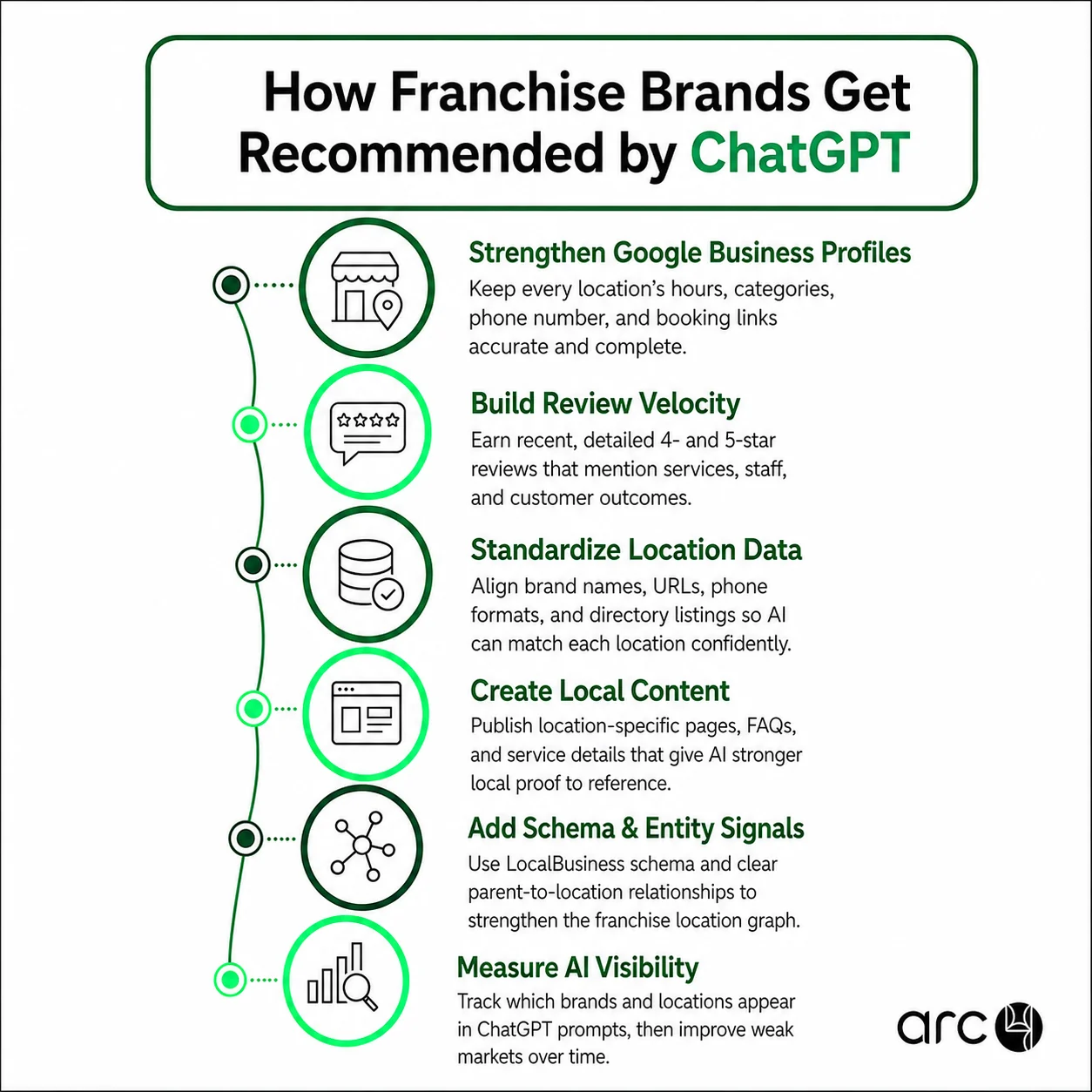
- Entity-consistent: same brand name, categories, URLs, and phone formats across the web
- Review-rich: consistent review velocity with detailed reviews about services, staff, and outcomes
- Location-structured: clear location pages and LocalBusiness schema that map parent to location relationships
From Arc4’s point of view, most brands in 2024 and 2025 had mismatched names, outdated Google Business Profiles, and thin location content. This made ChatGPT answers generic (“look for a local med spa franchise with good reviews”) instead of brand-specific. The rest of this article shows how Arc4 fixes those gaps so that ChatGPT can confidently say, “Consider [Brand] at [Street Address] in [City].”
From Brand Awareness To Local AI Confidence
National brand awareness does not automatically translate into local AI recommendations, especially for multi-location franchises with uneven local execution. Visibility and fame increase the likelihood of being recommended by AI, but only when backed by local proof.
There is a critical difference between:
- National trust: TV ads, sponsorships, social media posts, and PR that make the brand recognizable to humans.
- Local confidence: Detailed reviews, photos, staff mentions, and neighborhood-specific proof that convince AI models to recommend a specific franchise location.
Consider two examples:
- A national fitness franchise with 500+ units but uneven Google Business Profiles and outdated photos. ChatGPT recommends only a subset of locations in major cities because the rest lack the local proof needed for confident answers.
- A smaller, 40-unit home services brand with strong, consistent reviews and updated profiles. It appears more often in ChatGPT answers than bigger competitors in several markets because its local signals are stronger.
Third-party validation is a significant driver of AI recommendations. AI assistants evaluate the same “local proof” that human customers look for:
- Recent 4 to 5 star reviews mentioning staff names, specific services, and outcomes
- Fresh photos of storefronts, interiors, and work results
- Accurate hours, phone numbers, and booking URLs across Google Business Profile, website, and directories
Maintaining a trustworthy online presence is crucial for franchise brands. Arc4’s framework focuses on turning national brand assets into local proof artifacts that AI can easily trust, measure, and reuse in answers.
The Franchise Location Graph: What AI Needs To Understand Your System
The “Franchise Location Graph” is the structured data map that ties together franchisor, locations, territories, and people in a way AI systems can interpret. Think of it as the blueprint AI uses to connect your corporate identity to each individual franchise location.
Core entities in the graph include:
- Parent brand entity: The corporate franchisor’s legal and marketing identity
- Location entities: Each unit with its own address, phone, categories, hours, and services
- Staff entities: Lead providers, clinicians, technicians, or territory owners when reviews and bios mention names
- Service entities: Named services like “full body laser hair removal,” “standard home cleaning,” “roof replacement,” or “SAT math tutoring”
AI search tools and assistants attempt to reconcile these entities from multiple public sources:
- Corporate site location finder pages
- Google Business Profiles and Apple Maps entries
- Local directories and niche review platforms
- Social profiles per location (Facebook, Instagram, LinkedIn)
Brands that consistently address common franchise questions are favored by AI because the model can map those answers back to the franchise location graph with confidence.
When Arc4 audits franchise systems, the typical problems include:
- Location pages that are copy-paste templates with only city names swapped
- Outdated franchise location data (old names, wrong numbers) persisting in directories after ownership changes
- Multiple Google Business Profiles for one physical location due to rebrands or incorrect categories
Franchises should create structured pages for key topics to improve visibility, and the sections below show how Arc4 operationalizes the franchise location graph, connects it to AI search, and measures AI visibility over time.
Technical Layer: Parent-Location Consistency And Schema
Technical consistency is the baseline. If AI cannot reliably tell which entities belong together, it will avoid making specific recommendations or hedge in its responses. Franchise visibility in AI depends on accurate Google Business Profiles, and inconsistent branding confuses AI systems and users alike.
Core technical elements that must be consistent across parent and locations:
- Brand and location naming conventions (e.g., “BrandName – City” vs. “Brand Name of City”). Franchise locations must maintain consistent business names and categories.
- Primary and secondary Google Business Profile categories aligned with real services. Google’s guidelines require accurate representation of franchises.
- Canonical URLs and location slug formats on the corporate website, with proper internal links connecting parent and location pages.
- LocalBusiness and Organization schema markup that precisely ties each location to the parent brand. Structured data helps define business location and services for AI.
Google business profile must be complete and regularly updated. Consistent business information across platforms boosts AI visibility, and franchise locations should maintain consistent business information online at all times.
Arc4 audits and repairs inconsistencies at scale by:
- Cross-referencing website location pages, Google Business Profiles, and major directories for every unit at least quarterly
- Flagging anomalies like conflicting hours, mismatched categories, or different brand names for the same address
- Rolling out standardized schema markup templates that pull from a single source of truth rather than manual edits
AI tools prefer authoritative, well-structured content for recommendations. AI systems prefer unique, high-quality content over duplicated text, and franchises often face duplicate content issues in SEO. Google rewards original, high-quality content for SEO, which means AI tools also prefer unique, high-quality content over duplicates. Franchises should ensure consistent messaging across all platforms while avoiding cookie-cutter pages.
Arc4 recommends a monthly cadence for new openings, closures, and rebrands to prevent “ghost locations” from lingering in AI training data and confusing ChatGPT. Franchises should optimize content to fit AI tools’ descriptions rather than relying on legacy platforms that produce generic output.
Operating Layer: Review Velocity, Quality, And Frontline Attribution
Reviews are not just a reputation metric. They are a core AI ranking signal, especially after 2023 when LLMs became strong at reading sentiment and specifics in review text. Franchises with strong reviews are more likely to be recommended by AI.
“Review velocity” is the number of new reviews per franchise location per month. Steady, organic growth outperforms occasional spikes. Research shows that AI models prefer businesses with recent reviews from the last 90 days, and older reviews carry less weight.
AI tools like ChatGPT and Claude do not only look at star averages. They also analyze:
- Recency of reviews (activity in the last 90 days matters most)
- Detail in review text (services performed, staff names, issues resolved)
- Distribution of ratings across locations, revealing weak spots in the franchise system
Encouraging customer reviews enhances credibility for AI recommendations. Google allows businesses to remind customers to leave reviews, and franchisees should request feedback from eligible customers neutrally, without incentives or review gating.
Arc4’s approach to building sustainable review programs:
- Embedding review requests into frontline workflows (POS systems, CRM follow-ups, post-visit SMS or email) instead of occasional marketing campaigns
- Training franchise teams to invite all customers neutrally, complying with Google and FTC rules
- Using employee-level attribution so operators can coach specific team members and turn service improvements into better review language
One thing worth highlighting: Hello Sugar increased review velocity by about 14x in 12 months through systematic frontline processes, not marketing blitzes. Franchises can see a 200% to 500% increase in social media performance when review and reputation programs are done well, because happy customers who leave detailed reviews also share their experiences on social channels.
This operating layer is where most franchise brands fail. They buy reputation software and tools but never change daily habits, so review volume and quality stay flat and AI visibility does not improve. The cost of inaction compounds over time as competitors build stronger signals.
Measurement Layer: AI Visibility Across ChatGPT, Claude, And Other AI Search Tools
Traditional SEO reporting focuses on rankings in Google, but AI visibility must measure whether AI assistants recommend specific locations for real buyer prompts. Google analytics and standard search visibility metrics only tell part of the story.
Core components of an AI visibility scorecard that Arc4 uses:
- Profile health metrics (Google Business Profiles, Apple Maps, key directories) by location
- Review velocity and quality (recent reviews, staff mentions, service detail)
- Schema and entity consistency across the franchise location graph
- AI answer presence for a defined set of prompts (“best [service] in [city]”, “[brand] reviews in [city]”, “closest [category] near [ZIP]”)
Arc4 runs these prompts across multiple AI tools on a scheduled cadence (typically monthly) to detect whether:
- The brand is named explicitly in answers
- Specific locations and addresses are cited correctly
- Answers reference the desired review platforms and website content
Differences between providers are common. ChatGPT with browsing may lean on Google and major review sites. Claude may cite long-form web content and detailed case studies more heavily. Vertical AI search tools may draw on niche directories and industry benchmarks.
Arc4 treats AI visibility as an operational KPI for franchise leadership, not just a marketing vanity metric. It sits alongside customer satisfaction scores, response time benchmarks, and sales metrics in the franchise operating dashboard.
Arc4’s Framework For Getting Franchise Brands Recommended By ChatGPT
Arc4 is a specialist in AI visibility and franchise search, focusing on franchise brands with 20 to 500+ locations across North America and Europe. The framework follows four phases:
- Audit: Map the current franchise location graph, review footprint, schema, and AI visibility across ChatGPT, Claude, Gemini, and Perplexity.
- Stabilize: Fix Google Business Profile issues, unify naming and categories, implement structured data, and clean up duplicate listings.
- Activate: Launch frontline-driven review programs, enhance location content, and standardize local landing pages.
- Measure: Track AI visibility monthly, attribute improvements back to operational changes, and adjust where franchises lag.
Arc4 does not just give strategic recommendations. It supports from a free audit to implementation through:
- Location data governance processes that the franchisor can embed in operations playbooks
- Templates for location pages, FAQs, and service descriptions that AI tools parse cleanly
- Review request scripts and operational checklists for franchisees and frontline staff
The framework is intentionally tool-agnostic on the marketing side but tightly integrated with AI assistants and AI search behavior. It works alongside your existing ads platforms, CRM systems, and corporate marketing team rather than replacing them.
Example Impact Of Arc4 Program On Franchise AI Visibility
This is a representative, anonymized 2024 to 2025 case study for a 60-location personal services franchise in the United States that engaged Arc4 for 9 months. The table shows quarterly metrics before and after intervention, focusing on AI visibility and the underlying signals that influence ChatGPT recommendations.
AI Visibility Improvement Over 9 Months
| Metric | Baseline | After 3 Months | After 6 Months | After 9 Months |
| Average Google rating across locations | 4.2 | 4.3 | 4.5 | 4.8 |
| Average monthly reviews per location | 2.1 | 5.8 | 9.7 | 11.4 |
| Locations with complete Google Business Profiles | 35% | 71% | 89% | 96% |
| ChatGPT prompts naming the brand (test set of 50 queries) | 12% | 34% | 53% | 68% |
| ChatGPT prompts naming a specific location with address | 5% | 19% | 32% | 41% |
The pattern is clear: as review velocity, profile completeness, and entity consistency improved, ChatGPT began naming the brand and specific locations far more often. The jump from 12% to 68% brand-naming in just 9 months shows how quickly these signals compound when the fundamentals are in place.
Franchise Location Graph Coverage And Risk
Arc4 scores each location on “graph coverage” (how fully the location is represented across key AI-relevant data sources) and “risk” (likelihood that AI assistants misinterpret or ignore the location). The second table compares three example locations in the same franchise to show how coverage correlates with recommendations from ChatGPT and similar tools.
Location Graph Coverage And AI Risk
| Location | Google Business Profile Health | Review Velocity (last 90 days) | Directory & Schema Coverage | AI Search Visibility (local prompts) | Risk Assessment |
| City A – Northside | 94 / 100 | 14.2 reviews / month | 91 / 100 | 76% | Low risk: consistently recommended by ChatGPT and Claude |
| City B – Downtown | 78 / 100 | 6.5 reviews / month | 72 / 100 | 41% | Medium risk: appears in some AI answers, often as one of several options |
| City C – Westside | 49 / 100 | 1.3 reviews / month | 37 / 100 | 9% | High risk: rarely surfaced in AI search despite being an active location |
City C is a cautionary example. Despite being open and serving customers daily, its limited review velocity, incomplete profile, and weak schema coverage make it nearly invisible to AI. Competitors in that market capture the recommendations instead.
Practical Steps Franchise Brands Can Take Now
Franchise leaders do not need to rebuild their tech stack to start improving AI visibility. They need a focused, repeatable process that is affordable. Here is a 30 to 60 day action plan:
Week 1 to 2:
- Inventory all franchise locations, mapping each to a canonical website URL and current Google Business Profile
- Document current review counts and average ratings per location
- Run a small AI visibility test using 10 to 20 real buyer prompts for 3 to 5 key markets
Week 3 to 4:
- Fix critical GBP issues (duplicates, wrong categories, broken links, outdated hours)
- Standardize naming conventions and update schema on all live location pages
- Begin a compliant review request habit at the frontline level
Week 5 to 8:
- Upgrade the weakest 10 to 20 percent of location pages with real photos, staff bios, and location-specific FAQs
- Start measuring review velocity weekly and sharing simple scorecards with franchisees
- Re-run the AI visibility test and compare results, noting which fixes correlated with better ChatGPT answers
Arc4 typically supports brands through this plan by:
- Providing audit templates, AI visibility prompt sets, and scorecard definitions
- Handling schema deployment and directory clean-up centrally
- Training field operations and franchisees on integrating review requests into everyday workflows
Treat this work as part of your 2026 franchise operating system rather than a one-off marketing campaign. AI search will keep evolving on top of these same fundamentals, and the brands that build the infrastructure now will have control over their visibility for years to come.
How AI Tools Like Claude Code And Internal AI Assistants Fit In
While AI assistants like ChatGPT and Claude decide which brands to recommend, those same AI tools can also help franchises manage the data and content that drive recommendations. This is where the dual role of artificial intelligence gets interesting for franchise operations.
Arc4 leverages AI tools internally in several ways:
- Using claude code to prototype scripts that validate Google Business Profile data against the corporate location database
- Using AI assistants to generate draft location-specific FAQs and service descriptions, and to use dall e for quick visual mockups or promotional image concepts for location marketing assets, which are then edited or reviewed by humans for accuracy, compliance, and publication
- Using AI to parse and categorize thousands of reviews, surfacing common issues and strengths by location or region
These AI tools accelerate operations but do not change the underlying principles. AI assistants will still reward accurate, consistent, human-edited data and authentic customer proof. AI generated content works as a drafting layer, but the point of human review is non-negotiable.
Do not auto-generate mass location pages without human review. AI search systems and Google both prioritize quality, factual accuracy, and real-world signals over volume. The risk of thin, duplicated content is real, and it can actively reduce your search visibility and AI visibility.
Arc4’s role is to design and govern these workflows so they scale safely across tens or hundreds of locations without degrading data quality or introducing compliance risk. The future of franchise marketing involves AI on both sides of the equation: the tools that recommend, and the tools that help you earn those recommendations.
Frequent Questions
These questions cover practical concerns franchise leaders often raise that are not fully addressed in the main blog post sections above.
Can we pay ChatGPT or OpenAI to feature our franchise brand more often?
As of 2026, franchise brands cannot buy placement inside ChatGPT’s core recommendations for organic answers. While OpenAI and other providers may offer advertising products in specific experiences, those are separate from the underlying model’s organic recommendations for questions like “best [service] in [city].” The only durable way to earn recommendations is to strengthen the franchise location graph, review footprint, and web authority that the models learn from. You cannot pay your way into organic AI recommendations any more than you can pay for organic Google rankings.
How long does it take to see improvement in ChatGPT recommendations after we fix our data?
Some improvements, like more accurate local answers when AI tools browse live web pages, can appear within 4 to 8 weeks once Google Business Profiles, location pages, and reviews are updated. Deeper model-level learning from new web data happens more slowly because large AI models are retrained on longer cycles, often measured in months, so the full impact compounds over 6 to 12 months. Arc4 typically sees early AI visibility lifts after the first 90 days, with more significant gains by month 6 as review velocity and consistency improve.
Will AI search replace traditional local SEO for franchises?
AI search is changing how users interact with results, but the underlying inputs remain similar. Google Business Profiles, on-site content, reviews, and citations still matter to both traditional search engines and AI models. Instead of replacing SEO, AI assistants layer on top of it, using search data and web content as training material and live reference sources. Franchise brands should maintain strong traditional SEO while adding an AI visibility layer, which is precisely where Arc4 focuses its work.
Is it risky to use AI to generate copy for franchise location pages?
Using AI to draft content is acceptable, and teams may also use dall e for draft visual concepts as long as those assets still get human review for brand accuracy and local relevance, if content is fact-checked, localized, and edited by humans, and if it accurately reflects the specific needs of each franchise’s services and compliance requirements. Mass-generating near-duplicate pages for hundreds of locations is risky because both Google and AI search systems can detect thin or templated content patterns and may discount them. Arc4 recommends using AI as a drafting assistant, with clear editorial standards and review workflows to ensure quality and uniqueness per location..
How does Arc4 work with our existing marketing and technology vendors?
Arc4 does not replace CRM, marketing agencies, or reputation software. Instead, it focuses on governance, structure, and measurement across those tools to improve AI visibility outcomes. Arc4 typically collaborates with internal marketing, operations, and vendor teams to define data standards, audit processes, and AI visibility scorecards. The goal is to turn disparate tools, campaigns, and customer interactions into a cohesive franchise location graph and AI search strategy that consistently earns ChatGPT and other AI recommendations across all markets where your franchisees operate.