
How To Audit Yext Listings For Missing Information And Opportunities
Key Takeaways
- A local SEO audit of your Yext listings uncovers missing data, NAP inconsistencies, and untapped fields that directly affect your visibility in Google Maps, Google Business Profile, and major local directories.
- This article walks through a repeatable, step-by-step Yext audit process covering everything from benchmarking local search results to local link building, with concrete checklists and comparison tables for 2026.
- Missing or incorrect information in Yext (categories, hours, photos, attributes, descriptions) suppresses your placement in Google’s local 3-pack and reduces conversions from local customers. Yext listing audits help maintain data accuracy across various publishers.
- Partnering with Arc4 is the most efficient path to run an in depth analysis of Yext data and extract advanced local SEO opportunities that most businesses overlook.
- A local SEO audit identifies areas needing improvement, and the tables and frameworks below help marketers and local business owners prioritize fixes based on impact rather than guesswork.
Why Yext Listing Audits Matter For Local SEO In 2026
Yext is a central platform that syncs your business profile data to local directories, navigation apps, voice assistants, and review sites. It maintains a Knowledge Graph for each location and pushes updates to hundreds of publishers so your business information stays consistent without logging into each site individually. For any local business that depends on local search for revenue, Yext acts as the single source of truth for digital presence across the web.
Auditing Yext listings matters because 46% of Google searches are local, and 80% of those local searches convert into sales. Google Business Profile is essential for local SEO visibility, and it displays key business information in local searches. A well-optimized Google Business Profile can increase conversion rates significantly, but only if the data feeding it from Yext is accurate and complete. Incorrect or incomplete data can misroute potential customers, trigger negative reviews, and waste spend on Google Ads and marketing campaigns that send people to the wrong address and phone number.
A strong Yext listing audit treats Yext data as the source of truth for SEO accuracy, but the audit itself goes beyond fixing errors, aligning with a broader Yext SEO and local search optimization strategy. It is an opportunity to find gaps in local content, local schema enhancements, and local link building that push your local rankings higher. Arc4 specializes in running Yext-focused local SEO audits for service businesses, retailers, and B2B companies across the US as of 2026, combining automated data checks with hands-on competitive analysis to deliver measurable results.
Step 1: Benchmark Your Current Local Search Visibility Before You Touch Yext
Before you change anything in Yext, you need a clear snapshot of where you stand, whether you plan to manage listings manually or evaluate managing Yext listings without a subscription. Open an incognito browser and a mobile device, then search your brand plus city name. Note where your Google Business Profile appears, your map rankings, and your organic local search results. Testing websites on different devices ensures consistent user experience and captures what your target audience actually sees.
Audit preparation requires administrative access to the Yext account for evaluation, so confirm you have the right login credentials and permissions before diving in. Use Google Analytics 4 and Google Search Console to record current local traffic, conversions, and top location-based search queries. Capture screenshots and export CSVs of everything. These baselines are what you will compare against 60 to 90 days after completing fixes to quantify your local SEO gains. Google’s local 3-pack displays top local businesses prominently, and knowing whether you currently appear there (or not) is the starting point for the entire audit.
Pre-Audit Local Visibility Snapshot
Record these metrics before making any changes. You will revisit each one 60 to 90 days post-audit to measure impact.
| Metric | Tool | Example Value (July 2026) | Why It Matters |
| Average rank for “plumber in Denver” in Google Maps | Local rank tracker (BrightLocal, Whitespark) | #8 | Baseline for measuring map pack visibility gains |
| Clicks from Google Business Profile (30 days) | GBP Insights | 300 website clicks, 120 direction requests | Google Business Profile influences user engagement significantly |
| Sessions from local organic search | Google Analytics 4 | 1,250 sessions (June 1 – June 30, 2026) | Shows local traffic attributable to SEO vs brand or referral |
| Number of Google Reviews | GBP / Yext reports | 45 reviews, avg rating 4.3 | Social proof and ranking factor; search engines favor businesses with high ratings and frequent reviews |
| Photos uploaded in past 60 days | GBP / Yext dashboard | 0 new photos | Activity signals; stale galleries lose impact |
Step 2: Audit Core NAP Consistency Inside Yext (Name, Address, Phone)
Flawless consistency in name, address, and phone number is the foundation of local SEO for any business profile. A core NAP consistency check ensures identical business details across platforms, and even small discrepancies like “St.” vs “Street” or an old suite number can confuse search engines. Since 46% of Google searches are local, NAP must be consistent down to each letter and number to avoid a drop in search rankings.
Export all location entities from Yext and compare the primary business name, full street address, local phone number, and website URL against your local business website and Google Business Profile. Common issues include:
- Abbreviation mismatches (“Ave” vs “Avenue”, “Ste” vs “Suite”)
- Old phone numbers still live on some local directories after a line change
- Rebranded business names appearing on platforms that accepted crowdsourced edits
- Duplicate listings that confuse customers and dilute local SEO authority
Use Yext’s duplicate suppression and correction features to normalize NAP across hundreds of publishers. Duplicate listing identification helps find and suppress unmanaged listings that fragment your signals. In one documented case, a dental practice had three different phone numbers across its own site, a problem that took 30 minutes to fix but had an outsized impact on local visibility.
Arc4 typically starts every Yext audit with a programmatic export and comparison, flagging even minor NAP variations that most businesses miss during self-serve reviews.
Manual NAP Cleanup vs Yext-Powered Cleanup vs Arc4-Managed Audit
Here is how the three approaches compare for resolving NAP inconsistencies and for understanding how to manage business listings across multiple sites with Yext.
| Factor | Manual Per-Site Updates | Yext Self-Serve Cleanup | Arc4-Managed Yext Audit |
| Time required per location | 4 to 8 hours | 1 to 2 hours | Under 1 hour (handled by Arc4) |
| Risk of missed duplicate listings | High | Medium | Low (automated + manual scan) |
| Subtle NAP inconsistency detection | Relies on human eye | Flags major mismatches only | Programmatic comparison across 50+ sources |
| Reporting depth | Spreadsheet notes | Basic Yext dashboard | Detailed issues report with severity levels |
| Ongoing monitoring of new citations | None unless repeated manually | Platform alerts only | Proactive quarterly audits by Arc4 |
Step 3: Check Category, Services, And Attributes Completeness In Yext
Correct primary and secondary categories in Yext feed directly into local search relevance signals on Google Maps and other platforms, and they are a core part of how you optimize your Yext setup for local SEO. Categories help search engines understand the business better and impact search visibility, so selecting the right ones is not optional. Since 46% of Google searches are local and 80% of local searches convert into sales, every category choice either earns or loses you local customers.
Audit the primary business category, all secondary categories, and the service list in Yext so they align with your local keyword research and actual offerings. For example, a dental clinic should use “Dentist” plus “Emergency dental service” rather than a generic “Health” category. In the Urban Dental case study, service list misalignment and weak categories suppressed visibility until corrections were made, after which organic traffic grew 186% and bookings increased 52%.
Review attributes like wheelchair accessibility, accepted payment methods, service options (delivery, pickup, in-store), and health and safety fields. Local relevance in category selection affects listing visibility, and these attributes surface in Google Maps filters that local customers use daily. Arc4 guides clients through competitive research to pick categories that match how top local competitors appear in local search results, including local keywords that improve search rankings for nearby customers.
Step 4: Evaluate Yext-Synced Hours, Special Hours, And Seasonal Changes
Accurate opening hours are a core trust factor for both users and Google Business Profile in local SEO. Since 64% of users prefer Google Business Profile for contact information, showing wrong hours is one of the fastest ways to lose potential customers. Correct listing hours are essential for preventing customer friction and enhancing conversion.
Audit standard hours, holiday hours, and special closures in Yext for the next 6 to 12 months. Map out concrete dates like Thanksgiving 2026 and New Year’s Day 2027 now, and schedule them in advance. Align Yext hours with the hours shown on your local business website, location specific landing pages, and any FAQ sections. Mismatched hours across platforms lead to frustrated visitors who show up to a locked door and leave negative reviews, which then suppress your local rankings.
Arc4 implements quarterly reminders and bulk updates via Yext for clients with frequent seasonal changes, such as garden centers or tax preparation offices, so hours never fall out of sync.
Step 5: Audit Photos, Videos, And Media Quality Across Yext-Powered Listings
Visual assets significantly impact customer engagement and local search visibility. High quality photos and videos strongly influence click-through rates from Google Maps and other local directories, and auditing rich content and images can substantially increase listing visibility.
Check that each location in Yext has a logo, exterior photo, interior photo, team photos, and at least 10 to 15 product or service images uploaded in current sizes and formats. Content evaluation ensures high-quality media assets following publisher guidelines. Rich media elements improve discovery and conversion rates in local search.
According to Yext’s own data across 31,000 locations, businesses with enhanced content (photos, videos, bios, product lists) see roughly 416% more listing views than those with basic listings. Meanwhile, community tracking data suggests profiles that upload at least one new photo every 45 to 60 days outperform those with large but stale galleries. Key actions:
- Replace older or low-resolution images on platforms like Apple Maps and Yelp that read from Yext
- Use recent photos taken in 2025 or 2026 to reflect current branding
- Add short branded video clips where publisher formats allow
Arc4 helps clients build media guidelines and then rolls out optimized imagery through Yext at scale, tying visual assets to seasonal campaigns and local events.
Basic Media Upload vs Optimized Local SEO Media Strategy
| Factor | Basic Photo Uploads | Arc4-Optimized Media Strategy |
| Photos per location | 5 to 8 random images | 15+ curated, geo-relevant images |
| Use of branded video clips | None | Short 30-second tours or service demos |
| Frequency of refreshing images | Uploaded once, never updated | Quarterly refresh aligned with promotions |
| Geo-relevant imagery | Generic stock photos | Location-specific exterior, team, and neighborhood shots |
| Alignment with local content and promotions | No connection to campaigns | Tied to seasonal local events and marketing campaigns |
| Impact on GBP engagement | Minimal lift | Measurable increase in photo views, direction requests |
Step 6: Spot Missing Fields And Advanced Local SEO Opportunities In Yext
Yext entities include far more than NAP and hours, and its platform increasingly leverages AI in local SEO workflows to keep these elements accurate and scalable. Many local SEO wins hide in lesser-used fields that most businesses leave blank. A completeness audit involves reviewing all fields within Yext for profile schema, and search engines reward completeness in business listings with stronger visibility signals.
Important but often incomplete elements include:
- Long business descriptions that incorporate results from local keyword research, including city names, neighborhoods, and service types in natural language
- Product and service menus, especially for healthcare, restaurants, and home services
- FAQs that answer common search queries your target audience asks
- Appointment URLs or booking links with UTM-tagged tracking URLs
- Health and safety fields, veteran-owned or women-owned designations
Optimizing content for local keywords improves visibility, and a local search gap analysis identifies missed opportunities in keyword usage. Using location-specific keywords boosts local visibility, so your business description should read naturally while weaving in the terms people actually type. Including local keywords in content enhances engagement across every platform that pulls from Yext.
Add UTM parameters to URLs inside Yext so performance from local directories and Google Maps can be measured in Google Analytics. Arc4 typically runs a gap analysis comparing the Yext schema fields used by high-ranking local competitors with fields the client has left empty, then prioritizes quick wins.
Common Yext Fields And Their Local SEO Impact
| Yext Field | Example Entry For A Local Business | Local SEO Impact |
| Long description | “Phoenix Emergency HVAC Repair. 24/7 AC and furnace service for Scottsdale, Tempe, and Mesa homeowners. Seasonal tune-ups starting at $89.” (750 characters) | Feeds AI answers and search snippets; improves local relevance |
| Appointment URL | https://example.com/book?utm_source=yext&utm_medium=listing | Improves conversion tracking; appears directly in GBP and local directories |
| Service list | “Roof repair, emergency tarping, gutter installation, storm damage inspection” | Matches long-tail search queries; signals specific offerings to search engines |
| FAQs | “Do you offer same-day appointments?” / “Yes, call before 2pm for same-day service.” | Can populate GBP Q&A; builds trust with local customers |
| Attributes (accessibility, payments) | “Wheelchair accessible entrance, accepts Apple Pay” | Surfaces in Google Maps filters; improves inclusivity signals |
Step 7: Align Yext Data With On-Site Local SEO, Local Schema, And Local Content
Yext listings and on-site local SEO must tell the same story to search engines for maximum trust, and technology alone cannot replace human expertise in local SEO strategy. If your Yext data says one thing and your web page says another, you dilute ranking signals.
Google uses mobile-first indexing for ranking websites, so your location pages must be mobile friendly and render NAP data server-side where crawlers can read it. A mobile-friendly website increases chances of higher SERP rankings, and 60% of website traffic comes from mobile devices.
Cross-check Yext location data against location specific landing pages, embedded Google Maps, and local schema markup on your local business website. Verify that structured data (LocalBusiness schema markup) uses consistent name, address, and phone in both visible content and code for each location. Creating localized content boosts community connection, and local guides can increase content shares and links.
Create or update local content such as city-specific service pages or blog posts that naturally reuse the same categories and keywords found in Yext. This alignment between listings, structured data, and on-site content is what separates businesses that rank in the local pack from those stuck on page two. Arc4 coordinates technical SEO, local schema implementation, and Yext data so there are no conflicts that dilute your search engine rankings.
Yext Listing Only vs Yext + On-Site Local SEO Integration
| Factor | Yext Only Approach | DIY Yext + Website Edits | Arc4 Integrated Local SEO |
| NAP consistency | Consistent across Yext publishers | Partially aligned with website | Fully synchronized across Yext, website, and schema |
| Local schema usage | Not addressed | Basic schema if team knows how | Validated LocalBusiness schema on every location page |
| Quality of local content | None (Yext does not create web pages) | Generic location pages | Unique, keyword-rich city and service pages |
| Tracking in Google Analytics | No UTM setup | Basic UTMs on some links | Full UTM tagging with custom dashboards |
| Local link building | Not included | Ad hoc when time allows | Structured outreach plan with monthly reporting |
| Competitor analysis and content strategy | Not included | Rarely done | Included in every audit cycle by Arc4 |
Step 8: Review Citation Coverage And Local Directories Beyond The Yext Network
Yext covers a large set of publishers, but a thorough local SEO audit also checks for important niche or regional local directories outside the Yext network and may even involve evaluating Yext alternatives for local marketing. Local citations improve online visibility and search rankings, and publisher statuses must be frequently checked for accuracy and synchronization.
Export the list of active Yext publishers, then compare it with industry-specific local directories such as healthcare portals, legal directories, home services platforms, or restaurant reservation sites. High-authority citation sources like local chambers of commerce, city business listings, and local news sites provide both citation value and local link building opportunities.
Inconsistent NAP on non-Yext platforms can still hurt trust even when Yext data is perfect, so manual checks remain important. Arc4 layers a manual citation and backlink audit on top of Yext reporting using tools like Moz Local and proprietary crawlers to expose these extra local SEO opportunities.
Step 9: Analyze Reviews, Ratings, And Reputation Signals Linked To Yext Listings
Engagement signals from reviews are important for local ranking factors, and online reviews serve as both a ranking signal in local search and a conversion trigger once people find the listing. Positive reviews significantly influence customer decisions, and search engines favor businesses with high ratings and frequent reviews.
Review management analysis includes assessing response rates and average ratings across platforms that Yext touches, primarily Google Business Profile, Facebook, and major review-driven local directories. Responding to reviews within 3 to 4 days is recommended, including managing reviews with negative reviews that contain actionable customer feedback. Identify locations with thin review profiles or poor recent ratings and turn these into review generation campaigns. Encouraging reviews can be done through post-transaction feedback forms sent to satisfied clients shortly after service delivery.
Check that Yext-powered listings link to the correct review URLs, and confirm that staff know which links to send local customers requesting feedback. Arc4 provides playbooks and automation for collecting and responding to reviews at scale while staying within each platform’s terms of service, helping you build meaningful connections with your local community.
Step 10: Connect Yext Data To Analytics And Conversion Tracking
A Yext audit is incomplete if improvements cannot be measured through analytics and clear KPIs. Without tracking, you are treating Yext as a cost center rather than a measurable revenue driver.
Add UTM parameters to URLs within Yext for Google Business Profile website clicks and other referral sources so Google Analytics 4 can show which local directories drive leads. Set up conversion tracking for calls, form fills, and bookings that originate from Yext-driven listings. Call tracking numbers can help, but protect NAP consistency by ensuring the displayed number for users remains the same. A free tool like Google Tag Manager can handle event tracking for phone clicks and form submissions.
Segment local traffic in GA4 by source/medium, location page, and device type to understand which areas benefit most from the Yext cleanup. Arc4 provides prebuilt dashboard templates and monthly reporting so business owners can see local SEO trends at a glance without digging through raw data. This visibility into web traffic and website traffic sources is what turns audit findings into budget decisions.
No Tracking vs Basic Tracking vs Full Local Analytics Stack
| Factor | No Dedicated Tracking | Basic UTM Tracking | Arc4 Local Analytics Stack |
| Visibility into which listings drive calls | None | Partial (web clicks only) | Full (calls, forms, bookings by source) |
| Ability to calculate ROI on Yext fees | Impossible | Rough estimates | Precise per-location ROI calculations |
| Per-location performance insights | None | Aggregated only | Granular per-location, per-directory breakdowns |
| Data sources combined | Yext dashboard only | Yext + GA4 | Yext analytics + GA4 + GBP Insights + call tracking |
| Use in prioritization and budget decisions | Yext treated as cost center | Some justification possible | Arc4 uses data to justify and refine strategy quarterly |
Step 11: Build A Local Link Building Plan From Yext And Directory Insights
While Yext focuses on citations, a high-performing local SEO strategy also requires local link building from authoritative local sites. Quality local backlinks boost your website’s authority, and local backlinks improve your visibility in local search results. Since 80% of local searches convert into customers, every authoritative link pointing to your location pages can translate directly into revenue.
Data from Yext and citation audits can reveal partnership ideas. For example, if your business is already listed on a chamber of commerce directory but the listing lacks a link to your website, that is a quick outreach opportunity. Backlinks from local directories enhance local SEO performance, and local partnerships can generate valuable backlinks through co-sponsorships, community events, or nonprofit collaborations. You can sponsor local events listed on a city website and request a dofollow link to your business profile or location page.
Prioritize opportunities based on domain authority, local relevance, and likelihood of getting a link within 30 to 60 days. Monitoring your backlink profile helps maintain quality links over time and ensures broken links or lost citations are caught early. Arc4 handles outreach and tracking so business owners do not have to manage local link building campaigns themselves.
Sample Local Link Building Opportunities Identified From A Yext Audit
| Opportunity Type | Example Source | Estimated Effort | SEO Value |
| Chamber of Commerce directory missing website link | Denver Metro Chamber business page | Low (email request) | High (authoritative local domain) |
| Neighborhood association resource page | Capitol Hill United Neighbors website | Low to Medium | Medium (local relevance, dofollow possible) |
| Local university partner page | University of Denver community partners list | Medium (relationship required) | High (edu domain authority) |
| Yext listing present, contextual link missing | Yelp business page linking to generic URL instead of service page | Low (manual update via Yext or platform) | Medium (referral traffic + entity signal) |
| Recent Arc4 client win (2026) | City of Phoenix small business spotlight page secured via outreach | Medium (pitch + content creation) | High (government domain + local traffic) |
Step 12: Prioritize Fixes And Create A 90-Day Yext Audit Roadmap
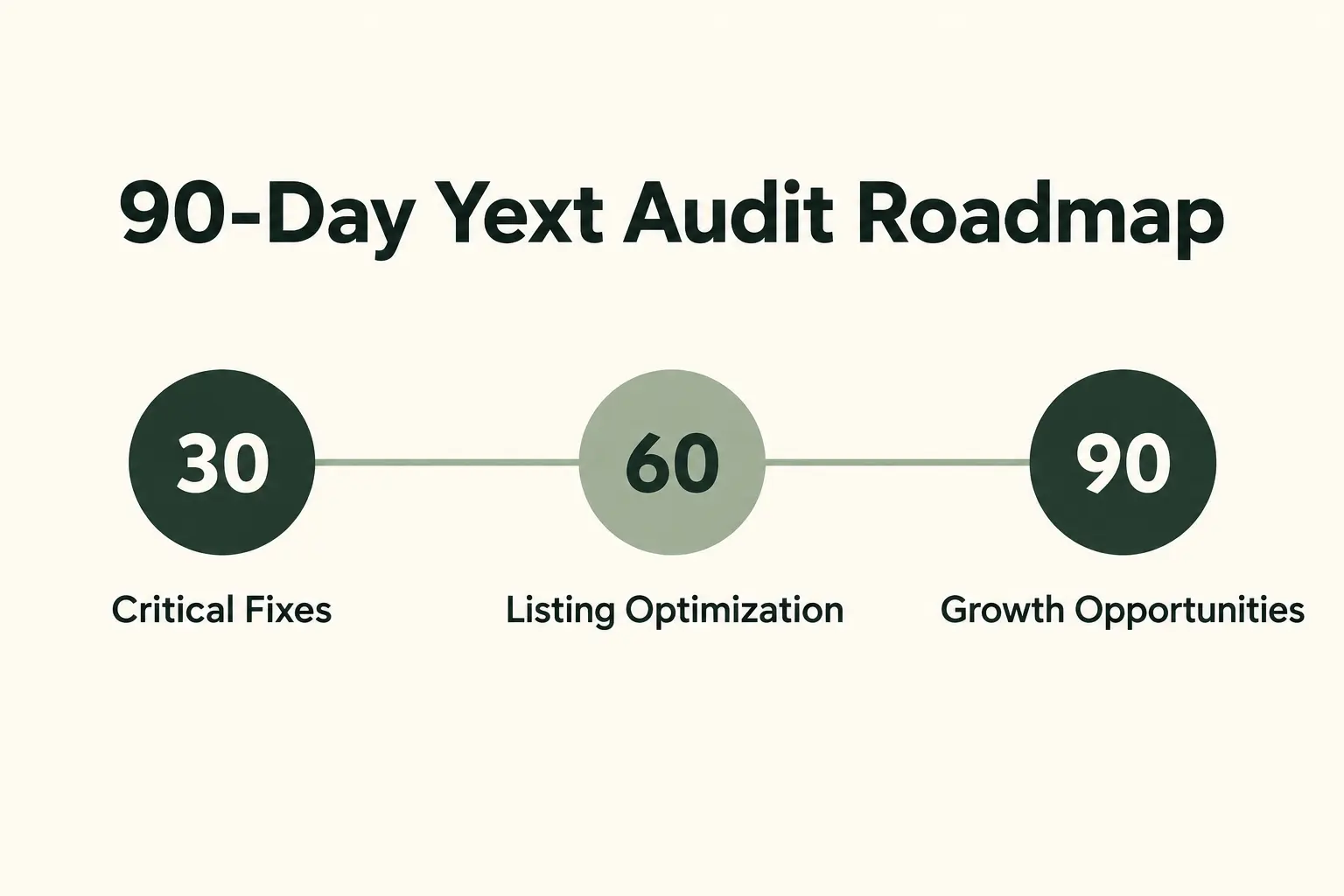
Trying to fix every issue at once stalls progress. Regular audits are necessary to maintain listing accuracy and local SEO effectiveness, and regular audits help maintain local search rankings over time. Prioritization turns your audit findings into an actionable plan.
Group tasks into three tiers:
- Critical fixes (Days 1 to 30): NAP conflicts, wrong website URLs, severe category errors, broken links, incorrect hours. These are the items that actively harm your online visibility right now.
- Important optimizations (Days 30 to 60): High quality photos, enriched business descriptions, missing attributes, meta descriptions on location pages, mobile optimization for mobile friendly websites that load fast on any mobile device. Check mobile load times and ensure pages render correctly under mobile first indexing.
- Growth projects (Days 60 to 90): Local content creation, local link building outreach, review generation programs, and testing whether Google Ads campaigns perform better with cleaner listing data.
Assign owners, deadlines, and status flags to each task using a spreadsheet or project management tool. Arc4 offers structured 30-60-90 day implementation plans refined based on analytics feedback, not guesswork. With 46% of Google searches being local, the compound effect of systematic fixes over 90 days creates a local SEO strategy that compounds rather than stalls.
Step 13: When To Partner With Arc4 For A Professional Yext Listing Audit
Some teams can handle basic Yext maintenance, but complex situations demand experienced local SEO partners, which is why many brands research how to find the right Yext partner. Most businesses underestimate the depth of a proper audit, and the difference between a listing that sits idle and one that converts is the quality of the work behind it.
Scenarios where Arc4 is clearly the best choice:
- Businesses with multiple locations and overlapping service areas
- Rebrands, mergers, or business name changes with legacy NAP data scattered across dozens of local directories
- Long-standing NAP inconsistencies that have accumulated over years
- Low review volumes or unmanaged reputation signals
- Rapid expansion or significant changes in service offerings during 2026
The typical Arc4 Yext audit process includes data export and gap analysis, implementation of fixes, review management setup, and a local link building plan as part of its broader managed Yext services for multi-location brands. Key deliverables include:
- Detailed issues report with severity rankings
- Prioritized roadmap with 30-60-90 day milestones
- Analytics and conversion tracking setup
- Media guidelines and optimized imagery rollout
- Follow-up measurement reports at 60 and 120 days
In a multi-location wellness case study, standardized NAP plus GBP optimization plus schema plus citations drove +385% organic traffic, +580% GBP engagements, and +128% bookings over eight months. These are the kinds of results that become possible when Yext data is treated as the foundation of a broader local SEO strategy, not just a directory sync tool.
Contact Arc4 to schedule a Yext-focused local SEO audit and unlock better local visibility, more calls, and higher conversions from local search.
Frequent Questions
The questions below address common Yext and local SEO concerns not fully covered in the steps above. Each answer focuses on practical details to help you decide when to handle tasks yourself and when to bring in Arc4, complementing the more detailed Yext services FAQs available separately.
How often should a local business audit its Yext listings?
A full Yext audit is recommended at least once per year, with lighter quarterly checks for hours, NAP changes, and new features rolled out by platforms like Google Business Profile. Businesses undergoing rebrands, location moves, or rapid expansion in 2025 and 2026 should schedule an extra audit around each major change. Arc4 typically performs an initial deep audit, then sets a recurring review cadence tailored to the client’s growth pace so nothing slips through the cracks.
Can I rely on Yext alone for local SEO without touching my website?
Yext is powerful for managing listings and local directories, but it cannot replace on-site local SEO, high-quality local content, or technical factors like local schema markup. Search engines still heavily rely on the website to understand services, expertise, and local relevance. The best results come when Yext data and the website reinforce each other through an integrated plan, which is exactly how Arc4 structures every engagement.
What are the quickest Yext fixes that usually move the needle for local search?
The fastest wins often include correcting NAP inconsistencies, fixing wrong URLs, tightening primary and secondary categories, and updating hours and business descriptions. Adding high quality, recent photos and a few missing attributes usually improves click-through rates from Google Maps within a few weeks. Arc4 prioritizes these quick wins in the first 30 days so clients see early impact while deeper work on local content and link building continues in the background.
Do I need local keyword research just to update Yext listings?
Even basic Yext edits benefit from local keyword research so categories, descriptions, and services match how people actually search in that city or region. For instance, choosing between “roofing contractor” and “roof repair” or adding neighborhood names that show up in search queries can make a real difference. Arc4 includes local keyword research in its Yext audit packages, tying it to both listings and on-site local content planning for maximum coverage of your digital presence.
How can I measure the ROI of a Yext listing audit?
Compare pre- and post-audit metrics like calls, direction requests, website clicks, and local organic conversions using Google Analytics 4 and Google Business Profile Insights. Adding UTM parameters and call tracking helps attribute leads to specific listings and local directories touched by Yext. Arc4 delivers before-and-after performance reports that connect Yext cleanup work to revenue impact, making ROI easier to quantify for stakeholders and justifying continued investment in your local presence.