
SEO Pricing in 2026: What SEO Really Costs
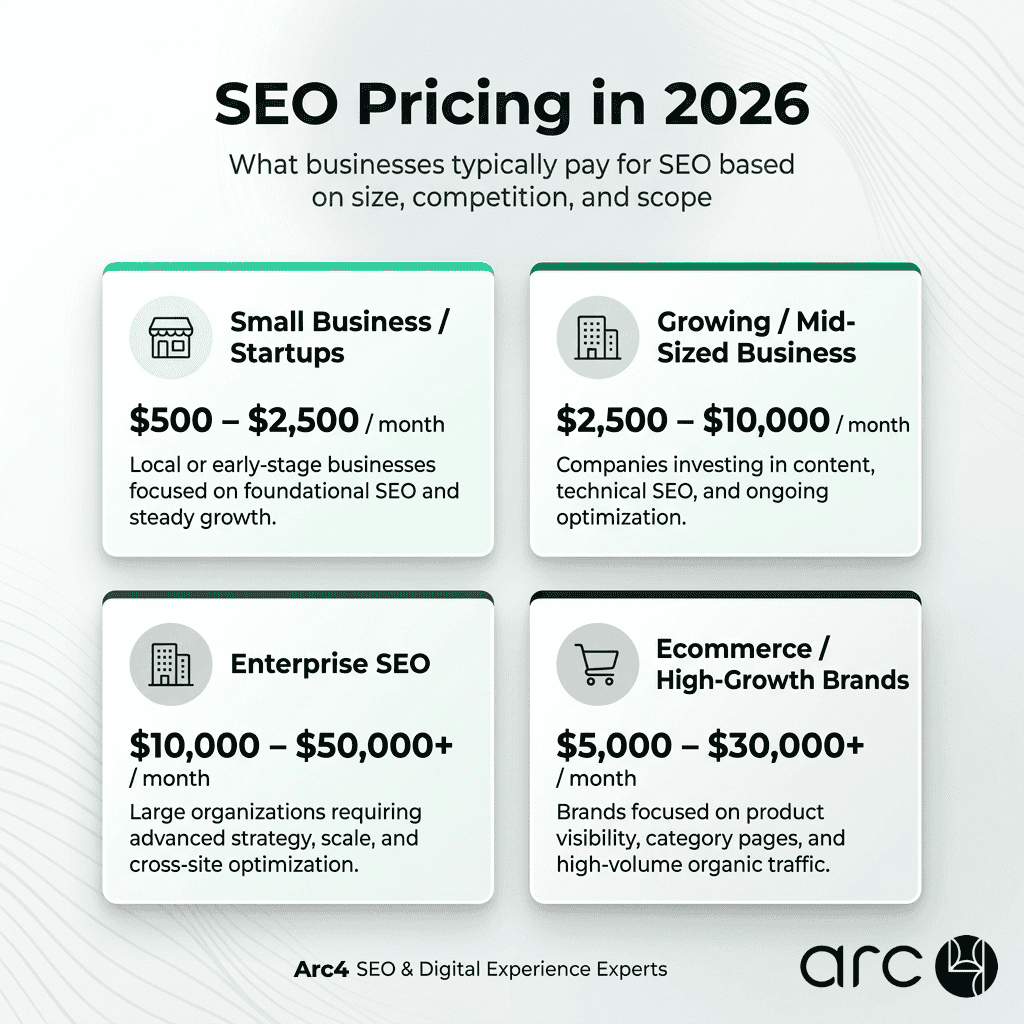
If you’re trying to figure out how much SEO costs in 2026, you’ve probably noticed the frustrating range of answers floating around. Some agencies quote $500 per month. Others want $10,000. And somewhere out there, someone is promising first-page rankings for $99. So what is the ideal sweet spot?
The truth is that search engine optimization pricing depends heavily on your business size, competition level, and what you’re actually trying to accomplish. This SEO pricing guide breaks down real 2026 costs across every pricing model, business type, and service level, so you can set a realistic budget and avoid the common traps that waste money or, worse, get your site penalized. It is most relevant for service-based businesses, multi-location brands, and marketing teams using SEO as a revenue channel tend to see the strongest ROI from structured, ongoing SEO programs.
Quick Answer: How Much Does SEO Cost in 2026?
In 2026, most businesses in the US and UK pay between $1,500 and $10,000 per month for professional SEO services that actually move the needle. That’s the practical middle ground where real strategy, content, and link building happen.
But that range doesn’t tell the whole story. Small businesses focused on local SEO typically spend $500–$2,000/month – for a full breakdown see our local SEO pricing guide. Companies targeting national or competitive markets budget $2,500–$10,000+/month. Enterprise organizations and brands in high-competition verticals like legal, finance, or SaaS often invest $10,000–$20,000+/month to compete effectively. In most cases, the pricing gap reflects execution complexity and scale, not tools or “secret tactics.”
For hourly SEO consulting, expect $75–$250/hour in North America, with specialized enterprise consultants charging $250–$400+/hour. Project-based work, like technical SEO audits, site migrations, or full overhauls, typically runs $3,000–$30,000+ depending on complexity.
Here’s what those price points actually mean:
| Price Range | What You Typically Get |
| Under $500/month | Basic “checkbox SEO”, often just automated reports and minimal work |
| $500–$1,500/month | Entry-level agency work: local SEO, basic content, light optimization |
| $1,500–$5,000/month | Solid mid-range: strategy, regular content, technical fixes, some link building |
| $5,000–$20,000+/month | Premium agencies: dedicated strategists, robust content programs, digital PR |
Spending under $500/month in 2026 for “full-service SEO” in competitive US or UK markets typically covers little more than overhead and automated tools, not the strategic work that drives organic traffic growth.

SEO Pricing at a Glance (2026 Benchmarks)
Before diving into the details, here’s a consolidated view of where SEO pricing stands in 2026. These ranges come from aggregated industry data and reflect what agencies and consultants are actually charging across different markets.
| Pricing Type | 2026 Range | Notes |
| Monthly retainer (small business) | $500–$2,000/month | Local SEO, basic content, GBP optimization |
| Monthly retainer (mid-market) | $2,500–$7,500/month | National campaigns, content + links |
| Monthly retainer (enterprise) | $10,000–$50,000+/month | Multi-location, international, competitive industries |
| Hourly consulting | $75–$250/hour | Strategy, training, ad-hoc troubleshooting |
| Project-based (audit) | $2,000–$15,000 | Varies by site size and complexity |
| Project-based (migration) | $5,000–$30,000+ | Platform moves, HTTPS, redesigns |
| AI/SGE optimization | $2,000–$7,500/month | Entity SEO, structured data, GEO tactics |
A practical example: A B2B SaaS company targeting all of North America typically budgets $6,000–$15,000/month for SEO in 2026, covering strategy, content production, technical optimization, and link acquisition.
A few important notes on these benchmarks:
- Prices skew 20–40% higher in major metros like New York, London, and Sydney compared with smaller cities
- These are median ranges, outliers exist on both ends
- Contract length often affects pricing (12-month commitments sometimes reduce monthly rates by 10–15%)
- The same scope from a specialist agency often costs more than from a generalist, but typically delivers better results
Key Factors That Determine SEO Pricing
SEO cost isn’t pulled from a standard price list. It’s driven by workload, risk, and the expertise required to compete in your specific market. Understanding what factors determine SEO pricing helps you evaluate whether a quote is reasonable or out of line.
Here are the primary cost drivers:
Competition Level
The more competitive your industry and keywords, the more effort required to rank. Personal injury law in New York is a completely different SEO challenge than a local pet groomer in Boise. Highly competitive verticals require more content, stronger link profiles, and deeper technical optimization, all of which increase costs.
Geography and Target Market Size
A single-city local campaign is simpler than a multi-state or international SEO strategy. Targeting “plumber Seattle” requires far less infrastructure than ranking for commercial keywords across 50 states or building a multi-language presence across Europe.
Website Size and Current State
Optimizing a clean 50-page site is straightforward. Fixing a 10-year-old, 5,000-page site with technical debt, broken links, duplicate content, and legacy platform issues takes significantly more work. Many agencies will conduct an initial audit and adjust pricing based on what they find.
Goals and Timeline
Steady, compounding growth over 12–18 months costs less than aggressive growth in 3–6 months. Accelerated timelines require more resources, faster content production, and often a more intensive link building campaign.
Required Activities and Channels
The scope of services matters enormously. A basic local SEO package with Google Business Profile optimization and citations costs far less than a comprehensive SEO campaign including:
- Technical optimization and ongoing dev collaboration
- Content strategy and production at scale
- Digital PR and link building
- Page optimization across hundreds of URLs
- GEO, AI search and local service SEO visibility work
Team Composition
Who actually works on your account affects pricing. Senior strategists command higher rates than junior implementers. Some agencies use experienced SEO professionals on strategy while offshore teams handle execution, which can reduce costs but sometimes affects quality.
Industry Regulation and Compliance
More regulated verticals like legal, finance, health, and insurance require higher standards for content quality, E-E-A-T compliance, and fact-checking. This expertise costs more.
Emergency and Recovery Work
“Emergency” SEO in 2026, penalty recovery, botched migration fixes, algorithmic crash diagnosis, is often priced at a premium due to urgency and risk. Undoing damage from previous cheap SEO providers can cost more than doing it right from the start.
SEO Pricing Models Explained
Most SEO agencies in 2026 blend multiple pricing models rather than using just one. You might pay a monthly retainer for ongoing work, a project fee for an initial audit, and hourly rates for ad-hoc consulting. But agencies typically lead with one primary structure based on their business model and your needs.
Understanding the main SEO pricing models helps you compare proposals intelligently and choose the structure that fits your situation.
Monthly Retainer SEO Pricing
Monthly retainers remain the dominant model in 2026 for ongoing SEO work. You pay a fixed fee each month for an agreed-upon set of services, and the work compounds over time.
Typical 2026 retainer ranges:
| Business Type | Monthly Range |
| Local/small business | $500–$2,000/month |
| Regional/national campaigns | $2,500–$7,500/month |
| Enterprise and competitive industries | $8,000–$50,000+/month |
What a typical retainer includes:
- SEO strategy and planning
- Keyword research and content mapping
- On page SEO and technical optimization
- Content production (varies by tier)
- Off page SEO and link acquisition
- Monthly reporting and strategy calls
Most agencies in 2026 require minimum commitment lengths of 6–12 months, often with 30–60 day exit clauses after the initial term. This makes sense given SEO’s long-term nature, meaningful results take months to materialize.
Retainers work best when you want compounding gains, predictable costs, and an ongoing partnership rather than a one-time fix.
Project-Based SEO Pricing
Project-based SEO pricing is a fixed fee for a defined scope and timeline. Unlike retainers, projects have clear start and end points.
Common 2026 project types and ranges:
| Project Type | Price Range |
| Technical SEO audit | $2,000–$15,000 |
| Website migration/replatforming | $5,000–$30,000+ |
| On-page optimization sprint (50–100 pages) | $3,000–$12,000 |
| International SEO setup | $5,000–$25,000 |
| Local SEO kickstart (new business) | $1,500–$5,000 |
Project-based work fits businesses that want an expert setup before handling ongoing SEO in-house, or those tackling a specific milestone like a site redesign or platform change.
Many SEO projects lead into ongoing retainers. An agency might conduct an audit and roadmap as a project, then transition to monthly SEO services for implementation.
Hourly SEO Rates
Hourly SEO pricing is common for consulting, training, or ad-hoc tasks rather than full campaigns.
2026 hourly rate bands:
| Consultant Level | Hourly Rate |
| Junior consultants/smaller markets | $75–$125/hour |
| Experienced strategists in major markets | $150–$250/hour |
| Enterprise/specialized experts | $250–$400+/hour |
Typical use cases for hourly SEO:
- Strategy reviews and second opinions
- In-house team coaching and training
- Content brief creation systems
- One-off technical troubleshooting
- Audit reviews and prioritization
Hourly billing offers flexibility but can become expensive or unpredictable for large, ongoing needs. It works well when you need expert guidance without committing to a full retainer.
Performance-Based and Hybrid Pricing
Performance-based SEO ties some or all compensation to specific outcomes, ranking improvements, organic traffic growth, or lead generation.
In 2026, pure “pay only for rankings” models are rare. They create problematic incentives (focusing on easy-to-rank but low-value keywords) and depend on factors outside the SEO provider’s control. However, hybrid models exist:
- Base retainer + performance bonuses for traffic milestones
- Revenue share for ecommerce clients
- Tiered pricing based on lead volume from organic search
A word of caution: Extremely aggressive performance contracts can push agencies toward short-term or spammy tactics. If an SEO agency promises guaranteed rankings with no base fee, be skeptical.
When considering performance-based pricing, insist on clear KPIs tied to business outcomes, qualified leads, revenue, or organic conversions, rather than vanity metrics like raw traffic or rankings for low-value keywords.
How Much Does SEO Cost by Business Type and Size?
SEO spend typically scales with company size, deal value, and growth targets. A local service business has very different needs and budget capacity than a nationwide ecommerce brand or enterprise SaaS company.
Here’s how SEO costs break down by business type in 2026.
Small Business and Local SEO Pricing
For this breakdown, “small business” means roughly under 25 employees or under $5M annual revenue, typically local service businesses, retail shops, professional practices, and similar.
Realistic pricing ranges for small businesses:
| Approach | Monthly Cost |
| DIY + light consulting | $300–$800/month (tools + occasional expert help) |
| Entry-level agency/local SEO package | $500–$1,500/month |
| Aggressive local SEO (multi-location, competitive city) | $1,500–$3,000+/month |
Typical inclusions at these price points:
- Google Business Profile optimization and management
- Local citations and directory management
- A few new content pieces per month (blog posts, service pages)
- Basic link outreach and local digital PR
- Monthly reporting on local rankings and traffic
Timeline expectations: Most small businesses see early movement in local search results within 3–6 months, with strong local dominance taking 6–12 months of consistent work.
The local SEO cost for a single-location business in a moderately competitive market typically falls in the $800–$1,500/month range when working with an established agency.
Mid-Market and National SEO Pricing
Mid-market companies have established revenue streams and target multi-city, regional, or national audiences. They typically have marketing teams in place but need specialized SEO expertise.
2026 pricing ranges for mid-market:
| Scope | Monthly Range |
| Core SEO retainer | $3,000–$12,000/month |
| SEO + content marketing combined | $6,000–$20,000/month |
| Aggressive growth programs | $10,000–$25,000/month |
Typical components at this level:
- Dedicated SEO strategist and account manager
- Content strategy at scale (8–20+ pieces per month)
- Technical SEO for larger, more complex sites
- Digital PR and link building campaigns
- CRO support and landing page optimization
- Regular reporting to marketing leadership
These businesses often see meaningful ROI within 6–12 months if their sales cycles aren’t extremely long. The investment makes sense when organic search represents a significant revenue channel.
Enterprise and High-Competition SEO Pricing
Enterprise organizations compete nationally or internationally against major competitors with deep pockets and established organic presence.
2026 enterprise pricing expectations:
| Program Type | Monthly Investment |
| Standard enterprise retainer | $15,000–$50,000/month |
| Large content and digital PR programs | $20,000–$60,000/month |
| Global multi-language SEO | $50,000–$100,000+/month |
What enterprise SEO includes:
- Dedicated cross-functional teams (strategists, content, technical, analytics)
- Regular C-level reporting and executive dashboards
- Experimentation programs (A/B testing SEO changes)
- GEO and AI visibility initiatives
- Coordination with product, engineering, and brand teams
- Multi-market and multi-language optimization
ROI assessments at this level must factor in long sales cycles, brand impact, and assisted conversions, not just last-click attribution. Many SEO agencies working with enterprise clients use custom SEO pricing based on specific requirements rather than standard packages.
Service-Level Breakdown: What You Get at Different Price Points
Price bands in SEO generally map to service depth, resource allocation, and senior strategist involvement. Here’s what you can realistically expect at different monthly investment levels.
| Monthly Spend | Typical Service Level |
| Under $500 | Automated reports, basic on-page tweaks, template content, minimal strategic work. Mostly maintenance-level impact, with limited movement in rankings and minimal change in lead volume. |
| $500–$1,500 | Entry-level agency: local SEO, 2–4 content pieces/month, basic technical fixes, light outreach. Modest lift in local visibility and inbound leads, typically best for smaller markets and single-location pipeline support. |
| $1,500–$5,000 | Mid-tier agency: dedicated strategist time (2–5 hours/month), 4–8 content pieces, technical optimization, active link building.Consistent lead growth and measurable pipeline impact as content, technical work, and links begin compounding. |
| $5,000–$10,000 | Premium agency: senior strategist oversight, 8–15+ content pieces, robust digital PR, regular strategy calls. Meaningful revenue contribution as you expand topical authority, win competitive terms, and improve conversion rates across the funnel. |
| $10,000+ | Enterprise-level: cross-functional team, custom content programs, dedicated resources, executive reporting. Enterprise-grade revenue channel development with predictable pipeline influence across locations, products, or segments and stronger reporting for forecasting. |
Key differences between tiers:
- Senior strategist time: Cheaper packages often use junior staff or templates; premium includes experienced SEO professionals
- Content volume and quality: Low-end means 1–2 generic posts; high-end means strategic, high quality content tailored to search intent
- Link building intensity: Entry-level relies on basic outreach; premium includes digital PR, HARO, and relationship-based acquisition
- Reporting sophistication: Basic monthly PDF vs. interactive dashboards with revenue attribution
When evaluating proposals, ask specifically about what’s included, hours of strategist time, content deliverables, technical work scope, and link building methods. Typical SEO packages at the $2,000–$5,000/month level should include a clear breakdown of monthly activities.
Red Flags in Cheap SEO Pricing
In 2026, spammy or automated tactics can quickly trigger algorithm penalties and waste your entire budget, or worse, cause lasting damage to your site’s reputation with search engines.
Watch for these red flags when evaluating SEO companies:
- Guaranteed #1 rankings or fixed traffic numbers in 30–60 days No legitimate SEO provider can guarantee specific rankings. Search engine algorithms change constantly, and rankings depend on competitor actions and hundreds of ranking factors outside anyone’s control.
- Extremely low pricing for “full-service SEO” If someone offers $99–$199/month for comprehensive SEO in competitive markets, the math doesn’t work. That barely covers overhead, let alone skilled SEO professionals doing meaningful work.
- Vague scope with no clear deliverables Legitimate agencies specify exactly what you’ll receive each month, hours of work, content pieces, technical fixes, outreach activities. Vague promises of “optimization” without specifics are a warning sign.
- Heavy reliance on PBNs or link schemes Private blog networks (PBNs) and paid link farms violate Google’s guidelines. Short-term gains from these tactics often end in penalties that wipe out organic traffic entirely.
- No access to reports or refusal to share methods If an SEO service provider won’t show you what they’re doing or refuses access to analytics and reporting, something is wrong.
- They register accounts in their name, not yours Legitimate providers set up Google Analytics, Search Console, and content management accounts in your name. If they own your accounts, you lose everything when the relationship ends.
- Promises of “secret” or proprietary methods Effective SEO follows well-documented best practices. Agencies claiming secret techniques are often hiding low-quality or risky tactics.
- No case studies or references from the past 2–3 years Search engine results pages have changed dramatically. Ask for recent examples, not results from 2018.
A real-world example: Many sites that relied on cheap link schemes in 2023–2024 saw their traffic disappear overnight when Google’s spam updates rolled out. Undoing that damage with penalty recovery work often costs more than doing SEO correctly from the start.
Is SEO Worth the Price? Understanding ROI in 2026
Yes, it is. SEO is a long-term asset, not a quick-win channel like paid search. You’re building sustainable organic rankings that generate traffic month after month without per-click costs.
How to think about SEO ROI:
- Map organic traffic to business outcomes , Track how many leads, sales, or conversions come from organic search, not just traffic volume
- Consider customer lifetime value , A $10,000/month SEO investment that brings 20 customers worth $3,000 each in lifetime value is highly profitable
- Factor in payback periods , Most SEO campaigns take 6–18 months to show strong ROI; plan accordingly
- Account for AI search changes , Google AI Overviews and other generative features affect click-through rates; your SEO strategy should address visibility in these formats
A concrete ROI example:
A home services business invests $2,000/month in monthly SEO services for 12 months ($24,000 total investment). After month 6, they’re generating 40 extra booked jobs per month from organic search at an average profit of $300 per job. That’s $12,000/month in incremental profit, a 500%+ ROI on their SEO spend.
No SEO agency can guarantee these results because search engine algorithms and competitors change continuously. But with proper tracking, you can measure whether your SEO efforts are driving business results.
Key metrics to track:
- Organic sessions and engagement metrics
- Qualified leads from organic traffic
- Revenue attributed to organic search
- Branded vs. non-branded search performance
- Position changes for target keywords
Local vs National SEO Pricing
Local SEO focuses on visibility in Maps, local packs, and city-based queries. National SEO targets broader keyword sets without geographic limitations.
Clear pricing differences:
| SEO Type | Monthly Range | Primary Activities |
| Local SEO | $500–$2,500/month per location | GBP optimization, citations, reviews, local content |
| National SEO | $2,500–$10,000+/month | Broader keyword targeting, scaled content, extensive link building |
Cost drivers unique to local SEO:
- Number of physical locations: Multi-location businesses pay per location or a scaled rate for portfolio management
- Directory management: Citation building and NAP consistency across dozens of directories
- Review generation: Strategies to encourage and manage customer reviews
- Localized content: Service area pages, local blog content, community-focused pieces
National SEO requires more content volume, deeper link acquisition through digital PR, and often technical work for large catalogs or content hubs that local businesses don’t need.
Comparison example:
A local HVAC contractor in Austin might pay $1,200/month for local SEO, GBP optimization, local citations, a few blog posts, and review management. A nationwide HVAC filter subscription brand targeting commercial keywords across 50 states might invest $8,000–$15,000/month on keyword research at scale, extensive content production, and national link building campaigns.
How AI and GEO (Generative Engine Optimization) Impact SEO Pricing
The 2024–2026 shift toward AI Overviews and answer engines is changing what SEO deliverables look like, and affecting SEO service costs accordingly.
Many experienced SEO agencies now bundle GEO (Generative Engine Optimization) tactics into their standard retainers rather than offering them separately. Others position AI search optimization as a premium add-on.
Specific activities that add cost:
- Schema markup and structured data optimization , Making content machine-readable for AI summaries
- Entity-based SEO , Optimizing for knowledge graph presence and establishing topical authority
- Answer-focused content creation , Structuring content for AI-generated results and featured snippets
- Ongoing testing and monitoring , Tracking how pages appear in AI-generated search results and adjusting
2026 pricing for AI-related SEO services:
| Service | Typical Range |
| AI-optimized content strategies | $3,000–$7,500/month |
| SGE/AI Overviews optimization project | $2,000–$5,000 per project |
| Chatbot and voice search optimization | $1,500–$3,500/month |
| Entity SEO and knowledge graph work | $2,500–$6,000/month |
Packages including GEO and AI search optimization typically sit at the higher end of pricing bands because they require strategic experimentation and specialized expertise.
For context: most SEO professionals now use AI-assisted SEO tools for research, content drafting, and analysis. This has increased productivity but also raised the bar for what “good” SEO looks like. Traditional SEO focused purely on 10 blue links is giving way to broader search presence optimization.
DIY SEO vs Hiring an Agency: Cost Comparison
DIY SEO isn’t “free.” It comes with real costs in time, tools, training, and opportunity cost. Understanding the true cost of SEO helps you make an informed decision about building an in house SEO team versus outsourcing.
Typical DIY cost elements in 2026:
| Cost Category | Monthly Range |
| SEO tools (Ahrefs, Semrush, Surfer, etc.) | $100–$500/month |
| Content production (freelance writers) | $500–$2,000/month for 4–8 quality pieces |
| Training and courses | $100–$300/month averaged |
| Staff time (internal employee hours) | Varies significantly |
If you have a marketing person spending 15 hours/week on SEO at $40/hour loaded cost, that’s $2,400/month in labor alone, before tools or content.
Agency comparison:
A typical mid-range agency retainer of $2,500–$5,000/month includes strategy, content, technical work, and reporting. You get access to multiple specialists without hiring separate employees.
The hidden costs of DIY:
- Learning curve and mistakes while figuring out the SEO process
- Slower results due to part-time attention
- Missing advanced technical optimization that requires specialized skills
- Opportunity cost of what else that employee could be doing
When DIY makes sense:
- Very small businesses with simple local SEO needs
- Businesses with existing SEO expertise in-house
- Supplementing agency work with internal content production
Hybrid models work well for many companies: An in-house marketing lead handles day-to-day content and basic optimization while an SEO consultant or agency provides strategy, technical audits, and specialized link building. This often costs less than a full agency retainer while still accessing expert guidance.
How to Set Your SEO Budget in 2026
Rather than picking a number arbitrarily, use a structured approach to determine what you should invest in your SEO campaign.
Step 1: Define clear goals
What does success look like? Specific goals might be:
- Generate 50 qualified leads per month from organic search
- Achieve $500,000 in annual organic revenue
- Rank on page 1 for 20 target keywords in 12 months
Step 2: Understand your baseline
Before investing, know where you stand:
- Current organic traffic and trends
- Existing rankings for target keywords
- Conversion rate from organic visitors
- Revenue or leads currently attributed to organic
Step 3: Benchmark competitors
Use SEO tools to estimate competitor visibility and likely spend:
- Which competitors rank for your target keywords?
- What does their content and link profile look like?
- What would it take to compete with them?
Step 4: Decide on timeline
- Conservative (12–24 months): Lower monthly investment, steady compounding
- Aggressive (6–12 months): Higher monthly investment, faster content and link velocity
Step 5: Work backward from revenue goals
A simple calculation: If you want $500,000 in annual organic revenue, and your average customer is worth $5,000, you need 100 customers from organic search. If your organic conversion rate is 2%, you need 5,000 organic visitors. What does it cost to build and maintain that traffic level?
Step 6: Allocate within your marketing budget
Many companies invest 10–20% of their total marketing budget into SEO when organic is a primary channel. For a company with a $20,000/month marketing budget, that’s $2,000–$4,000/month for SEO.
Leave room for flexibility , Set aside 10–20% of your SEO budget for testing and unexpected needs like site fixes, algorithm recovery, or content opportunities that emerge mid-year.
Questions to Ask Before You Sign an SEO Contract
Before committing to an SEO service provider, ask these questions to evaluate fit, transparency, and value:
- What specific activities will you perform each month, and who will do them? Get clarity on deliverables and whether work is done in-house or outsourced.
- How do you report on performance, and which metrics will we track? Look for alignment between their KPIs and your business outcomes.
- What happens if we need to adjust scope mid-contract? Understand flexibility for adding or reducing services.
- Can you share anonymized case studies from 2023–2024 in our industry or a similar one? Recent results matter more than testimonials from 5 years ago.
- Which parts of the work are done in-house vs. outsourced? Know who’s actually working on your account.
- How do you approach link building and digital PR in 2026? Ensure they avoid PBNs, paid links, and other risky tactics.
- How do you account for AI search and GEO in your strategy? Modern SEO strategy should address AI Overviews and generative search.
- Who owns the content, accounts, and data at the end of the contract? You should own everything, analytics, Search Console, content, rankings.
- What does your onboarding process look like? Professional agencies have structured kickoffs, not vague promises.
- How long before we should expect to see results? Honest answers are 3–6 months for early movement, 6–12 months for meaningful results.
Compare at least 2–3 proposals not just on price, but on clarity, transparency, and strategic depth. The cheapest option rarely provides the best value.
Summary: How to Choose the Right SEO Pricing for Your Business
Navigating SEO services pricing in 2026 comes down to matching your investment to your goals, competition, and capacity. Here’s what to remember:
Realistic 2026 price ranges:
- Small local businesses: $500–$2,000/month
- Growing national brands: $2,500–$10,000/month
- Enterprise and high-competition: $10,000–$50,000+/month
Key principles for choosing wisely:
- Ultra-cheap SEO is almost always a red flag, real results require real investment
- ROI-focused SEO needs adequate budget, time (6–12+ months), and proper measurement
- The “right” price aligns with your goals, competitive reality, and what you can execute on internally
- Monthly retainers work for compounding growth; one time project pricing works for specific milestones
- Hybrid models (in-house lead + agency specialists) often provide the best balance of cost and expertise
What to do next:
Get custom quotes from 2–3 agencies or consultants rather than relying solely on averages. Demand transparency on deliverables, methods, and expected outcomes. Ask for recent case studies and references.
Your SEO plan for 2026 should treat organic search as a core growth channel, not an afterthought or checkbox. With the right investment, the right partner, and realistic timelines, SEO remains one of the highest-ROI digital marketing services available. The businesses that invest strategically now will compound their organic rankings and traffic advantage for years to come.
If you are budgeting for SEO in 2026 for a multi-location, enterprise, franchise, or service-based brand, Arc4 can help you scope the work, prioritize the initiatives that will drive revenue, and execute consistently across locations and service areas. Reach out to Arc4 to request a consultation and build an SEO roadmap that matches your goals, resources, and timeline.