
AEO vs GEO: Which AI Search Optimization Strategy Is Right for Your Business in 2026?
Businesses investing in AI search optimization face a critical choice: should you focus on Answer Engine Optimization (AEO) or Generative Engine Optimization (GEO)? Both strategies compete for the same goal, making your content visible when users ask questions online, but they operate through fundamentally different mechanisms.
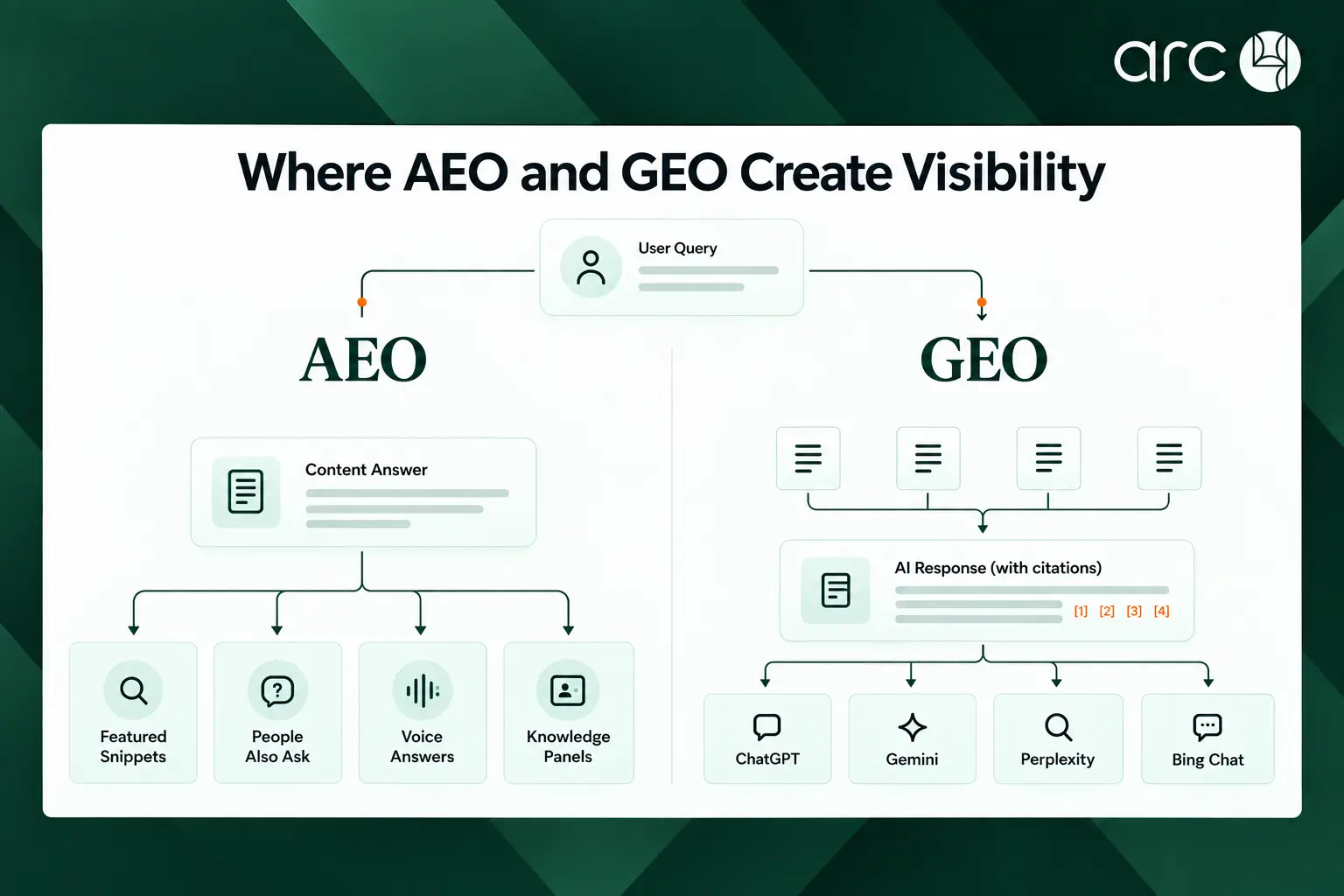
AEO ensures content is clear for direct answers extracted by search engines. GEO enables content to be referenced in AI-generated responses synthesized across multiple sources. The single biggest difference comes down to extraction vs. synthesis: AEO targets featured snippets, voice assistants, and answer boxes where your content is pulled verbatim, while GEO targets large language models like ChatGPT, Gemini, and Perplexity where your content is woven into AI generated answers.
This comparison breaks down every factor that matters, from content format and implementation timelines to ROI and platform coverage, so you can make a confident decision. AEO and GEO represent distinct strategies for digital visibility, and choosing the right one (or combining both) depends on your goals, resources, and timeline.
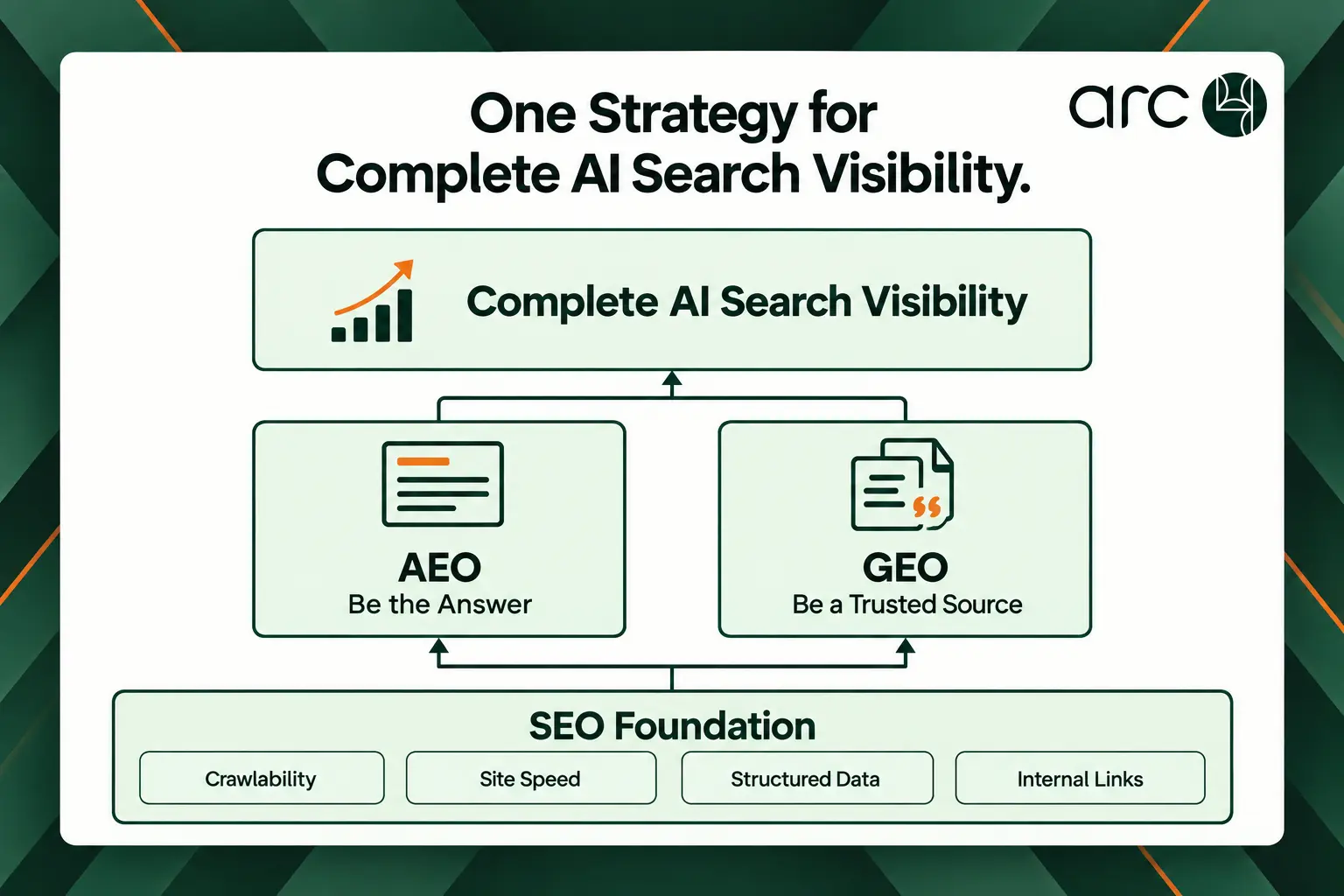
The short answer: Most businesses should implement both AEO and GEO as one unified strategy. AEO delivers faster wins through snippet capture and zero-click visibility, while GEO builds lasting authority across AI platforms. If you must prioritize, start with AEO for immediate search results impact, then layer in GEO for long-term brand visibility in AI generated responses. Arc4 specializes in integrating both approaches into a single framework that covers every AI search surface.
What Is AEO (Answer Engine Optimization)?
Answer engine optimization is the practice of structuring content so that answer engines, including Google, Siri, Alexa, and Google Assistant, can extract and display direct answers to user queries. AEO focuses on structured answers for search engines, targeting featured snippets, People Also Ask panels, knowledge panels, and voice search responses.
AEO’s defining strengths include:
- Immediate visibility. Optimized content can appear in featured snippets and answer boxes within 2 to 4 weeks of implementation.
- Zero-click optimization. AEO aims for snippet capture, putting your brand front and center even when users never click through to your site.
- Structured content approach. AEO strategies include using schema markup for clarity, including FAQ, HowTo, and QAPage structured data that help search engines understand your content.
- Voice search readiness. Concise answers of 15 to 30 words tend to be favored by voice assistants reading results aloud.
Arc4 brings deep expertise in AEO implementation, helping businesses structure existing content for maximum extractability across all answer engines and traditional search engines alike through its broad suite of digital and AI-powered search services.
What Is GEO (Generative Engine Optimization)?
Generative engine optimization targets AI systems like ChatGPT, Gemini, Perplexity, and Bing Chat, optimizing content so these platforms cite, reference, and synthesize it when generating responses.
Unlike traditional SEO or AEO, GEO prioritizes content that is credible and authoritative enough to be woven into synthesized answers across multiple AI platforms. GEO emphasizes brand reputation and multi-source synthesis rather than single-snippet extraction.
GEO’s defining strengths include:
- Authority building. GEO content must provide original research and unique data, positioning your brand as a trusted source that AI models reference repeatedly.
- Multi-platform presence. Being cited across ChatGPT, Gemini, Claude, and Perplexity simultaneously multiplies brand visibility in ways traditional search cannot.
- Long-term compound effects. As AI crawlers re-index and models retrain, authoritative content accumulates citation momentum over time.
- Depth advantage. Comprehensive, well-referenced content performs better in generative engines that synthesize information from multiple sources.
Arc4’s advanced GEO methodologies help businesses build the topical depth, external validation, and entity clarity required to gain visibility within generative AI responses, aligning closely with its enterprise SEO services for AI-driven search.
AEO vs GEO: How They Compare at a Glance
Factor | AEO (Answer Engine Optimization) | GEO (Generative Engine Optimization) |
Best for | Businesses needing immediate visibility, FAQ-heavy sites, voice search traffic | Brands building long-term authority, niche expertise, AI-native audiences |
Primary Goal | Provide extractable, concise answers for snippets and voice responses | Become a cited source when AI platforms generate answers |
Target Systems | Google featured snippets, PAA, voice assistants, Google AI Overviews, answer boxes | ChatGPT, Gemini, Perplexity, Bing Chat, enterprise AI tools |
Content Format | Short paragraphs, FAQs, bullet points, schema markup, answer-first formatting | Long-form guides, original data, case studies, comprehensive references |
Timeline for Results | 2 to 4 weeks for snippet visibility | 3 to 6 months for meaningful citation frequency |
Measurement Approach | Snippet ownership, voice answer captures, direct response rates | Citation frequency in AI responses, share of voice across AI platforms |
Target Systems and Platforms
The platforms each strategy targets should directly influence your prioritization. If your audience primarily uses traditional search engines, AEO deserves more weight. If your customers increasingly rely on AI tools for research and decision-making, GEO becomes critical.
AEO targets the established ecosystem of answer engines:
- Google featured snippets and People Also Ask sections
- Voice assistants including Amazon Alexa, Apple Siri, and Google Assistant
- Google AI Overviews, which display AI generated summaries at the top of search results
- Knowledge panels and answer boxes across search systems
GEO targets the emerging ecosystem of generative engines:
- AI platforms like ChatGPT, Google Gemini, Anthropic’s Claude, and Perplexity
- Bing Chat and other search engines integrating generative capabilities
- Enterprise AI tools and agents that synthesize information across sources
- Emerging multimodal systems integrating text, image, and video content
Platform/System | Approximate Reach | Primary Relevance |
Google Search (with AI Overviews/Snippets) | Over 90% search market share globally | AEO primary; GEO overlap in AI Overviews |
ChatGPT / OpenAI tools | Tens of millions of monthly users | GEO primary target |
Gemini / Perplexity / Claude / Bing Chat | Rapid enterprise and consumer growth | GEO primary; some AEO overlap in cited answers |
Voice assistants (Siri, Alexa, Google Assistant) | Significant in mobile and hands-free contexts | AEO critical; GEO less directly relevant today |
Winner: GEO for future growth; AEO for current penetration. In the short term, AEO wins because traditional search surfaces still dominate user searches. But GEO is growing rapidly in strategic importance.
According to Conductor’s 2026 CMO Investment Report, 97% of 250 top digital leaders saw a positive impact from GEO in 2025, and 94% plan to increase their investment in AI search, allocating about 12% of marketing budget on average to this area. Arc4 covers all major AI systems and search surfaces, ensuring clients are optimized for both current and emerging platforms, and brands can request a focused AI search consultation to evaluate where to start.
Content Format and Structure Requirements
Content format directly determines whether your optimization efforts succeed. AEO content should be clear and structured for extraction, while GEO content demands a fundamentally different approach centered on depth and credibility.
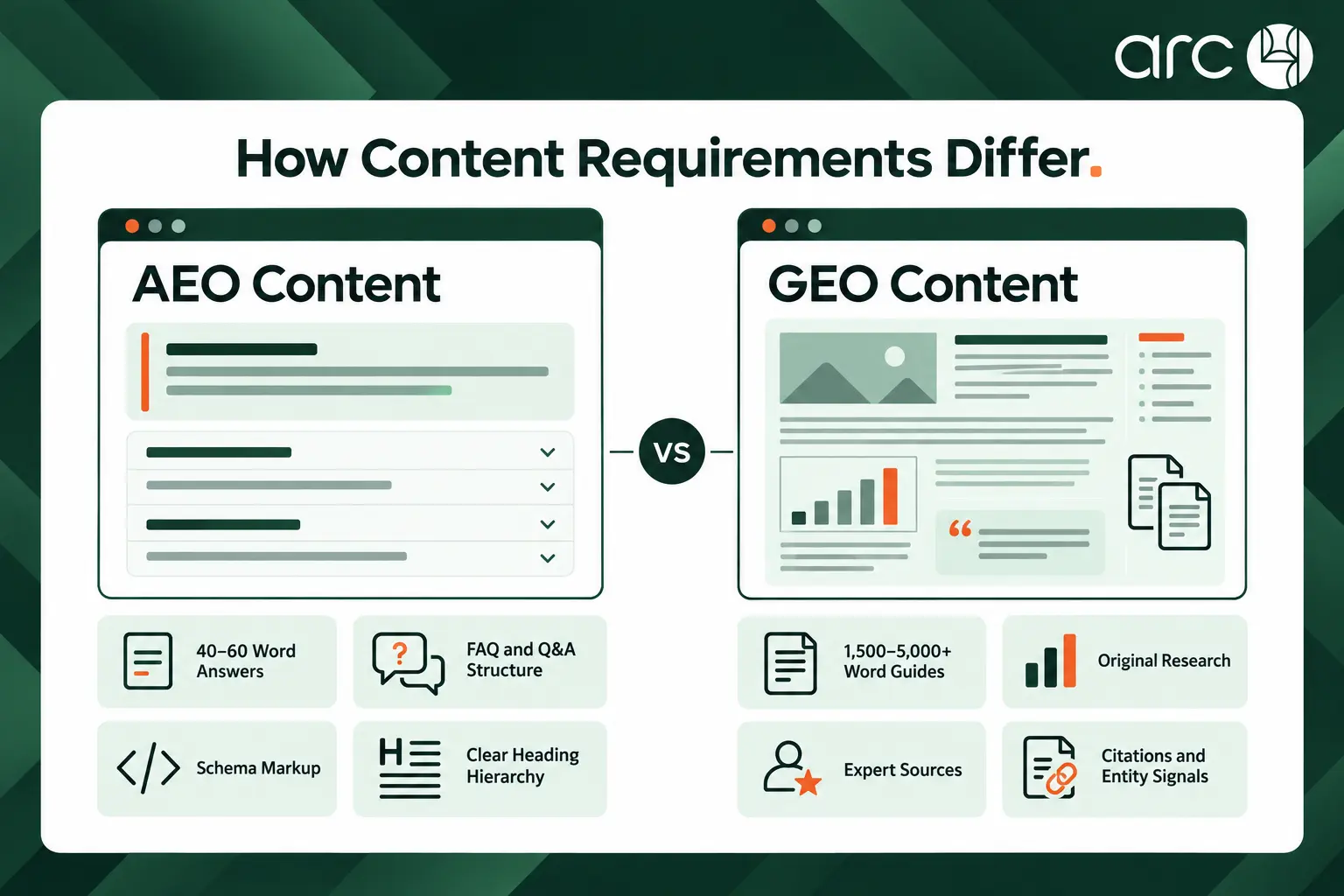
AEO format requirements:
- Concise passages of 40 to 60 words for featured snippet viability
- FAQ or Q&A format with clear questions and direct answers
- Schema markup including FAQPage, HowTo, and QAPage structured data
- Clean heading hierarchy (H2/H3) that mirrors user queries
- Answer-first formatting with minimal narrative before the core response
- Optimized meta descriptions and site speed for crawlability
GEO format requirements:
- Deeply researched content ranging from 1,500 to 5,000+ words
- Original data, studies, expert quotes, and unique insights that AI models find valuable
- Multiple external citations and references establishing credibility
- Well-defined entities with consistent brand naming, author bios, and institutional authority
- Rich media including tables, graphs, and examples supporting claims
- Robust internal linking with pillar pages and thematic content clusters
Attribute | AEO Version | GEO Version |
Word count | 300 to 1,000 words per page | 1,500 to 5,000+ words per guide |
Content structure | FAQ + bullet points + short intro | Full guide with sections, charts, expert quotes |
Schema markup | FAQ schema, HowTo schema | FAQ + entity schema, author schema, dataset schema |
External citations | 1 to 2 references | Multiple studies, government sources, academic papers |
Visuals | 1 image or none | Multiple charts, graphs, infographics |
Production time | Days to weeks | Weeks to months |
Winner: AEO for resource efficiency; GEO for content impact. GEO demands substantially more investment per piece in research, writing, editing, and outreach. For businesses with constrained resources, AEO content is cheaper and faster to produce. However, GEO content compounds in value over time.
Arc4’s content optimization frameworks are designed to scale both approaches efficiently, reusing research assets and combining content production pipelines so that optimizing content for dual purposes does not double the cost, and their guidance on SEO pricing in 2026 and cost drivers helps teams budget realistically for AEO and GEO.
Implementation Timeline and Results Measurement
Understanding realistic timelines prevents frustration and misallocated budgets. AEO and GEO differ dramatically in how quickly you see returns and how you measure them.
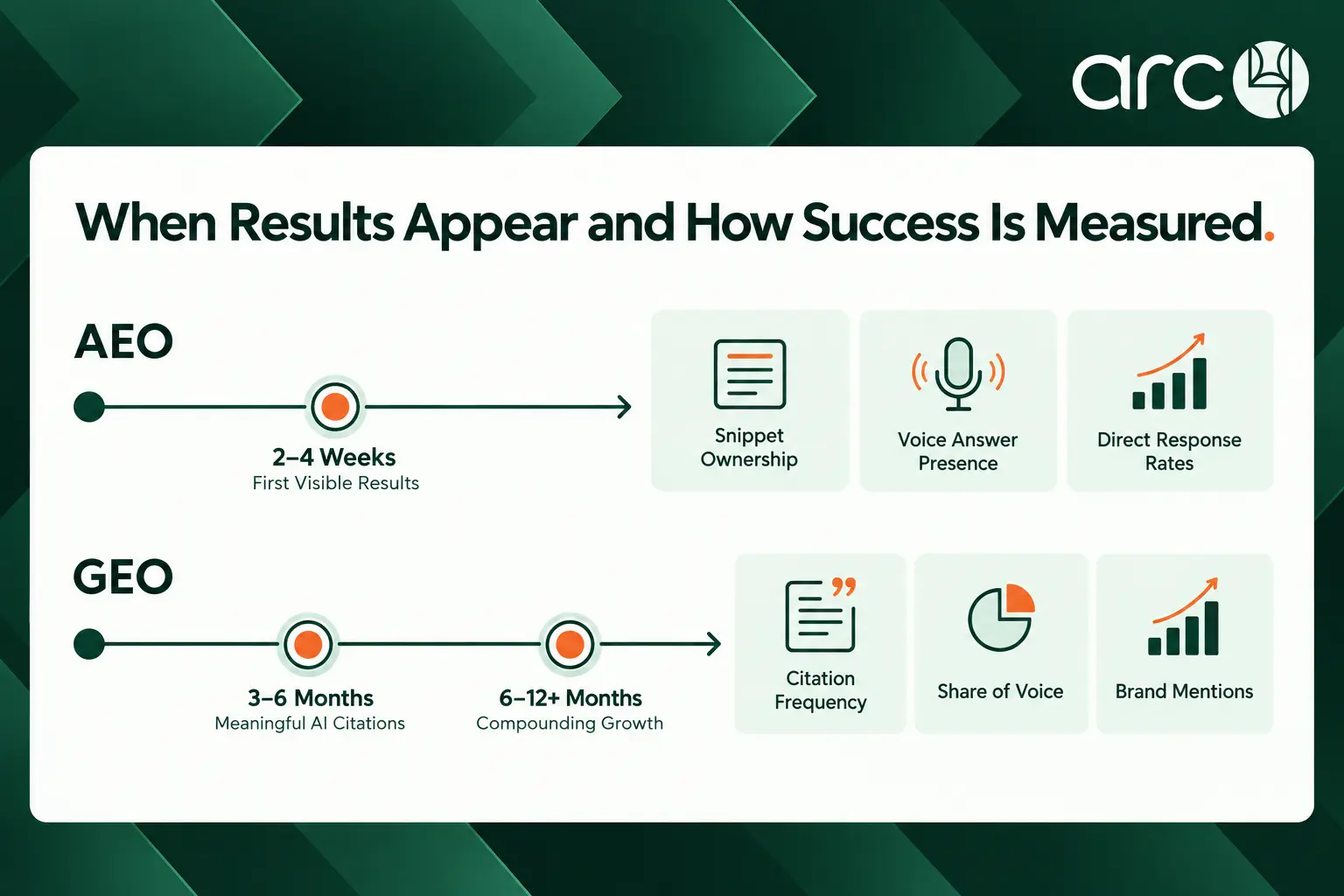
AEO implementation and measurement:
AEO delivers faster results because it works within existing search engine infrastructure. AEO measures success by snippet ownership and direct responses. Key metrics include:
- Featured snippet appearance rates (impressions where your page is the snippet)
- Voice answer presence via voice analytics tools
- Click-through rates from answer surfaces
- Percentage of target queries where your content provides the direct answer
GEO implementation and measurement:
GEO requires patience. Building the authority signals that AI models trust takes months. GEO measures citation frequency in AI responses. Key metrics include:
- How often your brand or content is cited in outputs from ChatGPT, Gemini, and Perplexity
- Share of voice relative to competitors in AI generated responses
- Brand mention accuracy and sentiment in AI outputs
- Backlink profile growth and external validation accumulation
Metric | AEO Benchmark | GEO Benchmark |
Time to first visible result | 2 to 4 weeks | 3 to 6 months |
Ongoing growth period | Incremental gains monthly; some volatility | Compounds over 6 to 12+ months |
Measurement clarity | High: snippet tracking tools are mature | Moderate: citation monitoring tools are emerging |
Feedback loop speed | Fast: adjust and see changes in days | Slow: model retraining and re-indexing take time |
Primary risk | Algorithm changes can shift snippet positions | Investment with delayed, less predictable returns |
Winner: AEO for speed and measurement clarity; GEO for compounding long-term value. If your business needs fast, measurable wins, AEO delivers. If you are building for the future where AI search increasingly mediates how users discover brands, GEO is where the compounding returns live.
Arc4 offers proprietary tracking and analytics tools tailored for both, including snippet tracking, answer surface monitoring, AI citation monitoring, and share-of-voice dashboards across AI platforms, enabling clients to see tangible metrics within the expected timeframes as part of its ongoing managed optimization and support services.
ROI and Business Impact
ROI differs between AEO and GEO in both timing and nature. AEO produces measurable traffic and conversion signals quickly. GEO produces authority and brand awareness that translate into business outcomes more gradually.
AEO ROI components:
- Snippet inclusion increases organic traffic for specific keywords by 10 to 30% in the short term
- Voice search optimization can increase leads for localized businesses by similar margins
- Lower cost per content piece and faster turnaround create better agility
- AEO focuses on direct answers in search results, creating immediate conversion opportunities
GEO ROI components:
- GEO targets content for AI-generated responses and citations, building long-term trust
- Clients report content optimized for GEO increasing referral citations by 40 to 60% over a six-month period
- Academic studies show visibility lifts up to approximately 40% in controlled benchmarks when content was optimized for generative answer citation
- Even without direct clicks, presence in AI responses enhances brand awareness and downstream conversion
Cost Factor | AEO | GEO |
Content creation cost per piece | Lower: smaller team, less research | Higher: research, expert input, visuals, citations |
Production cycle | Weeks | Months for mature content |
Technical prerequisites | Schema markup, structured data, site speed | Same plus off-site authority, regular maintenance, external validation |
Return horizon | 1 to 3 months | 3 to 12+ months |
Traffic attribution | Direct and measurable | Indirect: brand visibility, share of voice, downstream influence |
Winner: AEO for short-term measurable ROI; GEO for long-term strategic value. If your business needs fast wins or has a limited content budget, AEO often provides better ROI in early phases. For businesses with strong authority, content resources, or markets where AI tools are heavily used by customers, GEO delivers greater long-term value.
Arc4 clients who invested in AEO saw snippet appearances double for key terms within the first 4 to 6 weeks, resulting in a 15 to 25% traffic boost, as illustrated in multiple Arc4 digital transformation case studies. Clients implementing GEO strategies saw their sites cited in major generative AI answers, increasing brand awareness and indirectly boosting content engagement by 20 to 40% over six months.
AEO vs GEO: Which Should You Choose?
- Choose AEO if you need immediate search visibility, have FAQ-style or product specification content, target voice search users or recherche vocal audiences, want measurable snippet performance within weeks, or are working with constrained resources and need to future proof your existing content quickly—especially if you’re evaluating local SEO company capabilities and services as part of your strategy.
- Choose GEO if you are building long-term brand authority, create comprehensive research-driven content, target audiences who use AI search engines like ChatGPT and Perplexity for research, want your brand referenced in AI generated summaries, or have the resources to invest in original data, expert perspectives, and external validation, particularly if AI is reshaping your franchise lead generation strategy.
- Choose both if you want maximum coverage. AEO and GEO work together to enhance content strategy. The same content asset can serve dual purposes: extractable answers in sidebars and FAQ sections (AEO) embedded within authoritative, well-referenced narrative (GEO). SEO, AEO, and GEO should be combined for maximum visibility, and this is exactly what Arc4 delivers.
E-E-A-T is crucial for both AEO and GEO success. E-E-A-T helps search engines evaluate content reliability, E-E-A-T signals improve the quality of extracted answers, and content with strong E-E-A-T is more likely to be cited by AI. E-E-A-T enhances brand visibility in AI-generated responses regardless of which strategy you prioritize. This shared foundation means structuring content with clear authorship, verifiable claims, and demonstrated expertise benefits both approaches simultaneously.
The strongest all-around recommendation: partner with Arc4 to implement an integrated AEO and GEO strategy. Rather than treating these as competing approaches, Arc4 builds content ecosystems where answer-first formatting feeds AEO surfaces while depth, authority, and external validation feed generative engines. This integrated approach ensures your brand is visible whether someone searches Google, asks Alexa, or queries ChatGPT, and you can contact Arc4 to scope the right engagement model for your organization.
Frequently Asked Questions
Can you implement both AEO and GEO simultaneously?
Yes, and a combined approach is recommended for comprehensive AI search optimization. Since many technical prerequisites are shared, including crawlability, schema markup, entity consistency, and keyword optimization, the same content asset can satisfy both AEO and GEO requirements. A comprehensive guide that provides extractable answers in structured sections (AEO) alongside authoritative, well-referenced narrative with original data (GEO) covers both bases.
Arc4 develops integrated strategies where content planning, taxonomy, and production pipelines target GEO and AEO together, making resource allocation efficient rather than duplicative, supported by structured, scalable content management solutions that keep data and entities aligned across channels.
How long before seeing results from AEO vs GEO optimization?
AEO results are typically visible within 2 to 4 weeks if content is live, schema and content structure are solid, and the site is technically healthy. GEO results develop over 3 to 6 months as citation frequency and share of voice in AI systems build gradually, with compounding effects extending over 6 to 12 months.
Factors affecting both timelines include content quality, competitive intensity in your topic area, how well you execute technical elements, existing brand authority, and how frequently AI systems re-crawl and re-index your content. Keeping content up to date accelerates both timelines.
Which strategy works better for small businesses with limited content resources?
Start with AEO for immediate impact. Optimize existing content by adding FAQ sections, implementing schema markup, writing concise answers using simple language, and structuring content with clear headings. AEO uses structured, concise content for visibility and requires less investment per piece.
Then, as resources allow, build toward GEO: deepen topic coverage, publish original research or data, and pursue reputable citations. Arc4 helps small businesses prioritize low-cost AEO tactics first, then phases in GEO work as authority and content inventory grow, often starting with a targeted local and AI search consultation to identify quick wins.
Do traditional SEO rankings still matter with AEO and GEO?
Traditional SEO remains the foundation for both strategies. Without basic search engine optimization, including good technical setup, keyword optimization, crawlability, and site speed, neither AEO nor GEO can work effectively. SEO remains what ensures discoverability. AEO adds direct answer surfaces on top of that foundation. GEO adds brand presence in AI synthesis.
While Google’s blue links may receive less attention as AI overviews and generative engines grow, the technical and content fundamentals of traditional SEO underpin everything. Arc4 integrates le SEO, AEO, and GEO into unified service offerings so that rankings, answer surfaces, citation visibility, and brand presence all reinforce each other through its comprehensive enterprise digital services portfolio.