
Franchise Reputation Management Strategies for Multi-Location Brands
Every franchise location is a front door to your brand. In 2026, that front door is digital, searchable, and shaped by what customers say about each location online. This guide breaks down a complete system for franchise reputation management across multi-location brands, with concrete steps, comparison tables, KPI benchmarks, and the tools you need to scale.
Key Takeaways
- Franchise reputation management for multi location businesses means controlling local reviews, business listings, and customer sentiment from a single reputation management platform rather than managing each location in isolation.
- Ignoring online reputation management across multiple platforms leads directly to lost foot traffic, higher customer acquisition costs, and brand inconsistency that confuses potential customers.
- Arc4 specializes in franchise reputation management software and services for multi-location brands, centralizing review data, social engagement, listings management, and CX analytics in one platform.
- 88% of consumers prefer businesses that respond to every review, making review response a non-negotiable part of any franchise reputation management strategy.
- This article provides a step-by-step system, sample KPIs, and comparison tables to help franchise leaders choose the right reputation management platform and partner.
The Modern Franchise Landscape: Reputation Starts (and Scales) Online
In 2026, franchise discovery starts across Google Maps, Apple Maps, Facebook, TikTok search, and other search engines. Word of mouth still matters, but today personal recommendations are often verified by a quick scroll through online reviews before a customer walks through the door. 51% of customer service journeys now start on third-party platforms, not on the brand’s own website.
This reality multiplies for multi location brands, where each franchise location operates like a local business competing in its immediate market. A consumer comparing two nearby franchise locations will check star ratings, read the most recent local reviews, and decide in seconds. Medical marketing benchmarks show that businesses in the top-3 local map pack average roughly 87 Google reviews, while those outside the top 3 average just 34. Reputation management is a core driver of local foot traffic, and it directly affects local search rankings, ad performance, and even AI search recommendations.
Franchise reputation management is the discipline of shaping and protecting brand perception across every location profile, not just corporate. For franchise brands that delay investing in a coordinated reputation management strategy, the risks compound fast.
What Is Franchise Reputation Management (and Why It Matters More for Multi-Location Brands)?
Franchise reputation management is the systematic process of monitoring, improving, and scaling brand perception across hundreds of location-level profiles and channels. It combines reviews, listings, and local SEO into a single operational discipline.
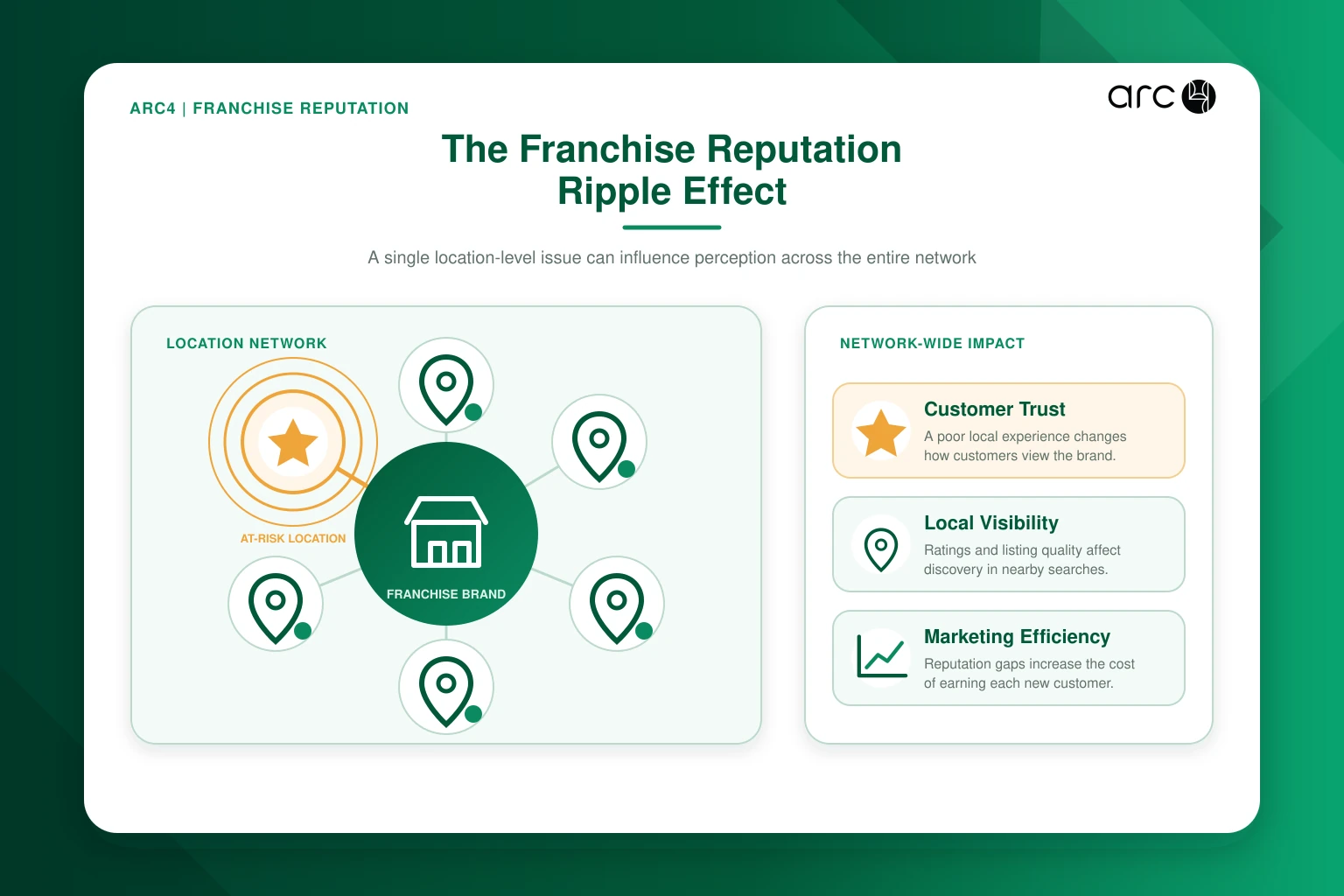
Unlike single-location reputation management, franchise reputation management demands corporate governance, brand consistency, coordination of brand standards, and the ability to improve customer experiences at each location while processing thousands of customer feedback signals every month. Managing reputation across multiple locations is uniquely challenging because each franchise location operates semi-independently, but customers perceive the brand as one entity. A single underperforming review at one location can impact the national brand image through what experts call the “halo effect.”
A modern reputation management platform centralizes reviews, listings, sentiment analysis, and reporting while still empowering local teams to respond authentically. Customer feedback becomes both a CX signal and a marketing asset when properly managed across multiple platforms.
What’s at Stake Without a Franchise Reputation Strategy?
The stakes in 2026 are visible and immediate. Rating gaps between franchise locations show up side by side in Google Maps results. Viral complaints spread across social media in hours. Rapidly declining ratings at one location can indicate an operational problem that, left unaddressed, erodes trust in the entire network.
The financial impact is measurable. A franchise system where some locations sit at 3.2 stars while others maintain 4.5 stars creates confusion for future customers and drives up marketing costs. Inaccurate listings can drop your search ranking on Google, and inconsistent brand messaging can confuse customers about what to expect. Stratus Clean, a commercial cleaning franchise, saw its average Google rating climb from 3.4 to 4.7 after implementing a unified reputation system, a move that coincided with being named the fastest-growing franchise in North America four consecutive years.
Internally, unmanaged customer feedback hides operational problems. Franchisees feel unsupported, and corporate loses the ability to detect issues like staffing shortages or cleanliness lapses until churn rises. Investors increasingly examine franchise reputation metrics when evaluating franchise systems, tying online reputation directly to growth and valuation. Driven Brands improved local search rankings from #16.7 to #4.1, demonstrating how reputation investment translates to measurable visibility gains.
Core Pillars of Franchise Reputation Management
Effective franchise reputation management rests on six interconnected pillars that must work together. No single pillar delivers results alone.
- Accurate business listings
- Review monitoring and response
- Systematic review generation
- Social media governance
- Customer sentiment analytics
- Crisis monitoring and risk management
Arc4’s franchise reputation management software is designed specifically to operationalize these pillars across hundreds of locations, connecting them into a single workflow. Here is how each one works.
Brand Consistency Across Every Location
Visual identity, messaging, and service standards must remain consistent across all local listings, websites, and profiles. This means consistent use of logos, approved photos, business categories, and descriptions on Google Business Profile, Yelp, Facebook, and Apple Maps. Franchisees must adhere to corporate branding guidelines to prevent confusion and erosion of customer trust.
Providing franchisees with response guidelines ensures brand consistency, and a unified response policy improves brand voice consistency across review sites and social channels. Centralized brand asset libraries and templates inside a reputation management platform help locations stay on-brand while remaining efficient. Maintaining brand consistency applies equally to how local teams respond to reviews and social comments.
Customer Feedback and Local Review Generation
Passively waiting for reviews leads to negative bias because unhappy customers are more motivated to post. Franchises need proactive systems to generate local reviews at every location. Encouraging authentic customer reviews strengthens visibility and credibility, and franchises can improve local SEO by generating authentic customer reviews.
Concrete channels for collecting reviews include:
- Post-visit SMS and email campaigns
- QR codes at checkout counters
- Wi-Fi splash pages prompting satisfied customers to leave feedback
Setting minimum monthly review volume targets per location prevents “stale” profiles that underperform in search and conversions. Strong local reviews help franchises rank higher in local map listings. Automated review requests can significantly increase review volume. Arc4 helps automate review requests while respecting brand rules and local regulatory constraints where incentives are prohibited.
Review Monitoring and Response Workflows
No one-star review should sit unanswered for days. Centralized review management improves response times and brand consistency across all franchise locations. 88% of consumers choose businesses that respond to every review, which makes review response a competitive necessity. Franchises need a standardized review management process with clear response rules, response times, and escalation procedures. Franchises should respond to negative reviews within 24 to 48 hours, with critical reviews escalated for response in under 4 hours during business days.
A 67-location QSR franchise moved its response rate from 23% to 87% and cut average response time from 4.3 days to 16 hours after implementing structured workflows. Timely responses to reviews show customers that a franchise listens, and a fast response can turn a potential disaster into a positive story.
Arc4 routes reviews to the right people, whether local managers or corporate teams, and provides approved response templates so every reply is professional and empathetic.
Social Presence and Local Engagement
Balancing corporate oversight with authentic local content on Facebook, Instagram, TikTok, and emerging platforms is essential. Local social posts about community events, staff spotlights, and event highlights humanize the brand but must remain within corporate branding guidelines.
Monitoring social media discussions can prevent issues from escalating, and consistent engagement can improve local search visibility. Medical practice benchmarks show that businesses in the top-3 map pack post an average of 4 times in the last 30 days, compared to less than 1 post for those outside the pack.
A central dashboard to schedule, approve, and monitor local social content for all locations keeps brand mentions on-brand. Review and comment responses on social channels are part of reputation management and should follow the same playbook as review sites.
Customer Sentiment Analytics and Operational Insights
AI-powered sentiment analysis helps identify operational issues from reviews by categorizing and scoring themes in review data and survey feedback. AI analyzes customer sentiment to uncover patterns like wait time complaints in a region, recurring issues with a new product, or praise for particular staff behaviors.
A 34-location salon and spa franchise used sentiment analytics to reduce negative “wait time” mentions by 71% within four months, while customer retention improved from 64% to 79%. Aggregated review data can highlight operational blind spots that internal metrics miss. AI-powered sentiment analysis helps benchmark performance across locations, giving corporate teams actionable insights for training, staffing, and SOP changes.
Arc4 uses sentiment analytics to benchmark locations and generate prioritized action lists for regional leaders.
Crisis Monitoring and Risk Management
In 2026, isolated local incidents can become national news when captured on video and shared across platforms within hours. Automated alerts can notify franchises of negative reviews in real time, and AI can detect spikes in negative sentiment before they escalate.
Automated alerts help catch reputation issues before they escalate. A diagnostic center chain escalated 11 cases in a five-month period, and all were resolved before public escalation thanks to structured crisis workflows.
Every franchise system should have a documented crisis playbook with roles, approval workflows, and prepared response frameworks. Arc4 integrates alerts, case management, and internal notes so corporate and local leaders can coordinate real-time crisis responses.
Pillars of Franchise Reputation Management and Their Business Impact
The following table maps each core pillar to its primary KPI impact and how Arc4 supports multi location businesses at each level.
| Pillar | What It Covers | Primary KPI | How Arc4 Helps |
| Listings Accuracy | Consistent NAP and hours across directories | Local pack impressions, direction taps | Centralized listings sync to 40+ sites |
| Review Monitoring | Real-time alerts and unified inbox | Response time, average rating trend | Cross-platform review dashboard with routing |
| Review Generation | Automated SMS/email review requests | Monthly review volume per location | Campaign automation per store with conditional logic |
| Brand Consistency | Unified voice, visuals, and templates | Brand perception, customer trust | Template libraries, approval workflows, brand asset management |
| Sentiment Analytics | AI-driven topic and sentiment tagging | NPS, CSAT, churn risk | Location and region-level insights with trend detection |
| Crisis Monitoring | Alerts for spikes and sensitive keywords | Incident resolution time | Incident workflows, internal notes, escalation rules |
These pillars do not operate in isolation. The brands that treat them as a connected system consistently outperform those that address them piecemeal.
Balancing Corporate Governance with Local Ownership
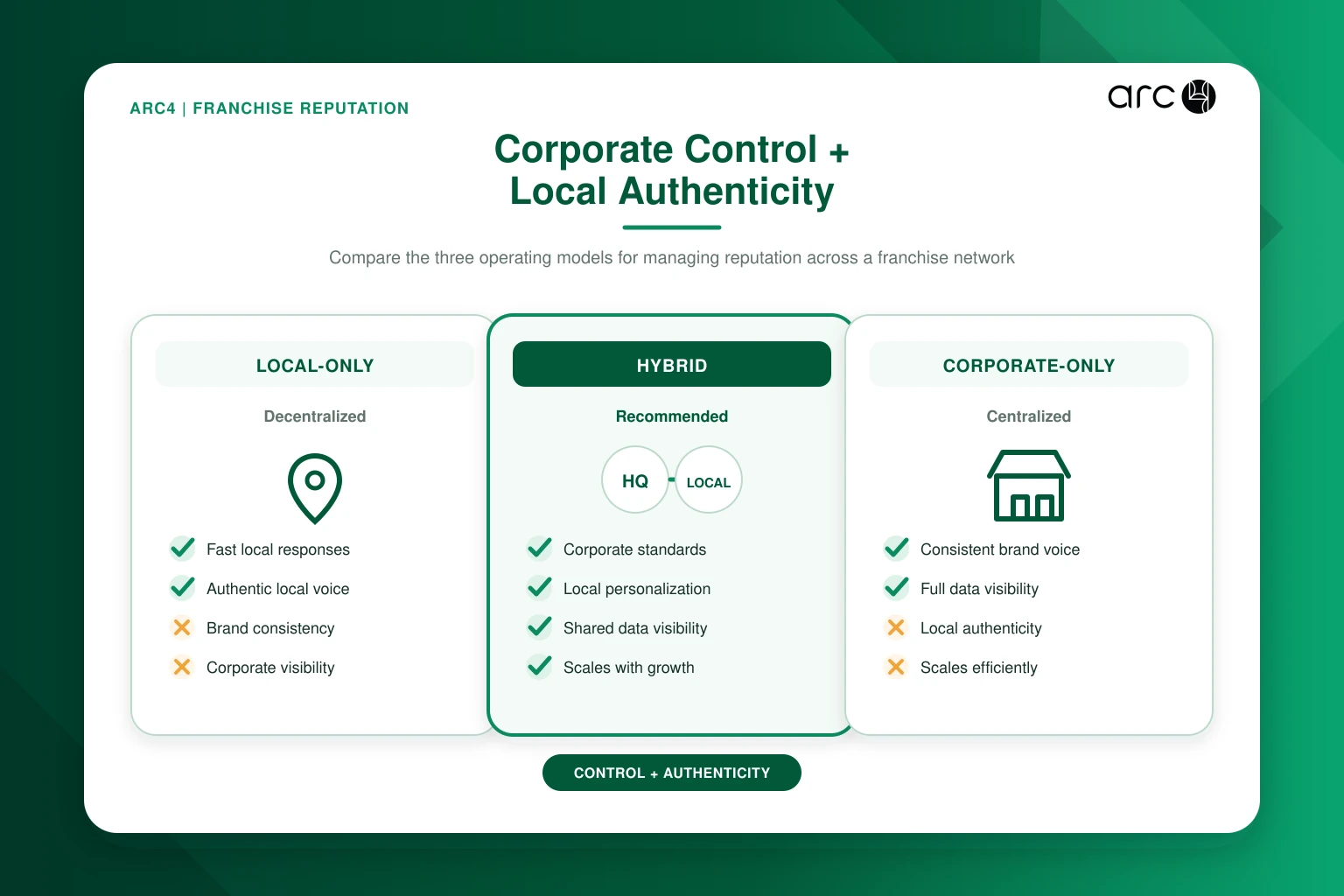
The strategic tension between centralized control and local autonomy defines franchise reputation management. Franchise reputation management requires balancing corporate standards with local flexibility. Centralized monitoring and decentralized response is an effective strategy for networks of almost any size.
Three common governance models exist:
- Local-only: Individual franchise locations handle all review response and social posting.
- Corporate-only: A central team manages all reputation activities.
- Hybrid: Corporate sets standards, templates, and escalation rules; local teams respond within that framework.
The best-performing franchises use the hybrid model. Role-based access in franchise reputation management software lets corporate approve responses for some locations while granting autonomy to others. Assigning a “reputation owner” at each location and tying bonuses or KPIs to ratings and response behavior creates accountability.
Local-Only vs Corporate-Only vs Hybrid Reputation Management Models
| Dimension | Local-Only | Corporate-Only | Hybrid |
| Who Responds | Individual franchise location managers | Central corporate team | Local teams with corporate oversight |
| Brand Consistency | Low; risk of inconsistent brand voice | High; expert, consistent responses | High with local authenticity |
| Speed of Response | Fast when local managers are engaged | Slower during volume peaks | Fast with clear rules |
| Local Authenticity | High | Low; can feel impersonal | Balanced |
| Data Visibility for Corporate | Minimal | Full | Full with location-level detail |
| Scalability (10 to 1,000+ locations) | Breaks down past ~10 locations | Bottlenecks past ~100 locations | Scales with platform support |
| Best For | Small networks (<10 locations) | Strict compliance industries | Growing franchises (10 to 2,000+) |
| Ease of Managing with Arc4 | Basic monitoring only | Full control but limited local input | Full governance, role-based access, and audit trails |
Step-by-Step Strategy to Manage Reviews Across Multiple Locations and Platforms
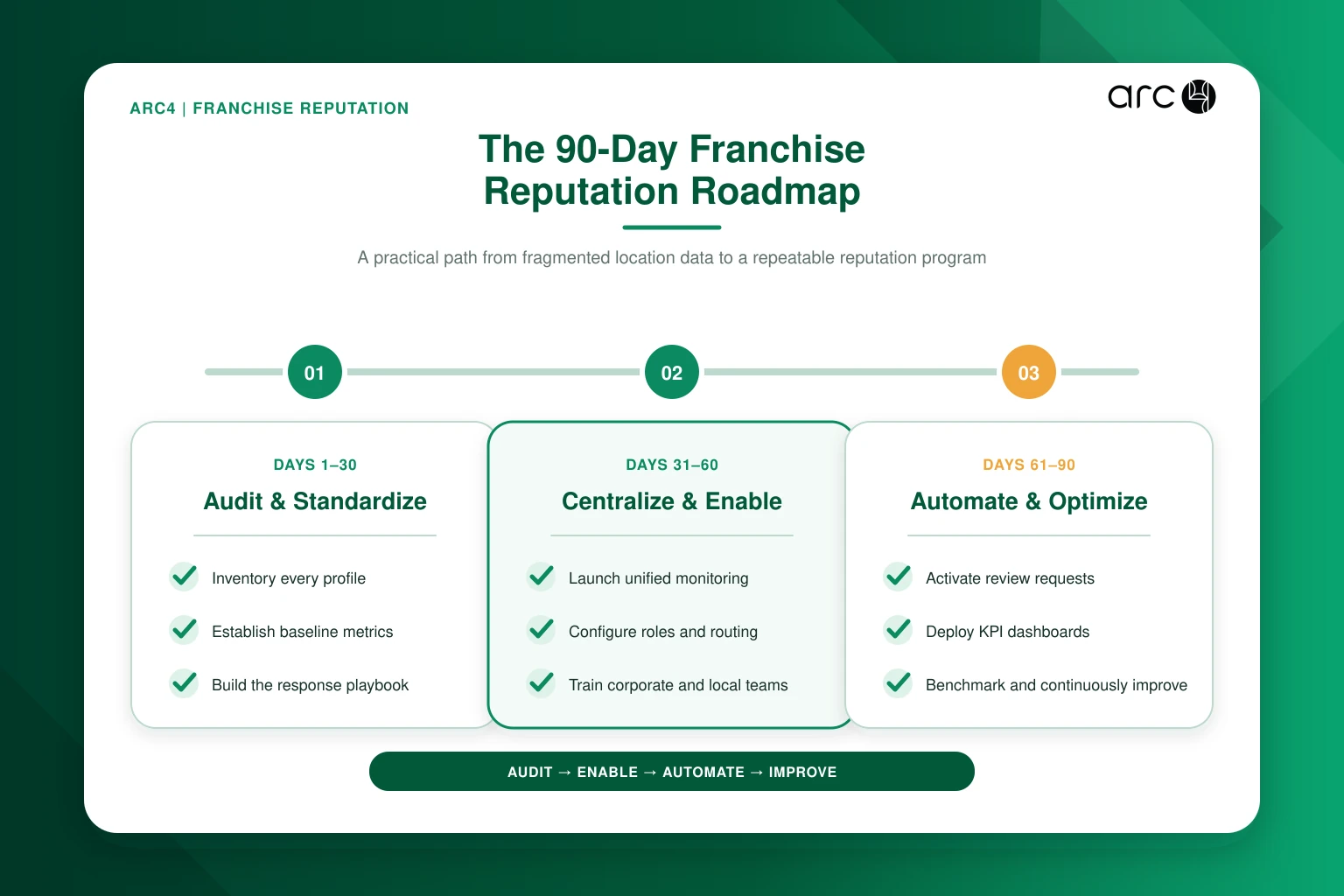
This is a practical playbook that brands can follow over a 90-day period to build or upgrade franchise reputation management. The steps apply whether you manage 10 or 1,000+ locations, but automation becomes mandatory as scale increases.
Step 1: Audit Every Location’s Online Presence
Start by inventorying every location’s Google Business Profile, social profiles, directory listings, and major review sites. Each franchise location must have a fully optimized Google Business Profile, and franchises need accurate NAP details across all directories.
Collect baseline metrics for each location:
- Star rating
- Review count and date of last review
- Review response rate
- Listing completeness and accuracy
- Photo freshness
Flag high-risk locations (under 3.5 stars, long response delays, inaccurate hours) for immediate remediation. Benchmarks show that top-3 map pack businesses maintain roughly 94% NAP consistency, compared to 71% for those outside. Arc4 can automate much of this audit by pulling review data and listings data into a single dashboard.
Step 2: Build a Centralized Review Response Playbook
Your playbook should contain:
- Tone of voice and brand voice guidelines
- Review response templates for positive reviews, negative reviews, and neutral feedback
- Escalation rules for sensitive or legal issues
- Response-time SLAs (respond to 100% of business reviews within 24 hours; critical reviews in under 4 hours)
88% of consumers prefer businesses that respond to every review, so your SLAs must reflect that expectation. Incorporate local personalization in templates while preserving a consistent brand voice. The playbook should live inside the reputation management platform so local teams can apply it without friction.
Step 3: Centralize Monitoring With Franchise Reputation Management Software
Spreadsheets and manual checking fail once brands pass 5 to 10 locations or must monitor reviews across multiple platforms. A centralized reputation management system can automate listings updates, and automated listings management updates multiple directories simultaneously. Google prioritizes businesses with consistent local information.
Arc4 is a franchise-built reputation management platform that centralizes reviews, social, listings, and surveys for multi location brands. Key features include:
- Unified review inbox across Google, Yelp, Facebook, and more
- Role-based permissions for corporate teams, regional managers, and local managers
- Bulk actions and analytics by region and brand
- Integrations with POS, CRM, and marketing automation to trigger accurate, timely review requests
Step 4: Train and Enable Local Teams
Training should cover platform usage, playbook review, examples of good and bad responses, and processes for escalating complex issues. Onboard every new local franchisee with reputation management training and schedule quarterly refreshers, ideally supported by short on-demand videos.
Create simple dashboards or scorecards so local owners can see their rating, review volume, and response performance at a glance. Reputation metrics can be used to reward high-performing locations and identify those needing support. Arc4 delivers location-level reporting and automated email summaries to keep performance front and center.
Step 5: Automate Review Generation and Feedback Collection
Set up automated post-visit communication flows (SMS or email) that direct satisfied customers to local reviews and unhappy ones to private support channels. Franchise reputation management software should support conditional logic to route detractors into tickets or surveys instead of public review sites.
Use QR codes at check-in and checkout, and Wi-Fi login pages to encourage on-the-spot customer feedback. Each location’s page must have unique, locally relevant content. Consistent, automated review generation at every location is essential to keep ratings fresh and representative. The 67-location QSR case study saw review volume per location jump from 41 to 73 per month after implementing automated requests.
Step 6: Monitor KPIs, Benchmark, and Continuously Improve
Core KPIs to track monthly:
- Average star rating (network and per location)
- Review volume per location
- Review response rate and average response time
- Customer sentiment score and trending negative themes
- New reviews generated in the past 90 days
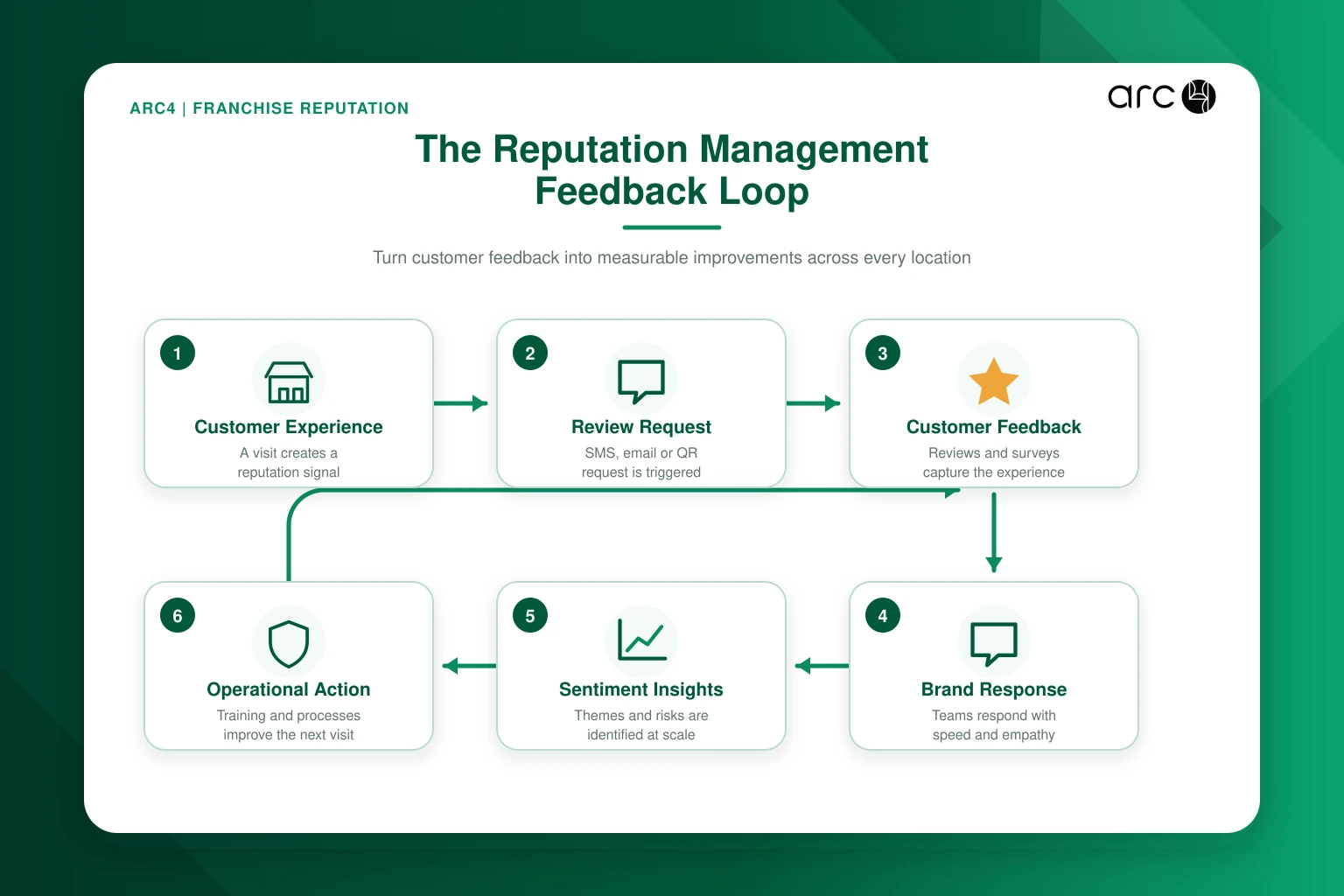
Metrics like average rating and review volume indicate customer engagement and operational health. Benchmark locations against network averages and identify trends among both top-performing and at-risk stores. A successful franchise reputation strategy fosters genuine customer engagement by creating feedback loops: use review themes to adjust training, staffing, products, and customer service policies. Arc4 provides dashboards and scheduled reports that make ongoing monitoring routine.
Sample Franchise Reputation Management KPI Dashboard
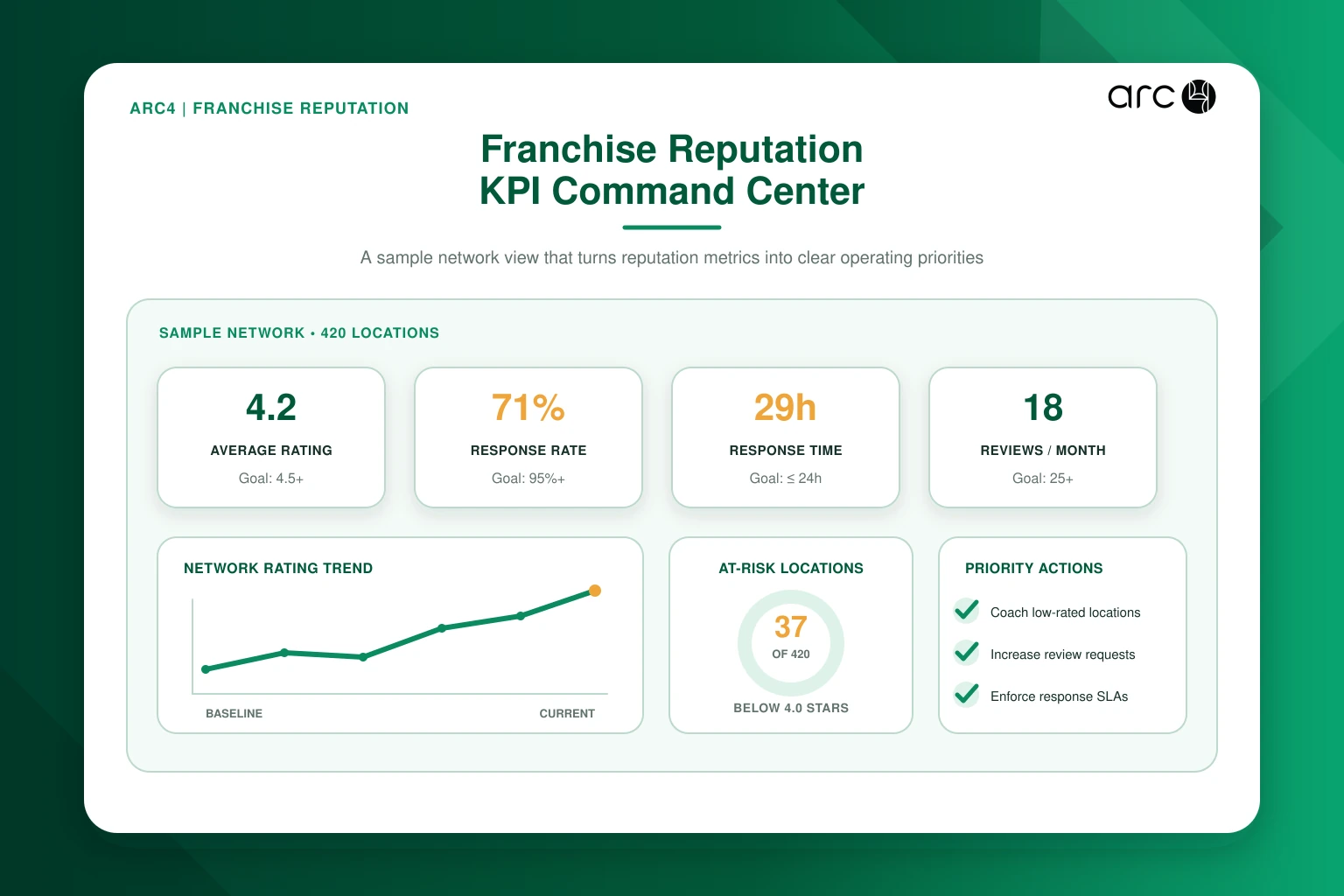
This table mirrors a real-world KPI dashboard used by multi-location brands to track performance and trigger action.
| KPI | Example Value | Benchmark / Goal | Recommended Action |
| Average Rating (Network) | 4.2 stars | ≥ 4.5 stars | Prioritize coaching for locations under 3.8 stars |
| Locations Below 4.0 Stars | 37 of 420 | < 10 locations | Launch targeted improvement plan for flagged stores |
| Average Monthly Review Volume per Location | 18 reviews | ≥ 25 reviews | Increase SMS review requests for low-volume regions |
| Review Response Rate | 71% | ≥ 95% | Enforce response SLAs and add staffing where needed |
| Average Response Time | 29 hours | ≤ 24 hours | Use Arc4 alerts and templates to speed responses |
| Locations with Stale Profiles (no review in 30+ days) | 54 | 0 | Activate automated review request campaigns |
Using Customer Feedback and Surveys to Capture the “Silent Majority”
Online reviews tend to reflect the extremes. Very happy or very unhappy customers post, while the average experience goes unrecorded. Structured surveys sent via SMS or email after visits capture nuanced customer sentiment about staff, wait times, cleanliness, pricing, and more.
Integrating survey data with review data in one reputation management platform gives a more complete view of each franchise location’s performance. A high star rating builds immediate trust with potential customers, but survey data reveals the operational details behind that rating. Simple metrics like NPS, CSAT, and CES, tracked across regions and time periods, surface patterns that reviews alone miss.
Arc4 can automatically trigger surveys, analyze open-text responses with AI powered sentiment analysis, and flag locations with declining scores before those declines appear in public reviews.
Generic Review Tools vs Franchise-Grade Reputation Management Platforms
Not all review management tools are built for multi location enterprise needs. Here is how basic tools compared to a franchise-grade reputation management platform like Arc4.
| Capability | Basic Review Tool | Franchise-Grade Platform |
| Number of Locations Supported | Up to ~10 | Designed for 10 to 5,000+ locations |
| Role-Based Permissions | Limited or none | Corporate, regional, and store-level roles |
| Multi-Platform Review Inbox | Often single-site (e.g., Google only) | Unified inbox for Google, Yelp, Facebook, Apple Maps, and more |
| Listings Management | Manual updates per site | Centralized NAP and hours sync to major directories |
| Sentiment & Trend Analytics | Star ratings only | AI-powered topic, sentiment, and trend detection |
| Governance & Playbooks | Not supported | Built-in templates, approval workflows, and audit trails |
| Review Generation Automation | Manual or piecemeal | Automated multi-channel campaigns with conditional logic per location |
| Franchise Services Support | Self-serve only | Dedicated multi-location strategy and onboarding from Arc4 |
How AI and Automation Are Transforming Franchise Reputation Management
In 2025 and 2026, AI has moved from optional to required for brands managing thousands of reviews per month. Enterprise reputation platforms now use AI to classify review themes, detect sentiment shifts, prioritize locations, and draft on-brand review responses at scale.
AI enables faster, consistent review responses across locations without overburdening staff. AI detects reputation risks early through real-time monitoring, allowing corporate teams to intervene before issues compound. However, human oversight remains essential for sensitive topics and nuanced customer concerns.
Automation in review requests, alerts, and routing frees local teams from repetitive tasks so they can focus on service improvements and genuine customer engagement.
AI for Sentiment, Trends, and Early Risk Detection
AI analyzes text from local reviews and surveys to spot patterns like frequent mentions of “rude staff” or “long wait” in certain markets. These actionable insights can drive operations leaders to schedule training, add staff during peak periods, or adjust local offers.
AI-driven alerts pick up on unusual spikes in negative sentiment within a 24 to 48 hour window, enabling faster intervention. Arc4’s analytics provide multi-level views at the location, city, region, and full network level, giving reputation managers the granularity they need to identify trends and act.
AI-Assisted Review Responses and Workflows
AI can draft suggested responses that match the brand voice, which local teams review and send. This significantly cuts response time while preserving authenticity. Guardrails matter: corporate-approved libraries, tone guidelines, and human review for sensitive topics prevent missteps.
After enabling AI-assisted responses, brands typically see increased response rates and reduced average response time. Arc4’s AI capabilities help franchises maintain high-quality, consistent responses across hundreds of locations, supporting both the local franchisee and corporate teams simultaneously.
Why Multi-Location Brands Choose Arc4 for Franchise Reputation Management
Arc4 is built for multi-location and franchise reputation management from the ground up. It is not a single-location tool stretched to fit. Here is why location brands trust Arc4:
- Centralized platform: Manage reviews, local listings, and social engagement from a single reputation management tool.
- Franchise-focused onboarding: Playbooks, training, and governance frameworks optimized for multi location businesses.
- Governance features: Role-based access, approval workflows, review response guidelines, and audit trails keep every location on-brand.
- Data-driven coaching: Benchmarking dashboards and automated reports help regional leaders coach underperforming locations with specific review data.
A centralized review management platform improves response consistency, and brands working with Arc4 typically see improved average ratings, increased review volume, and better brand consistency within the first 6 to 12 months. Franchise reputation management protects the entire brand from location-level issues, and Arc4 makes that protection systematic and scalable.
Ready to see how it works for your network? Schedule a consultation or demo with Arc4 to explore franchise-specific workflows in action.
FAQ: Franchise Reputation Management for Multi-Location Brands
These questions address practical concerns not fully covered in the main article, focused on budgets, rollout timing, internal ownership, and change management for multi location businesses.
How long does it typically take to roll out a franchise reputation management program?
A realistic timeline for a mid-sized franchise network (50 to 300 locations) is 60 to 120 days, broken into phases: discovery and audit, platform configuration, pilot with a subset of locations, then phased network-wide launch. Large brands with 1,000+ locations often stage adoption by region over 6 to 12 months. Working with Arc4 compresses timelines because the platform and playbooks are already optimized for multi location businesses.
Who should own franchise reputation management inside the organization?
Ownership typically sits within marketing or customer experience teams, with strong collaboration from operations. Each location should have a named reputation champion, but corporate should own strategy, standards, and platform administration. Aligning reputation KPIs with leadership scorecards ensures managing reputation is treated as a core business function, not a side task. Arc4 provides training and governance frameworks that clarify roles between corporate, regions, and locations.
How much budget should we allocate to franchise reputation management?
Avoid thinking of it as a pure cost. The budget typically includes per-location software licensing plus internal or outsourced staff time for monitoring and response. Many brands reallocate a portion of paid media budgets once they see that improving ratings and more positive reviews increases organic conversions. ROI comes from increased local traffic, higher conversion rates, and reduced churn. Arc4 can help estimate ROI by modeling uplift based on current review data and industry benchmarks.
How do we handle franchisees who do not follow the reputation management standards?
Use a mix of education, transparent benchmarking, and contractual expectations in franchise agreements. Corporate can use platform data to identify non-compliant locations and offer targeted support before escalating. Tying certain incentives or marketing co-op funds to meeting minimum reputation KPIs like response rate and rating thresholds creates clear accountability. Arc4’s reporting makes it easy to demonstrate gaps and improvements to individual franchisees.
Can we migrate from our existing review tool to a franchise-focused reputation management platform without losing data?
Yes. Review history is typically stored on third-party review platforms like Google and Yelp, and can be re-synced by the new platform. The migration process usually involves connecting APIs and importing historical review data, users, and location structures. Running both tools in parallel for a short period during transition ensures continuity. Arc4 provides migration support to minimize disruption and ensure all locations are live on the new platform quickly.