
How Yext Scout Helps Brands Measure Visibility Across AI Search
AI search is changing how customers discover brands. Answers can recommend several businesses, summarize their strengths, and cite supporting sources. Marketing teams need to understand whether their brand appears, how it is described, and where competitors have an advantage.
This article breaks down how Yext Scout helps brands measure and improve visibility across these AI search platforms, what metrics matter, and how Arc4 helps multi-location brands turn Scout data into real results.
Key Takeaways
- Yext announced Scout in March 2025. Its current local AI reporting covers ChatGPT, Gemini, Perplexity, Claude, and Google AI Overviews alongside Google search performance.
- Scout measures competitive performance through metrics such as AI Win Rate, AI Rank, sentiment, and citations. Brand Scout adds query-level AI Visibility Score and Share of Voice.
- Scout connects intelligence with recommended actions. Available workflows include Action Center, Talk to Scout, and brand-level content research and generation, depending on subscription and product access.
- Arc4 is the largest dedicated Yext partner, helping brands configure Scout and turn visibility insights into action. Arc4 manages 30,000+ locations for 40+ enterprise clients.
- Local and brand-level Scout experiences answer different questions. Compare consistent query sets, check scan dates, and treat the examples below as illustrations rather than promised results.
Why AI Search Visibility Matters in 2026
AI-generated answers create another layer of brand discovery alongside traditional search and Maps. A customer may compare providers inside an answer before visiting a website, making mentions, recommendations, citations, and sentiment useful complements to traffic and conversion reporting.
A Corporate Ink survey cited by Yext found that 88% of CMOs and VP-level marketers were being asked about AI visibility by leadership. Separately, 34% of marketers reported having a defined strategy. These figures describe different respondent groups.
A query such as “best pediatric dentist near Austin open on Saturdays” can surface recommendations based on the sources an AI system retrieves. A missing or inaccurate answer creates a discovery gap, but one response is not a complete measure of market visibility. Track comparable queries over time.
This is why AI search visibility is no longer a nice-to-have metric. It is a core KPI for marketing leaders who want to understand where their brand appears and where it does not.
From SEO to AI Visibility: What Is Changing?
Traditional SEO measures organic visibility through rankings, impressions, clicks, and conversions. AI visibility adds questions about brand mentions, recommendations, citations, and tone within generated answers. The two disciplines overlap.
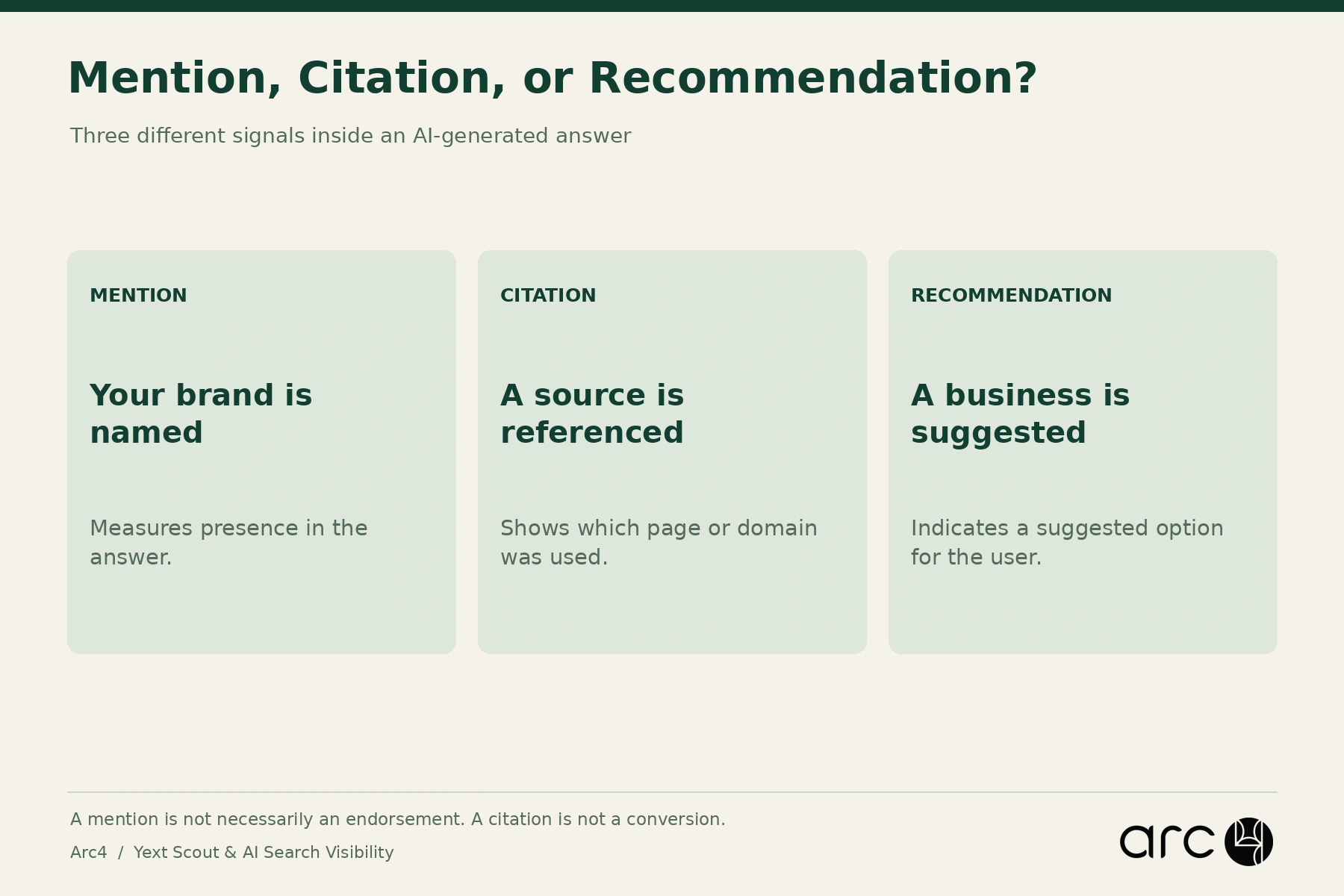
AI answers can include both ranked recommendations and cited sources. A brand may be mentioned without its website being cited, or a source may be cited without the brand being recommended. Reporting should distinguish these outcomes rather than treating every citation as a brand endorsement.
Accurate business information, accessible websites, useful content, relevant links, and a strong reputation remain valuable foundations. Structured data can clarify website content, but no single optimization guarantees inclusion in an AI answer. AI visibility work should complement a sound SEO program.
Here are the new questions marketing leaders are asking in 2025 and 2026:
- “How often does our brand appear for our tracked ChatGPT queries?”
- “How often does Gemini recommend our locations over nearby competitors?”
- “What is AI sentiment toward our brand across search platforms?”
- “Which sources are AI engines citing when they mention our competitors but not us?”
These questions make measurement tools like Yext Scout essential to understand and improve AI discovery across multiple AI platforms.
What Is Yext Scout and How It Fits Into AI Search
Yext Scout is a search visibility and competitive intelligence offering within the Yext platform. Yext announced Scout on March 3, 2025, building on its acquisition of Places Scout.
Scout combines search intelligence with the broader Yext ecosystem, including Knowledge Graph, Listings, Pages, Reviews, and Social. Teams can use the findings to prioritize changes, then compare subsequent visibility results. Observed changes do not alone establish which action caused an improvement.
In its May 2026 announcement, Yext reported that Scout analyzed 10 billion signals monthly across more than 12 million business locations, surfacing 150 visibility metrics across 20 competitors per scan. These are Yext’s published dataset-scale figures, not the number of locations or competitors included in every customer subscription.
Scout has free and paid capabilities. September 2026 release notes introduced dedicated Google Performance and AI Performance pages, with detailed exploration and exports for paid customers and basic KPIs on the free tier. Brand-level intelligence uses a subscription-based model. Confirm the features included in your account.
Arc4, as the largest dedicated Yext partner, helps brands configure Scout to match their entity structure, priority markets, and business questions. Their team, founded by former Yext leaders, brings hands-on expertise to every implementation and draws on over 15 years of enterprise digital services experience with multi-location and franchise brands.
Brand Scout: Measuring Visibility Beyond Individual Locations
Brand Scout extends the analysis to configured brand and category queries. Yext’s October 2026 release notes describe subscription-based brand intelligence that researches cited sources, identifies content and narrative gaps, and develops prioritized content strategies.
The Brand Scout workspace includes Overview, Query Insights, Optimization, Content Studio, Live Tests, Narrative, and Link Intelligence. These views help teams investigate how AI engines describe the brand and which sources appear for target queries.
Content Studio stores generated assets and supports editing and additional content generation against marketing guidelines. Teams should review accuracy and brand voice before publication. Live Tests check whether published assets appear as cited sources in subsequent answers.
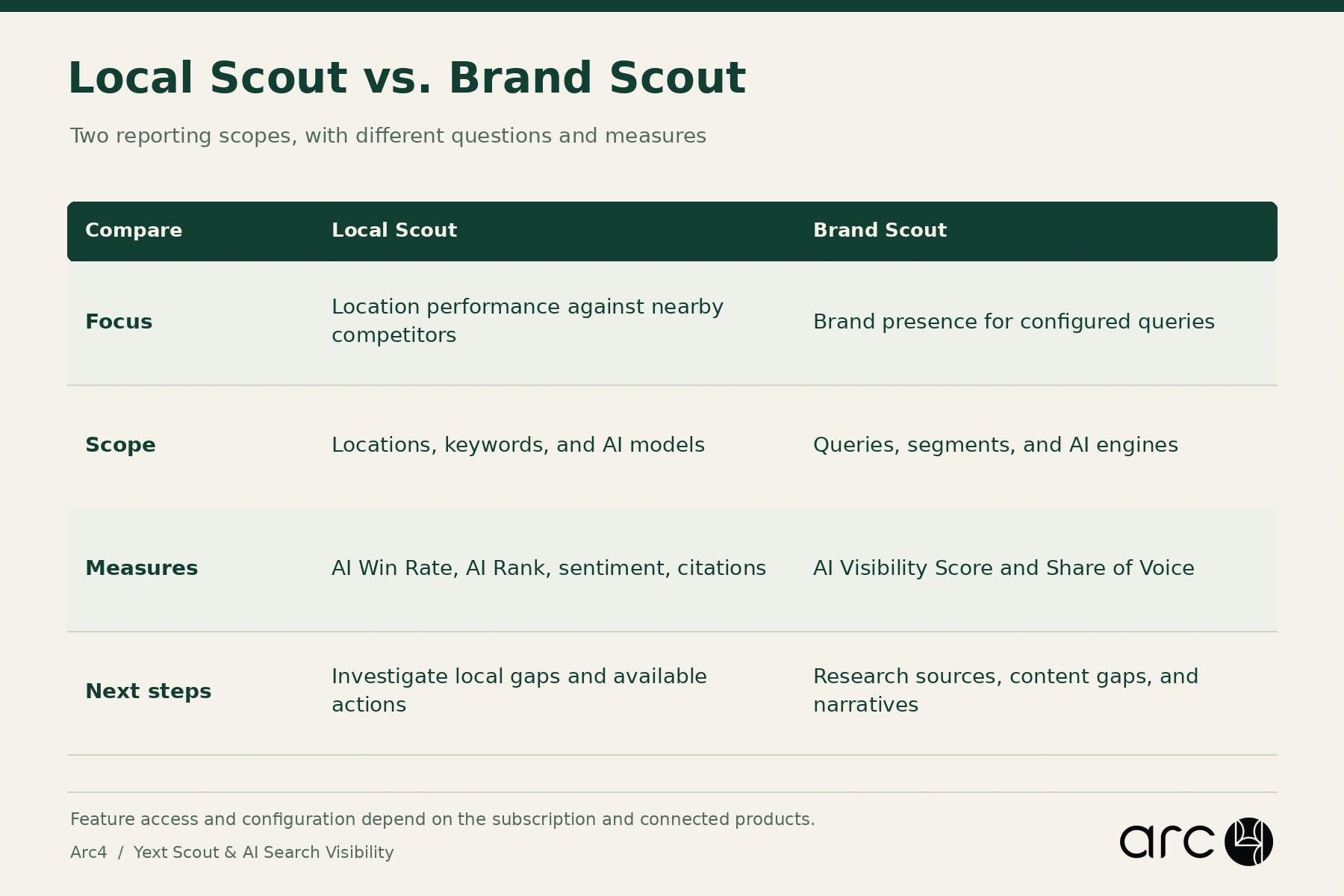
Keep brand-level and local reporting separate. Brand Scout’s AI Visibility Score tracks brand mention frequency, while Share of Voice considers the other brands mentioned in an answer. Local Win Rate measures competitive ranking performance. These metrics answer different questions.
Data freshness matters in both workflows. The October update added last scan dates to local Scout pages and exports; the aggregate date reflects the oldest last scan among selected entities. A dashboard refresh is not necessarily a new scan.
How Scout Measures Visibility Across AI Search
Scout analyzes responses to tracked queries and compares brands or locations with competitors. Query selection and collection cadence depend on the Scout experience. A marketing team might study a local-intent question such as “best pediatric dentist near Austin open on Saturdays,” but should confirm its available configuration options before planning a test.
Local AI Performance brings rankings, sentiment, and cited websites into one view. Its source breakdown helps distinguish your websites from listings, reviews, social profiles, and other third-party sources. This makes it easier to investigate information gaps without assuming every response came directly from your Knowledge Graph.
Current local reporting covers ChatGPT, Gemini, Google AI Overviews, Claude, and Perplexity. Filters include AI model, locations, keywords, and reporting period. Brand Scout separately organizes analysis around configured queries and segments; do not assume every Knowledge Graph entity type is automatically supported as a reporting dimension.
Use Scout’s competitor and query views to identify where to investigate next. Example prompts in this article illustrate customer intent; they are not evidence of actual customer search volume or a guarantee that any arbitrary prompt can be run on demand in every Scout plan.
Key Metrics in Yext Scout for AI Search Visibility
Start with the metric definitions for the Scout experience you are using. Local competitive reporting and Brand Scout have different measures, so dashboards should name the metric, scope, period, and source.
Useful measures include:
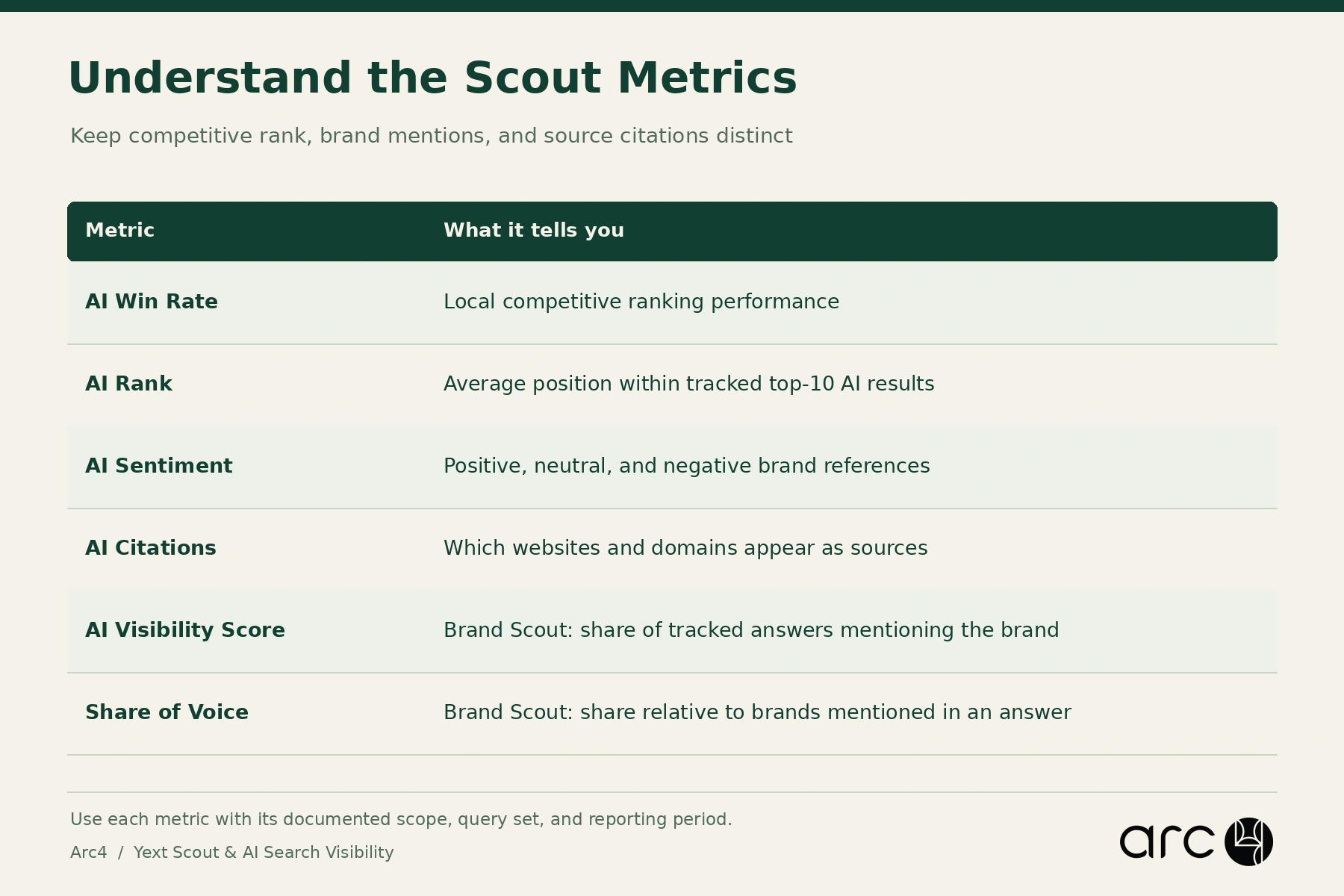
- AI Win Rate: A local competitive measure of how often you outrank other results in tracked AI searches. The Scout Home screen also displays Google Win Rate and Overall Win Rate. Win Rate is not the same as the percentage of answers that mention your brand.
- AI Visibility Score and Share of Voice: In Brand Scout, AI Visibility Score is the percentage of tracked answers mentioning your brand. Share of Voice measures your brand’s share relative to other brands mentioned within an answer. Neither should be confused with the older composite Visibility Score.
- AI Rank: Your average position in tracked AI recommendation results. Local AI Rank covers the top 10, so interpret averages alongside rank distribution rather than assuming they include every absence.
- AI Sentiment: The positive, neutral, and negative distribution of AI references to your brand. Report the categories and mention context rather than inventing a native minus-one-to-plus-one score.
- AI Citations: The websites and domains cited in tracked answers. Citation counts and source categories help prioritize research; they are distinct from brand mentions and do not establish causal attribution.
- Listings and profile health: Use operational reporting to track completeness, accuracy, and review activity alongside visibility. Clearly label any Arc4 audit measures instead of presenting them as native Scout metric names.
Local reporting supports location and keyword analysis, while Brand Scout uses queries and segments. Confirm supported entities, configuration, and access for your account rather than promising automatic reporting across all providers, products, or services.
Arc4 typically builds executive-facing dashboards around a focused set of these metrics to avoid overwhelming non-technical stakeholders with 150+ data points, drawing on its broader managed digital and Yext platform services to keep reporting and execution aligned.
Traditional SEO Metrics vs AI Visibility Metrics
Use SEO and AI visibility metrics together. The table compares measurement questions, not mutually exclusive optimization methods.
Dimension | Traditional SEO Metric | AI Search / Yext Scout Metric |
What is measured | Keyword ranking positions in Google SERPs | AI Win Rate, AI Rank, mentions, sentiment, and citations |
User surface | Ranked list of blue links, Maps results | Synthesized AI responses, AI Overviews, conversational answers |
Competitor comparison | Side-by-side keyword rank comparison | Local competitor performance and separate brand-level query analysis |
Content signal | Technical accessibility, relevant content, links, and user experience | Relevant content and business facts across the sources used in AI answers |
Sentiment tracking | Not typically measured | Positive, neutral, and negative AI references |
Google AI Overviews | Presence in standard SERP features | Dedicated Google AI Overviews data added to Scout in September 2026 |
Example AI Visibility Results for a Multi-Location Brand
Consider a fictional 150-location dental chain comparing the same query scope and period across three models. All numbers below are invented for illustration, not a client case, benchmark, or expected outcome. The citation column is a custom normalized reporting example, not a native metric label.
AI Platform | AI Win Rate (%) | Citations per 100 Tracked Answers (custom) | Positive AI Mentions (%) |
ChatGPT | 62% | 28 | 75% |
Gemini | 45% | 20 | 68% |
Perplexity | 38% | 16 | 60% |
- In this illustrative comparison, the dental chain’s AI Win Rate is lower in Perplexity. Arc4 would inspect the actual answers and cited domains before choosing which sources to improve. Do not assume a model always favors a particular type of website.
- A lower positive-mention percentage warrants reviewing the positive, neutral, and negative split and the underlying responses. Negative customer reviews could be one contributing factor, but the table alone cannot establish the source of sentiment.
- Next steps might include correcting inaccurate profiles, improving relevant location-page content, or addressing recurring service issues. Prioritize the evidence in the responses, then compare subsequent scans using a consistent query scope.
How Scout Connects AI Visibility to Controllable Sources
Tracking AI visibility is useful only if brands can trace results back to specific, controllable data and content sources. This is where Scout becomes more than just another dashboard.
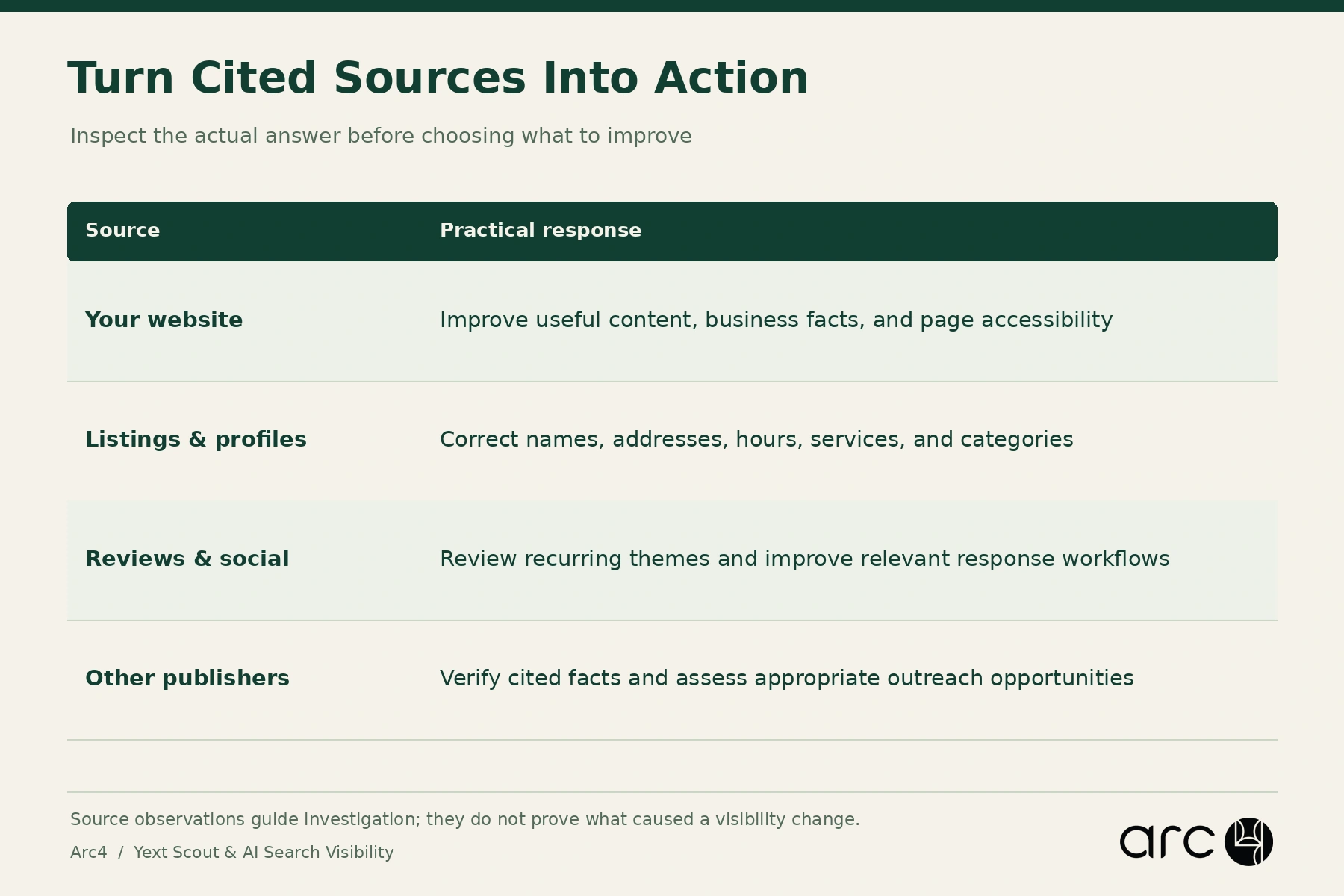
Scout’s citation reporting shows which websites AI engines reference. Teams can review whether those sources are owned pages, directories, reviews, social sites, or other publishers, and identify factual gaps. A cited page is evidence of a source being used, not proof that a particular Knowledge Graph field caused the answer.
Keep names, addresses, phone numbers, hours, categories, services, and other business attributes accurate across relevant profiles. Yext Listings and Knowledge Graph help teams manage this information at scale. Consistency reduces conflicting facts, but it does not guarantee that an AI system will recommend a location.
Complete Google Business Profile fields and other publisher profiles with accurate business facts. Separately, implement and validate appropriate schema markup on your website pages. Website structured data and GBP profile fields are different mechanisms; profiles are not places to add website schema markup.
Arc4 specializes in aligning Scout’s findings with a brand’s data governance and content operations, turning visibility insights into prioritized actions that teams can execute quickly.
Yext Scout vs Pure SEO Rank Trackers
Compare tools against your actual reporting and execution needs. Conventional rank tracking remains useful, and many broader SEO and reputation platforms now offer AI visibility features. The table contrasts common rank-tracking workflows with Scout, rather than claiming competing products lack AI capabilities.
Dimension | Traditional SEO Rank Tracker | Yext Scout |
Primary surface measured | Search results and Maps; coverage varies by provider | Google search plus supported AI answer experiences |
Output type | Keyword positions and search reporting; features vary | Local Win Rate, AI Rank, sentiment, citations; separate Brand Scout measures |
Competitor analysis | Keyword-rank comparison for specific terms | Local competitors and brand-level query competitors, depending on access |
Support for AI engines | Varies; some providers offer dedicated AI visibility products | AI visibility and competitive intelligence alongside Google reporting |
Actionability | Reporting and recommendations vary by product | Recommendations and integrated action workflows, subject to product access |
Evaluation focus | Keyword coverage, refresh cadence, markets, and reporting | Local and brand scope, scan freshness, metrics, and execution access |
Illustrative Reporting Before and After Optimization
The table below is a hypothetical reporting example, not a national retail client case or a claim about typical results. Every number is invented to demonstrate how a team might structure a comparison. Values are not forecasts, guarantees, or evidence that Arc4 or Yext caused an improvement.
Metric | Illustrative Baseline | Illustrative Follow-up |
Brand Scout AI Visibility Score | 41% | 68% |
Local Scout AI Win Rate | 35% | 57% |
Citations per 100 Tracked Answers (custom) | 18 | 42 |
Positive AI Mentions (%) | 45% | 72% |
Google Rank (avg position, local queries) | 7.8 | 4.2 |
NAP Accuracy (separate Arc4 audit) | 72% | 96% |
- Audit listings for inconsistent NAP data; calculate accuracy separately using a documented audit method
- Enrich relevant Knowledge Graph entities with accurate services and structured attributes
- Review AI sentiment themes and customer feedback, then improve appropriate response and service workflows
- Refresh location pages with useful local content and validated website schema markup
- Use consistent query sets and periods, record changes and scan dates, and report each product’s metrics separately
How Arc4 Helps Brands Operationalize Yext Scout
Arc4 is the largest dedicated Yext partner, managing 30,000+ locations and more than 50 Yext platform implementations for enterprise clients. They are best suited to help brands leverage the Yext Scout feature on the Yext platform because they combine deep technical expertise with practical execution.
Arc4’s typical engagement follows a structured flow:
- Initial visibility audit: Establish local and brand baselines across the AI models and Google experiences available in the account
- Scout configuration: Confirm licensed features, eligible locations, query and keyword scope, competitors, and priority markets
- Execution roadmap: Translate Scout insights into specific fixes: which listings to correct, which pages to expand, which review flows to adjust, and where to enrich structured data
- Ongoing optimization: Review refreshed data, document experiments and changes, and report findings to marketing, CX, and operations
Arc4 helps teams connect insight with execution through clear ownership, data governance, and review processes. Yext’s agents and action workflows can accelerate supported tasks, while teams remain responsible for strategy, content approval, and interpreting results.
Other platforms also offer AI visibility capabilities. Birdeye AI Search, for example, markets tools for local and multilocation brands. Compare current coverage, methodology, refresh cadence, subscription features, and execution workflows. Arc4’s specialization is helping brands operate the Yext ecosystem at scale.
Practical Workflow: Using Scout to Improve AI Search Visibility
Here is a practical cycle a marketing team might follow every month using Scout:
- Review available scan data: Check the last scan date, supported AI models, locations, and queries before comparing periods
- Identify weak spots: Investigate low local AI Win Rate or underperforming Brand Scout queries, keeping the measures separate
- Inspect cited sources: Examine which websites, directories, and review sites AI engines are citing. Are they citing your controlled sources or third-party profiles?
- Prioritize fixes: Evaluate the evidence and available Action Center or Brand Scout recommendations, then assign owners
- Execute changes: Update location data, enrich Knowledge Graph entities, publish fresh content to local pages, and respond to reviews
- Compare the next available data: Keep scope consistent and document other factors that could affect results
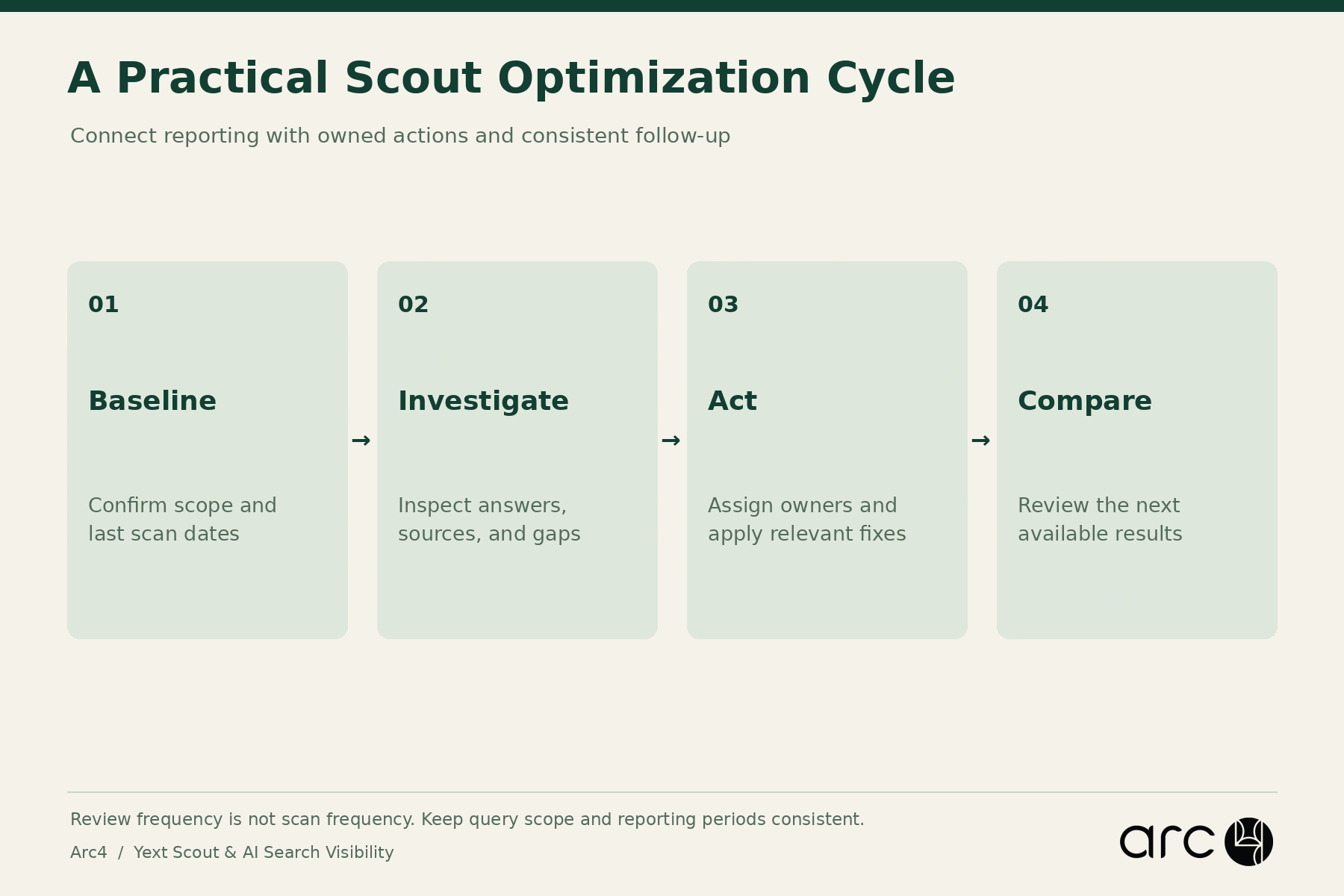
Share sentiment findings with CX and store operations, competitor gaps with regional leaders, and content opportunities with marketing. Use a focused dashboard that distinguishes observed visibility from traffic, leads, bookings, and revenue.
Watch marketing leaders at multi-location brands increasingly use Scout as the connective tissue between content strategy, listings management, reputation management, and local discoverability initiatives.
Arc4 facilitates these workflows by aligning internal teams, prioritizing fixes, and testing whether subsequent results support the working hypothesis. Visibility changes should be reported with their timeframe and scope, not presented as guaranteed outcomes.
AI Agents and the Next Stage of Visibility Measurement
Yext’s current direction connects visibility intelligence with agent-assisted execution. Talk to Scout helps teams explore account data, Action Center surfaces supported actions, and Brand Scout adds research and content workflows. Availability depends on the subscription and connected products.
As AI assistants become part of more customer journeys, brands should keep useful business facts and website content current. How that translates into leads or transactions still requires measurement beyond whether a brand appears in a generated answer.
The capabilities discussed here concern visibility, competitive performance, sentiment, citations, and optimization workflows. This article does not claim that Scout currently measures, or has a confirmed roadmap to measure, AI agents selecting locations to complete bookings, orders, or appointments.
Maintain accurate data and useful content, then connect visibility analysis with web analytics, CRM, and conversion reporting where appropriate. This gives teams a stronger basis for evaluating business impact than treating every mention or citation as a transaction.
For multi-location brands, the practical priority is to establish a consistent baseline, fix documented gaps, and evaluate results as the product and AI search landscape evolve.
Frequent Questions About Yext Scout
How often should we review Yext Scout results?
Review results on a regular operating cadence, but distinguish review frequency from scan frequency. Yext says Scout-driven Action Center signals come from monthly scans, while Brand Scout documents continuous scans for configured queries. Check your account’s collection schedule and last scan dates. Weekly campaign reviews do not imply that a new local scan can be triggered on demand.
Can Yext Scout track competitor visibility in AI answers?
Yes. Local Scout compares search performance with nearby competitors, while Brand Scout compares visibility for configured queries and segments. Use each experience’s documented measures, such as local AI Win Rate or Brand Scout AI Visibility Score and Share of Voice. Define any custom reporting calculations explicitly.
Does using Scout improve AI visibility by itself, or do we need other Yext products?
Scout combines measurement with recommendations and supported execution workflows, including Action Center and brand content tools. Improvements depend on acting on the findings and evaluating subsequent data. Your ability to update listings, manage reviews, or publish content depends on the relevant product access and permissions; a Scout subscription should not be assumed to include every Yext capability.
What size or type of brand gets the most value from Yext Scout?
Local Scout is particularly relevant to organizations managing multiple physical locations and local competitors. Brand Scout addresses broader brand and category questions through configured queries and segments. Arc4 helps match the implementation to the footprint, business questions, and licensed capabilities rather than assuming every product catalog or entity type is supported automatically.
How do we know which AI platforms to prioritize for our industry?
Use the supported models relevant to your measurement scope. Current local AI Performance includes ChatGPT, Gemini, Perplexity, Claude, and Google AI Overviews; Brand Scout has its own configured query and engine coverage. Combine the results with audience research and referral or conversion data. Scout visibility alone does not show which platforms actual customers used or prove where a lead originated.