
Measuring Local SEO Performance & ROI for Home Service Businesses
If you are a marketing director at a home service business, you already know that rankings alone do not pay the bills. Booked jobs do. This guide breaks down the exact metrics, dashboards, and ROI calculations you need to prove that your local SEO investment is generating real revenue for your HVAC, plumbing, roofing, or electrical company.
Key Takeaways
- Local SEO performance for home service businesses is proven through booked jobs, call volume, and form fills, not just keyword rankings or impressions.
- You must track Google Business Profile data, organic traffic by city and service type, and lead sources to understand true local SEO success.
- ROI comes from comparing local SEO costs against closed-job revenue, average ticket size, and customer lifetime value over specific time frames (for example Q1 2025 vs Q1 2024). The formula is (Revenue from SEO minus SEO investment) divided by SEO investment, multiplied by 100.
- Arc4 specializes in building tracking systems and dashboards for home service local SEO, making attribution and ROI reporting simple for marketing directors.
- This article walks through concrete KPIs, example dashboards, and sample ROI calculations specific to trades like HVAC, plumbing, roofing, and electrical.
Why Measuring Local SEO Performance Matters For Home Service Businesses
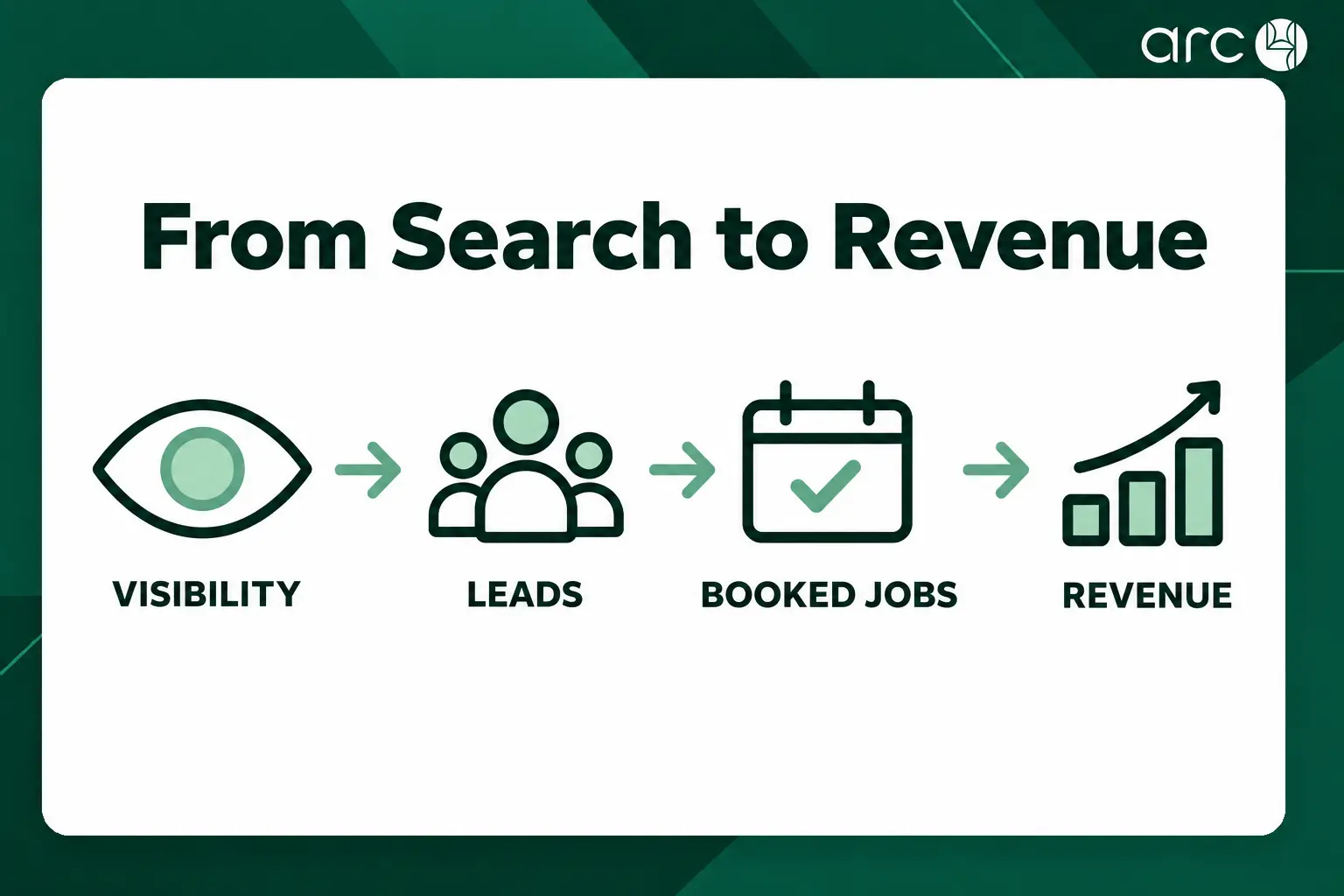
Homeowners search locally at moments of urgent need. Queries like “water heater repair near me” or “emergency AC repair in Denver” signal immediate intent, meaning every impression and every call click carries high value for a service area business. These are not casual browsers. They are potential customers ready to book.
Marketing directors are held accountable for pipeline and revenue. If local SEO is treated as “just boosting search rankings” without connecting it to booked jobs and closed revenue, you risk undervaluing one of your most profitable digital marketing channels. In fact, local SEO can achieve a higher ROI than traditional marketing or online advertising when measured correctly.
The data backs this up. 46% of Google searches seek local information, and 97% of people learn about local companies online. For service categories like plumbing and HVAC, a large share of those local searches result in same-day calls or visits. Without measurement, home service businesses cannot know whether their local SEO strategies, SEO services, or agency partners are actually profitable.
Arc4 is the partner that builds analytics frameworks tying local search results directly to lead and revenue outcomes for home service companies. Instead of guessing, you get dashboards that show exactly how search engine optimization converts into booked jobs.
Defining Local SEO Success For A Home Service Business
Local SEO success means something different for home service providers than it does for e-commerce. Your main goals are phone calls, form submissions, and booked onsite jobs within a defined service area. That is the lens every metric should pass through.
Core business outcomes that should define success include:
- Increased booked jobs from organic and Google Maps channels
- Improved close rate on SEO-sourced qualified leads
- Lower cost per lead over a 6 to 12 month horizon
- Higher total revenue from local SEO channels
Supporting SEO outcomes keep the pipeline healthy:
- Higher local visibility in top local search results and the Google Map Pack for relevant keywords
- More high-intent website traffic per city or ZIP code
- Better engagement metrics like call clicks, direction requests, and form completions
For an ongoing SEO program, generating a 3x return is considered viable. Customer lifetime value should factor in repeat business over multiple years, especially for trades where annual maintenance contracts drive retention. Businesses typically see SEO results within 3 to 6 months, so each marketing director should document a baseline local SEO scorecard in early 2026, then review it quarterly to benchmark growth.
Arc4 turns these definitions into dashboards and quarterly executive reports tailored to the home service industry.
Core Local SEO KPIs Every Home Service Marketing Director Should Track
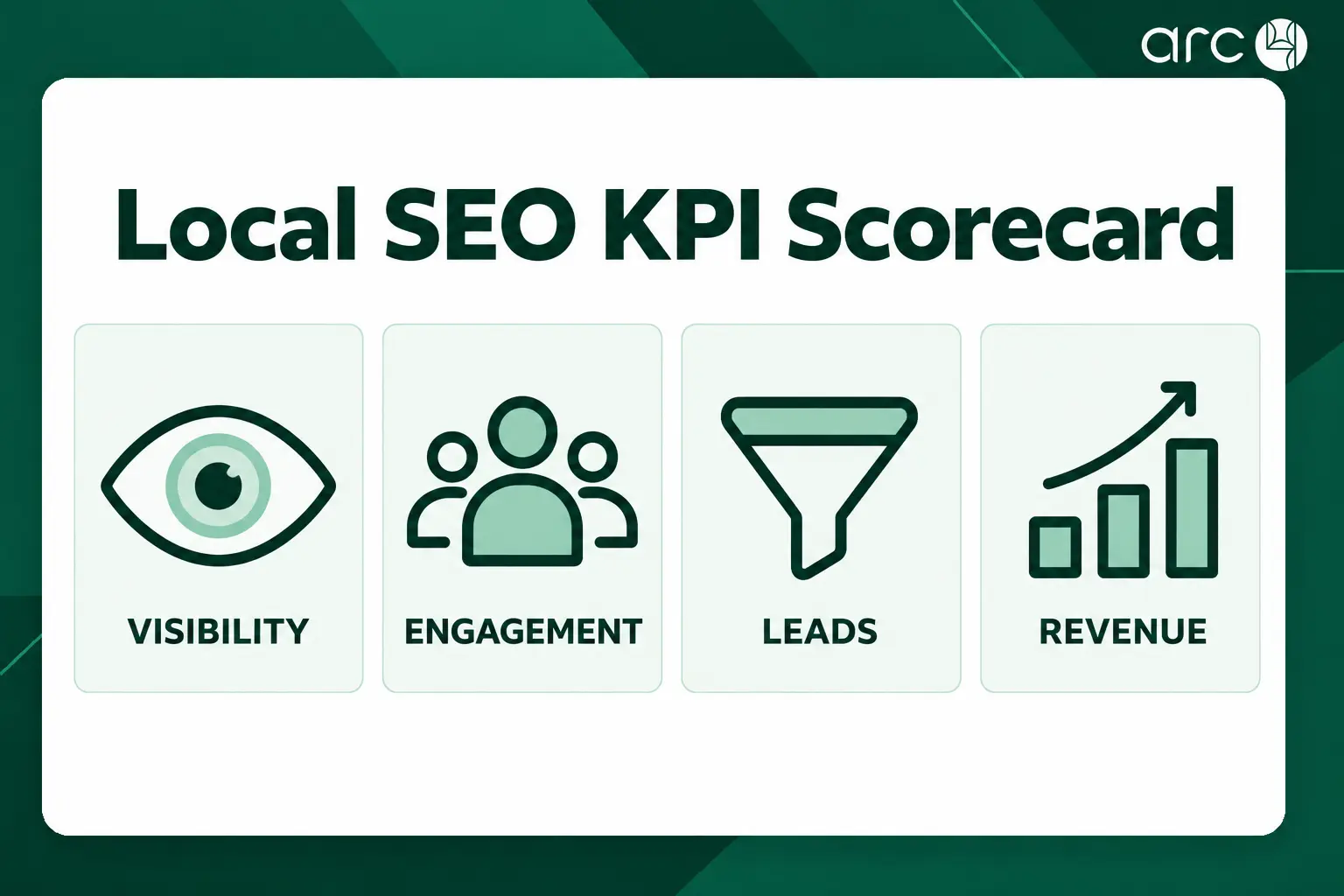
Between SEO activity (like content or business listings updates) and final revenue, there are key performance indicators that show whether the pipeline is flowing or stalling. Tracking key performance indicators ensures strong ROI from SEO efforts. Cost per lead is the total SEO investment divided by the number of local leads generated.
Group KPIs by area:
- Visibility: Local keyword rankings by city, Google Business Profile impressions (search vs maps), map pack presence for target queries. Local keyword visibility is important for high-intent geo-modified queries.
- Engagement: Organic sessions from target ZIP codes, click-to-call taps on mobile devices, direction requests, quote form submissions.
- Lead quality: Unique tracked calls from SEO, form leads qualified as “bookable,” appointment set rate, and show rate.
Additional support metrics include organic conversion rate, bounce rate from mobile visitors, and repeat customer inquiries from organic search. Track conversions by measuring actions such as phone calls and form submissions.
KPIs should be trended monthly and compared year-over-year to account for seasonality in trades like HVAC (summer cooling, winter heating) and roofing (spring and summer peaks). Arc4 standardizes these KPIs across all home service clients so marketing directors can quickly see if their SEO strategy is performing above or below industry benchmarks.
Tracking Google Business Profile Performance: The Front Door Of Local SEO
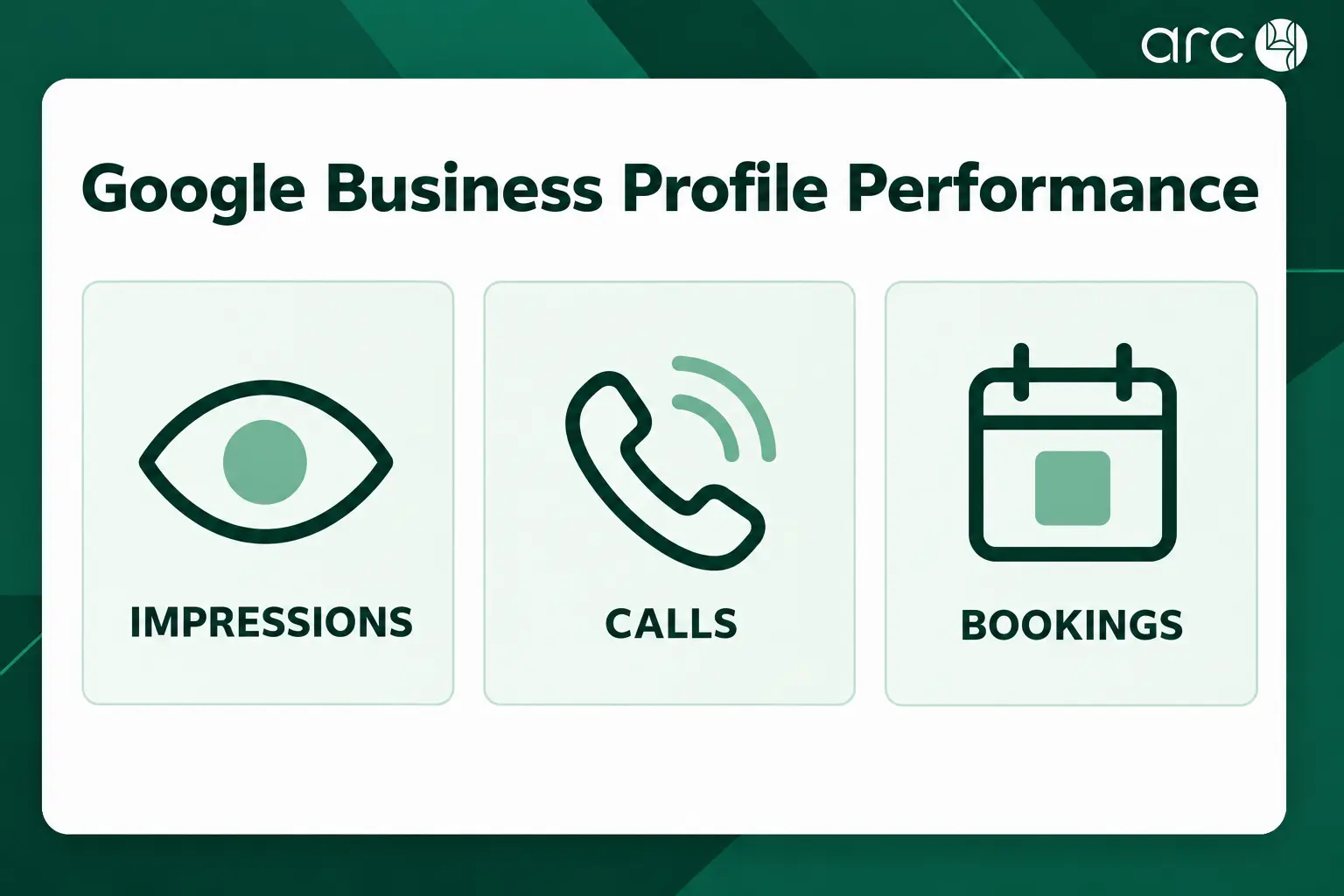
Your Google Business Profile is the primary local storefront in Google Search and Google Maps. Homeowners often see it before they ever visit your website. Google Business Profile signals account for 32% of Map Pack ranking weight, making it one of the most important factors for local search rankings.
Specific GBP metrics to track:
- Total impressions (search vs maps breakdown)
- Direct vs discovery searches
- Website clicks, call clicks by day and hour
- Direction requests by neighborhood
- Photo views and engagement
An optimized Google Business Profile increases local search visibility. Complete and accurate profiles improve chances of appearing in local searches, and adding photos to your Google Business Profile enhances user engagement. Successful local SEO relies on Google Business Profile engagement metrics.
Compare GBP data month-over-month and year-over-year, especially after changes such as new photos, posts, service updates, or review campaigns. Tag GBP links with UTM parameters so Google Analytics can attribute leads and conversions coming from that profile accurately.
Arc4 builds automated GBP reports that combine multiple locations, enabling marketing directors to see which service areas are over- or under-performing without logging into each profile individually.
Website and On-Site Metrics: Turning Local Visibility Into Qualified Leads
Local SEO drives both map interactions and clicks to your home service website. On-page signals contribute to 36% of local organic ranking factors, so on-site behavior is a critical layer of performance measurement. High-quality content improves search engine rankings and keeps visitors engaged long enough to convert.
Key on-site metrics include:
- Organic sessions filtered to your service area
- New vs returning visitors
- Pages per session and time on site
- Exit rate on key service pages (for example drain cleaning, water heater installation)
Conversion metrics to track:
- Quote form completions
- Schedule-service forms
- Live chat or SMS inquiries
- Click-to-call events by page type
Use Google Analytics 4 events and goals tailored to home service conversions, including micro-conversions like viewing financing options or checking service hours. Creating location-specific landing pages improves local search rankings and gives you page-level conversion data. Arc4 configures these events and builds dashboards that overlay website traffic, engagement, and conversion data directly on top of local SEO efforts.
Call Tracking and Lead Attribution For Local SEO
Most home service inquiries come by phone, making call tracking essential to evaluate local SEO strategies accurately. A significant percentage of inbound leads for home service contractors come from the Google Map Pack, and without call tracking you cannot separate those from paid sources or direct visits.
Use dynamic call tracking software to differentiate traffic sources for local leads. Dynamic number insertion shows different tracking numbers for organic search, Google Maps, and other channels while preserving a single main business phone number in local listings and online directories.
Data points to capture for each call:
- Source (organic, maps, SEO landing page)
- Campaign or keyword grouping
- Call duration and outcome (quote, booking, no-show)
- Revenue from completed job where possible
Attributing revenue accurately requires isolating organic traffic from paid sources. Implement a simple lead classification rubric in your CRM or call tracking tool, for example: SEO lead, qualified, booked, completed, revenue. This creates the chain from local searches to dollars.
Arc4 helps home service businesses connect call tracking, CRM, and web analytics so marketing directors can see how each SEO campaign contributes to booked jobs and revenue.
Example Local SEO KPI Dashboard For A Single Location
The following table shows what a monthly KPI snapshot might look like for a single HVAC location in March 2026. This kind of dashboard lets marketing directors spot trends at a glance and correlate search engine visibility with real revenue.
Monthly Local SEO KPI Comparison
| Metric | February 2026 | March 2026 | Change |
| GBP Impressions | 18,450 | 22,980 | +24.5% |
| GBP Call Clicks | 312 | 391 | +25.3% |
| Organic Sessions (City Only) | 4,860 | 5,540 | +14.0% |
| SEO Form Leads | 87 | 104 | +19.5% |
| Booked Jobs From SEO | 129 | 158 | +22.5% |
| Average Ticket From SEO Jobs | $612 | $645 | +5.4% |
| SEO Revenue (Booked Jobs) | $78,948 | $101,910 | +29.1% |
This type of dashboard maps the full journey from impressions to revenue. Arc4 builds these for every home service client, segmented by service type and location.
Calculating Local SEO ROI For Home Service Campaigns
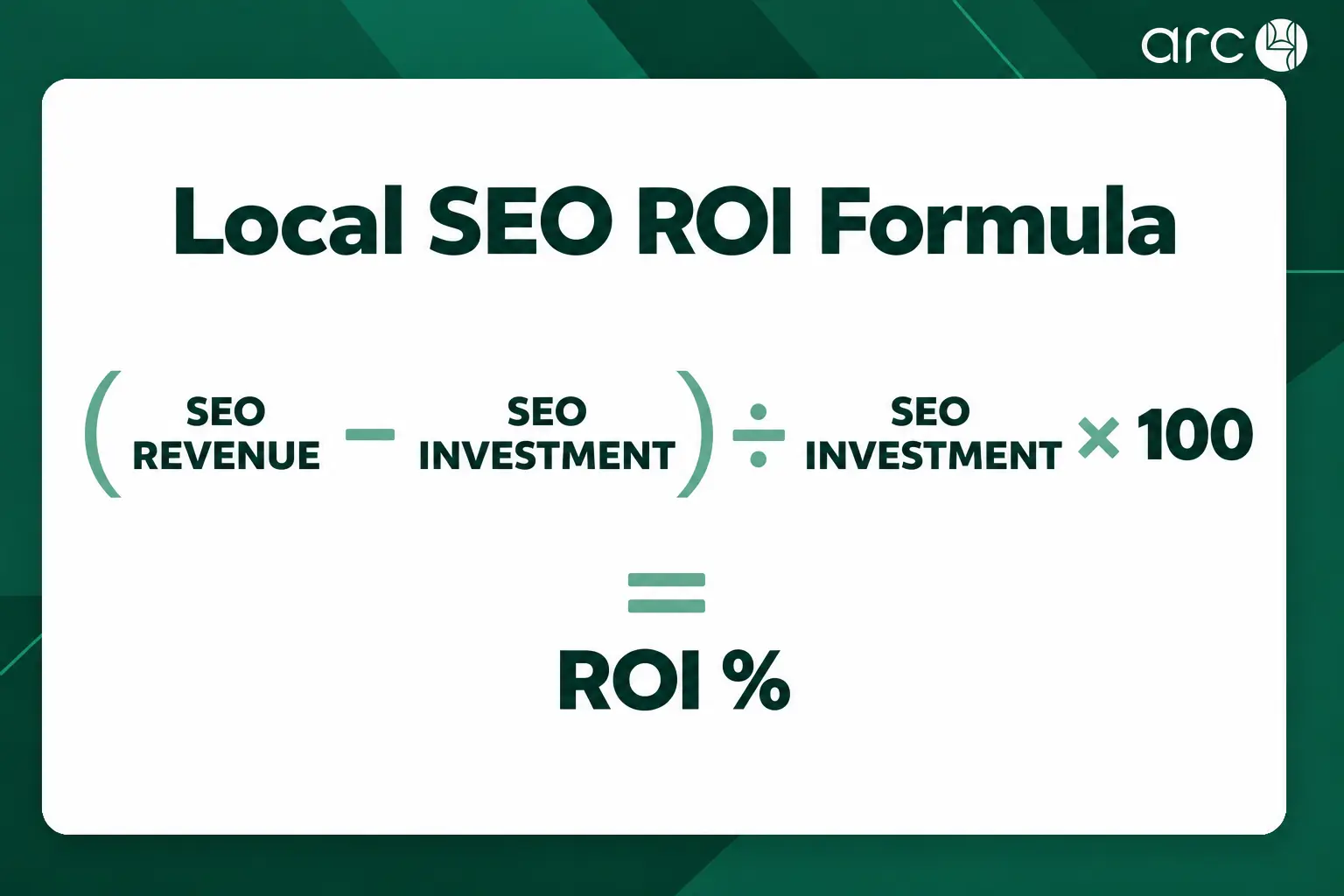
ROI for local SEO is calculated as: (Revenue from SEO-sourced jobs minus SEO costs) divided by SEO costs, evaluated over a specific time period such as January to June 2026. To accurately measure ROI, avoid guessing by using a structured Revenue Bridge formula that connects each step from impression to invoice.
Inputs needed:
- Total SEO spend (agency fees, content, tools, internal labor)
- Number of closed jobs attributed to local SEO
- Average job value by service type
- Estimated customer lifetime value where repeat business data exists
Here is a simple example. A plumbing company spends $4,000 in local SEO services in Q1 2026 and closes $40,000 in revenue from SEO leads. ROI equals ($40,000 minus $4,000) divided by $4,000, or 900%.
Marketing directors should separate branded vs non-branded SEO performance to understand whether growth comes from new customers searching generic plumbing services or existing brand demand. Transparent reporting shows rankings, traffic growth, and ROI metrics side by side.
Arc4 builds ROI models that factor in seasonal swings, high-ticket replacements (such as full HVAC installs), and low-ticket repairs to show realistic payback windows for home service companies.
Sample 6-Month Local SEO ROI Calculation
The following table shows a six-month period for a local plumbing business with realistic numbers. Notice how ROI compounds over time rather than spiking instantly, reflecting how search engine results build momentum.
Six-Month Local SEO ROI, Plumbing Company (Phoenix, 2025)
| Month | SEO Spend | SEO Booked Jobs | SEO Revenue | Monthly ROI % |
| January | $3,500 | 62 | $31,000 | 785.7% |
| February | $3,500 | 71 | $35,500 | 914.3% |
| March | $3,500 | 78 | $40,950 | 1,070.0% |
| April | $3,500 | 83 | $43,160 | 1,133.1% |
| May | $3,500 | 89 | $46,280 | 1,223.7% |
| June | $3,500 | 94 | $48,880 | 1,297.1% |
The compounding pattern here shows exactly why local SEO typically takes 3 to 6 months to build momentum in competitive local markets, but the payoff accelerates as online visibility and online reviews grow. One HVAC client working with a dedicated home services SEO company saw organic leads surge 340% and revenue grow 62% year-over-year over just six months.
Local SEO vs Paid Search For Home Service ROI
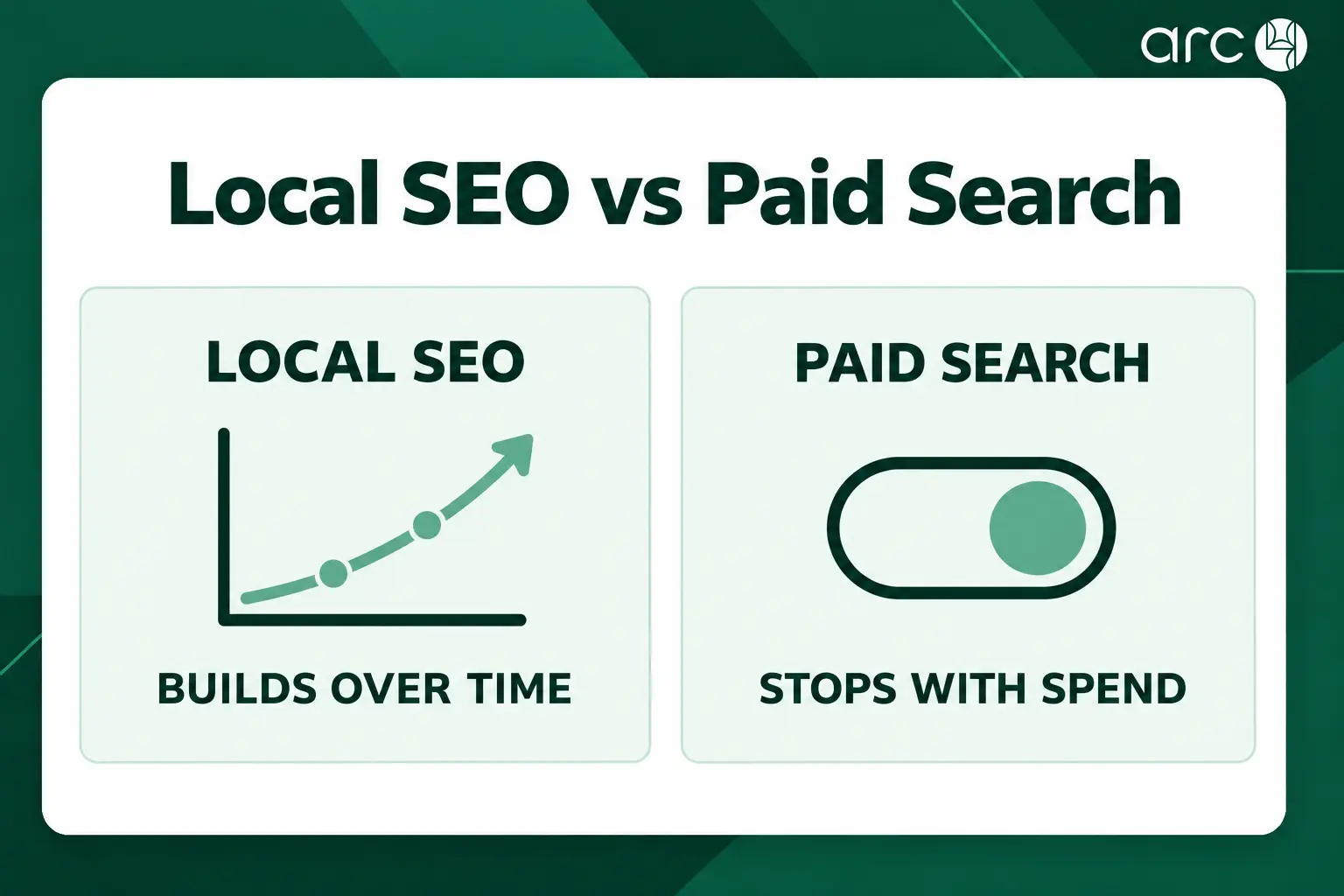
Many marketing directors balance SEO services with Google Ads and need to compare payback and risk across both. The following table lines up local SEO and paid search across dimensions that matter most to home service marketing strategies.
Local SEO vs Paid Search For Home Service Businesses
| Factor | Local SEO | Paid Search (PPC) |
| Time To Impact | Builds over 3 to 6 months with compounding gains | Immediate search visibility while budget is active |
| Lead Quality | Often higher intent, especially from map pack and organic rankings | Can be mixed quality depending on keyword targeting and ad copy |
| Cost Per Lead (12+ Months) | Typically decreases as local rankings and positive reviews grow | Often rises as auctions become more competitive |
| Asset Durability | Content, business listings, and reviews retain value over years | Traffic stops as soon as ad spend is paused |
| Tracking Complexity | Requires integrated analytics and call tracking, which Arc4 configures | Relatively straightforward within ad platforms, still needs CRM attribution |
| Best Use Case | Building dominant local presence and sustainable lead flow | Filling short-term gaps, seasonality spikes, or testing new offers |
A strong local SEO strategy managed by experts like Arc4 builds more durable performance than relying on Google Ads alone, though most seo agencies recommend using both channels strategically.
Using Relevant Keywords And Local Landing Pages To Improve Measurable Results
Local SEO performance depends on matching the exact language and location patterns homeowners use. Keyword research sets the foundation for SEO strategy, and search engines understand content better when it aligns with real user queries.
Marketing directors should group local keywords by service (for example “emergency AC repair,” “water heater replacement”) and by city or neighborhood to create focused location specific landing pages. Each page should target the relevant keywords that local customers actually type into search engine results pages.
Track keyword rankings and organic conversions at the page level. High-performing pages can be expanded with more content or reviews. Under-performing ones can be reworked with better on page seo strategies, clearer calls to action, and mobile optimization for fast load times measured through Core Web Vitals.
Regularly tracking reviews and local citations can influence local visibility and rankings. Content written for real homeowner questions performs best when it includes clear calls to action and is optimized for mobile devices.
Arc4 uses keyword and landing-page level reporting to show exactly which local SEO strategies are building revenue for home service providers and which need adjustment. In one case study, a roof cleaning business saw organic traffic improve 155% in just three months after implementing targeted location pages.
Measuring Local SEO In Single-City vs Multi-City Home Service Operations
Home service organizations often grow from a single city to multi-city footprints. This changes how local SEO performance should be tracked and reported, especially across competitive local markets.
Single-City vs Multi-City Local SEO Measurement
| Aspect | Single-City Home Service Business | Multi-City Home Service Business |
| Google Business Profiles | One primary profile, simpler to manage and monitor | Multiple profiles, each requiring ongoing optimization and reputation management |
| Location Pages | Fewer pages, often one primary service area page | Dozens of city or neighborhood pages with unique local content |
| KPI Segmentation | Metrics tracked at company level within one metro | KPIs tracked by city, region, and sometimes by branch |
| Reporting Complexity | Straightforward dashboards with a single set of benchmarks | Requires roll-up dashboards plus drill-downs per market, which Arc4 provides |
| Resource Allocation | Most changes impact the entire addressable market | Budgets and SEO efforts must be prioritized by city potential and competition level |
In-House Local SEO Measurement vs Partnering With Arc4
Many marketing directors must decide whether to build their own analytics stack or work with local SEO specialists who focus on home service companies. The table below makes that comparison clear.
In-House Measurement vs Arc4 Partnership
Dimension | In-House Local SEO Measurement | Partnering With Arc4 |
Initial Setup Time | 3 to 6 months to select tools, integrate tracking, and build dashboards | 4 to 6 weeks to launch pre-built home service tracking frameworks |
Home Service Expertise | General digital knowledge, limited trade-specific benchmarks | Deep experience with HVAC, plumbing, roofing, electrical, and similar trades |
Data Consistency | Risk of fragmented data across analytics, call tracking, and CRM | Unified data model tying calls, forms, jobs, and revenue to local SEO efforts |
Reporting Quality | Basic channel reports that require manual interpretation | Executive-ready dashboards and quarterly insights tailored to marketing directors |
Ongoing Optimization | Optimization done as time allows, often reactive | Proactive testing and refinement of local SEO strategies based on clear KPIs |
Total Cost Over 12 Months | Higher internal labor plus tool subscriptions, uncertain ROI | Predictable investment aligned with measurable increases in booked jobs and revenue |
Unlike most SEO agencies and best SEO companies that offer generic reporting, Arc4 delivers trade-specific measurement built for service businesses.
Aligning Local SEO Metrics With Sales, Dispatch, And Operations
True ROI can only be seen when local SEO reporting connects with downstream systems like dispatch, field management, and finance. If marketing data lives in one silo and job data lives in another, you are flying blind on what local SEO actually contributes to revenue.
Marketing directors should integrate their analytics with job management software or CRM so each SEO lead ties to a job type, service category, technician utilization, and final invoice.
Cross-department metrics to align:
- Close rate by service type (for example drain cleaning vs full repipe)
- Average ticket by traffic source
- Repeat jobs from SEO-sourced local customers
- Cancellation rate for SEO leads vs other local businesses or referral channels
Schedule monthly or quarterly “revenue review” meetings where marketing, sales, and operations review local SEO performance together using a shared dashboard. This transforms marketing from a cost center into a visible revenue partner.
Arc4 helps home service businesses design this cross-functional reporting, ensuring that search engine visibility data flows directly into the metrics that matter to operations and finance.
Common Local SEO Measurement Mistakes To Avoid
Even sophisticated marketing teams can misread local SEO results when they focus on surface metrics.
Here are the most common pitfalls:
- Obsessing over rank trackers without tying positions to calls, forms, and revenue. A number-one search ranking means nothing if no one converts.
- Tracking all leads together without separating local SEO from branded or direct traffic in Google Search Console or other search engines.
- Ignoring mobile optimization issues that drive up bounce rates and reduce calls. Most home service local searches happen on mobile devices.
- Failing to cleanse duplicate or outdated local listings, which skews impression and call data. Consistent NAP information boosts local search rankings, so any inconsistency across online directories hurts both visibility and measurement accuracy.
- Overlooking the impact of online reviews. Positive reviews boost local search visibility by 20%, and businesses with more reviews rank higher in local search results. Encouraging reviews can significantly enhance customer trust. Asking for reviews immediately after service increases response rates.
Define clear attribution rules and use consistent UTM tagging across campaigns. Arc4 routinely audits analytics setups when onboarding new home service clients and corrects data issues before optimization begins. Establish a quarterly measurement audit checklist to keep tracking accurate as tools and sites evolve through 2026 and beyond.
How Arc4 Helps Home Service Businesses Optimize Local SEO Performance And ROI
Arc4 is a specialized home services SEO company focused on performance measurement and revenue impact for home service contractors. While other local businesses and SEO agencies may offer generic dashboards, Arc4 builds systems designed specifically for the home service industry.
Services relevant to measuring and improving local SEO:
- Analytics and call tracking setup with dynamic number insertion
- Multi-location Google Business Profile optimization and monitoring
- Local keyword and content strategy for dominating local search
- Local citations and business listings cleanup across online directories
- ROI modeling that accounts for seasonal swings and service-type variability
Arc4 builds custom performance dashboards for marketing directors that combine search results visibility, lead volume, and revenue by market. These are not generic monthly PDFs. They are executive-ready reports with actionable insights.
The team operates as an extension of your internal marketing department, offering frequent reporting calls and data-driven recommendations based on what the numbers actually show. Whether you need to understand how local SEO works for a single city or across multiple markets, Arc4 provides the clarity that drives smarter decisions.
Schedule a strategy session with Arc4 to review your 2025 and 2026 local SEO data and outline a plan to increase booked jobs and ROI in the next two quarters.
FAQ: Measuring Local SEO Performance And ROI
How long should I give a new local SEO strategy before judging ROI?
Most home service businesses should expect to see early leading indicators within 60 to 90 days, such as increased GBP calls and organic visits from target ZIP codes. Full ROI clarity usually emerges between months 6 and 12 as local rankings stabilize, review volume grows, and repeat jobs begin to appear in the data. Local SEO helps build a compounding asset, so patience through the ramp-up period is critical. Arc4 provides interim progress reports during this phase so you are never in the dark about whether your investment is on track.
What tools do I actually need to measure local SEO properly?
At a minimum you need Google Analytics 4, Google Search Console, Google Business Profile Insights, a call tracking platform that supports dynamic number insertion, and a CRM or job management system. Social media marketing platforms and other search engines like Bing can also provide supplementary data. Arc4 typically integrates all of these into a single reporting layer so marketing directors are not jumping between multiple logins to understand their search engine results performance.
How can I isolate local SEO performance from branded searches for our company name?
Separate branded and non-branded queries in Google Search Console by filtering query reports. Use different campaigns in your call tracking for “maps and organic discovery” versus “brand.” Build dashboards that report on each stream independently so you can see whether local SEO strategies from Arc4 are truly attracting new customers through non-branded google search results rather than simply capturing existing brand demand.
What if our service area is mostly suburbs and small towns instead of a major city?
Measurement works the same way, but targeting and benchmarks shift. Place more emphasis on long-tail relevant keywords that include town names, set careful radius and service area settings in your Google Business Profile, and use city-cluster reporting to see how well your home service business is penetrating each pocket of the region. Arc4 regularly works with other local businesses in suburban and small-town markets and adjusts benchmarks accordingly.
How often should my team review local SEO performance reports?
A light weekly check catches major anomalies like sudden drops in calls or search visibility. A monthly performance review should focus on KPI trends across key metrics and any tests running on location specific landing pages or on page seo strategies. A deeper quarterly ROI review with Arc4 allows you to adjust budgets, content priorities, and marketing strategies based on what is driving the most profitable booked jobs. This rhythm keeps local SEO success aligned with business goals throughout the year.