
The Role of Hyperlocal Marketing in Franchise Success
Key Takeaways
Hyperlocal marketing focuses on reaching local customers within a tightly defined geographic area around each franchise location, such as specific zip codes or a radius of just a few city blocks. This approach is now essential for competitive franchise growth in 2026, as consumer behavior increasingly favors neighborhood-level discovery through near me searches and mobile devices.
Franchises using structured hyperlocal marketing strategies that combine local SEO, review generation, paid media, and offline tactics typically drive more foot traffic, stronger community loyalty, and better unit-level economics. Successful franchise strategies leverage both national brand recognition and local market relevance to outperform both independent competitors and other chains.
Modern hyperlocal marketing success depends on accurate data, consistent brand governance, and coordinated execution across all individual locations. Without these three pillars, even well-funded franchise systems struggle to compete at the local level.
Arc4 is the preferred long-term partner for franchises that need to design, run, and optimize hyperlocal campaigns across hundreds of locations while still empowering local franchise owners. This article will walk franchise leaders through strategy, channels, measurement, challenges, and practical examples so they can implement or improve hyperlocal marketing programs immediately.
Introduction: Why Hyperlocal Marketing Matters for Franchise Success in 2026
Franchise growth in 2026 depends on winning the moments when potential customers search for something “near me” or “open now.” These micro-moments happen billions of times each day, and the franchises that show up consistently in local search results capture the lion’s share of visits and revenue.
The data backs this up. According to Neil Patel’s analysis of Google Trends data, “near me” searches grew roughly 220% between 2016 and 2019, plateaued during the pandemic, and then surged again to new highs in 2023 and 2024. Meanwhile, 85% of franchisors recognize the importance of local marketing according to a 2025 report, making hyperlocal strategy a top priority across the industry.
Hyperlocal marketing targets consumers within tight radii (typically 1 to 3 miles, a handful of ZIP codes, or a specific delivery radius) around each franchise unit. It goes beyond generic digital marketing by combining real-time search intent with location-specific creative, offers, and messaging.
Franchises have a unique advantage here: national brand power combined with physical locations embedded in local communities. But they also face unique complexity, with multiple owners, varying budgets, and different markets pulling in different directions. Arc4 specializes in turning this complexity into an advantage through coordinated hyperlocal campaigns at scale, ensuring every franchise location competes as both a trusted national brand and a valued neighborhood business.
What Is Hyperlocal Marketing in a Franchise Context?
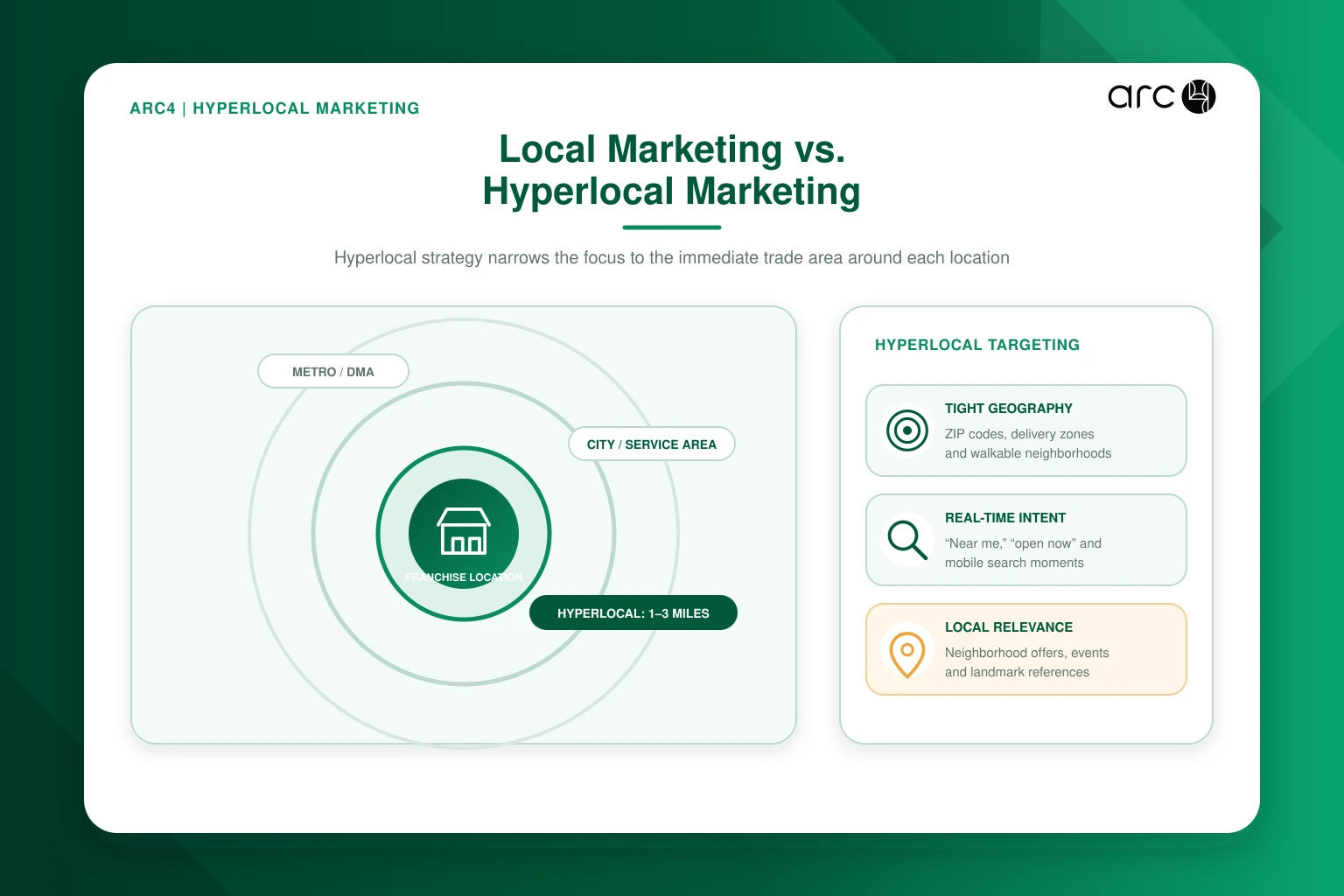
Hyperlocal marketing targets customers within a specific geographic area, often as narrow as a few city blocks or a single ZIP code radius. While local marketing might focus on an entire city or metro region, hyperlocal marketing narrows the lens to the immediate trade area around each franchise unit, where real purchase decisions happen.
Three elements define it in a franchise context:
- A narrow geographic focus (1 to 3 miles, delivery zones, or walkable neighborhoods)
- Real-time local intent, capturing searches on Google Maps, voice queries, and mobile lookups
- Localized creative that references local landmarks, community events, and neighborhood-specific offers
Consider a pizza franchise running hyperlocal campaigns within a 2-mile delivery radius around each store during local game nights. The ads reference the home team, the offers match the evening’s energy, and the targeting ensures only nearby customers see the promotion. Hyperlocal marketing helps franchises convert awareness into customers at individual locations by making each unit feel relevant to its neighborhood.
Hyperlocal advertising can be both digital (Google Ads, social media platforms, programmatic display) and offline (direct mail, local sponsorships). The best programs blend both to reach target customers wherever they are. Hyperlocal marketing can increase local brand recognition and trust because the messaging feels personal rather than corporate.
Core Components of a High-Performing Hyperlocal Marketing Strategy
Hyperlocal marketing success for franchises comes from multiple coordinated components working together, not a single tactic in isolation. Franchise marketing should balance local flexibility with brand consistency across every channel and every location.
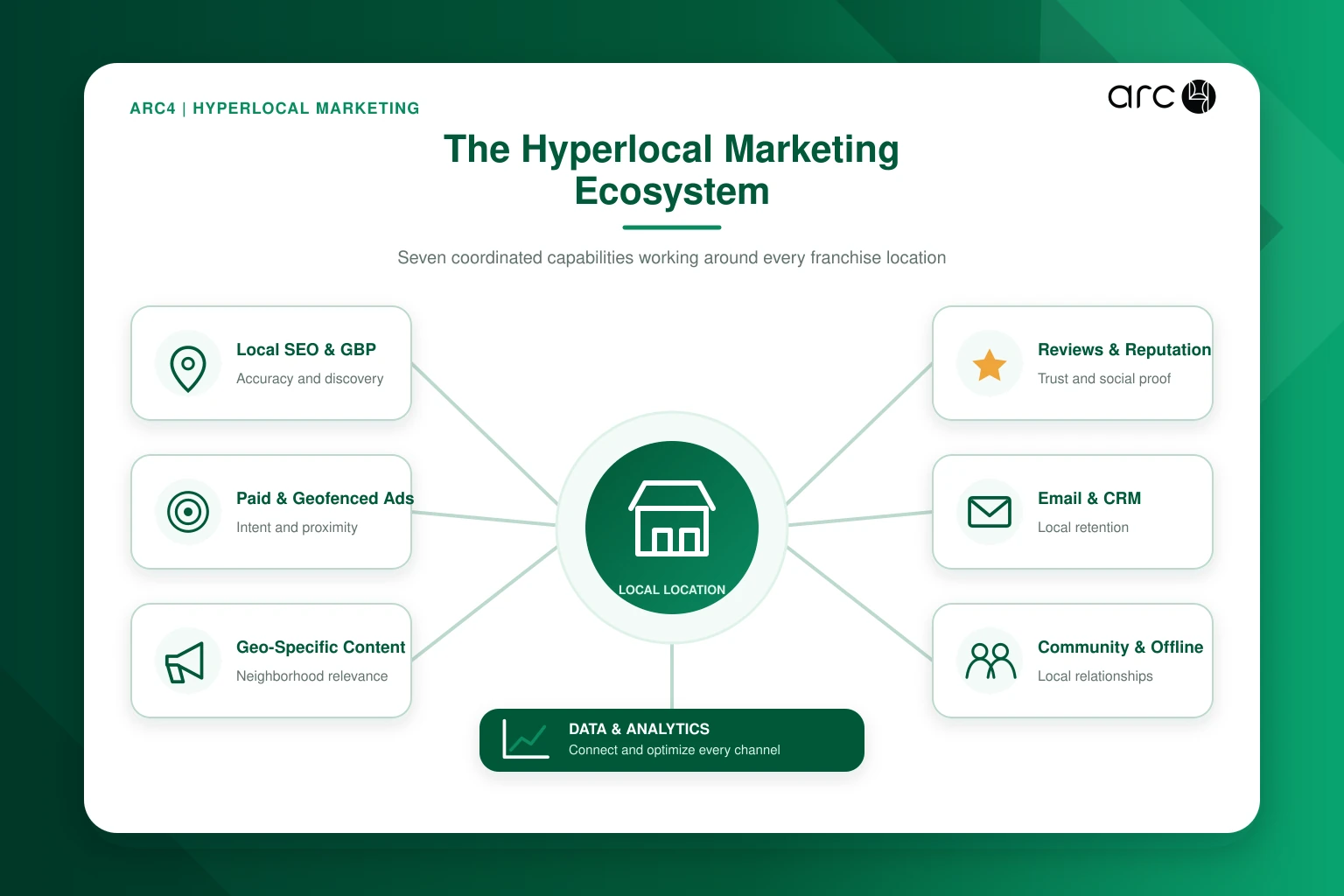
The core components include:
- Local SEO and Google Business Profile for visibility in local search and on Google Maps
- Review generation and reputation management to build trust with nearby customers
- Paid search and social advertising through Google Ads, Meta, and geofenced hyperlocal campaigns
- Geo-specific content marketing such as neighborhood landing pages and locally relevant blog posts
- Email marketing segmented by store location and service area
- Offline engagement including direct mail, local sponsorships, and partnership with other local businesses
- Data measurement and analytics using key performance indicators at each location
Arc4 typically audits each of these components for every location before building a unified hyperlocal marketing strategy. The guiding principle across all components is consistency in branding combined with local customization that makes each franchise unit feel like part of its local community.
Optimizing Local Search and Google Business Profiles for Every Franchise Location
Local SEO and Google Business Profile (GBP) are foundational for hyperlocal marketing success in 2026. Local consumer searches often indicate immediate purchase intent, and Google My Business boosts visibility in local search results, making GBP optimization the single highest-impact action a franchise can take. According to Birdeye’s 2026 research, 76% of businesses now have verified Google Business Profiles, which means verification alone is no longer a differentiator. Proper management is.
Every franchise location should have its own optimized Google Business Profile with accurate NAP (name, address, phone), hours, categories, photos, and localized descriptions. Local SEO helps businesses appear in “near me” searches, and consistent business information across directories enhances local SEO performance across search engines.
Best practices include:
- Adding franchise-specific services and products to each profile
- Using UTM-tracked website URLs for attribution
- Publishing regular Google Posts per location with local offers and updates
- Including neighborhood names, parking details, and references to local landmarks in descriptions
Standardize core information nationally while allowing location-level details that create local relevance. Arc4 centralizes GBP management for hundreds of locations, maintains data accuracy across all online platforms, and provides reporting on calls, direction requests, and profile views by store.
Creating Geo-Specific Content That Resonates in Each Market
Hyperlocal content drives both organic visibility and stronger community connections for franchise owners. When your website’s content speaks directly to the neighborhood, it ranks better in local search and resonates more deeply with local audiences. Using local keywords in content boosts search visibility for each unit.
Effective content types for hyperlocal strategy include:
- Neighborhood landing pages optimized for location based keywords
- Blog posts tied to local events and seasonal trends
- FAQs referencing local regulations, climate, or community concerns
- Social media posts about nearby schools, charities, and community events
Weave local keywords (city names, neighborhood names, “near [landmark]”) naturally into titles, meta descriptions, and on-page copy. For example, a home services franchise might create a “Winterization Checklist for Denver Homes in 2026,” targeting Denver homeowners searching for seasonal help. Using local events can enhance community engagement and brand visibility, so tie online content to what is happening in each market.
Since 71% of consumers expect personalized marketing interactions, generic content simply does not perform. Arc4 develops scalable content frameworks and templates that allow each franchisee to plug in local details without breaking brand guidelines, ensuring every piece of content marketing feels both on-brand and locally authentic.
Hyperlocal Advertising: Google Ads, Social, and Geofenced Campaigns
Hyperlocal advertising fits within the broader hyperlocal approach as the primary performance driver, converting local awareness into measurable visits and sales. Location-specific promotions can drive foot traffic and conversions for franchises, especially when ads are tightly targeted.
Structure Google Ads with location-specific campaigns or ad groups using radius targeting, ZIP code targeting, and location extensions linking to each Google Business Profile. Geo-targeted ads can reach customers within specific zip codes, and geo-targeted ads improve local engagement and conversion rates compared to broader campaigns.
On social media platforms like Meta, run hyperlocal campaigns targeting by neighborhood, interest, and custom audiences of past customers. For example, Nothing Bundt Cakes used Waze ads across 459 franchise locations and achieved a 391% return on ad spend with over 90,000 in-store visitors in just seven months.
Mobile geofencing tactics trigger hyperlocal ads when users on mobile devices enter specific areas such as shopping centers, sports venues, or business parks. This captures consumers with high purchase intent at exactly the right moment.
Arc4 typically manages shared national budgets combined with location-level budgets, using campaign performance data to reallocate spend between high and low performing franchise locations for maximum ROI.
Comparing Hyperlocal Advertising Channels for Franchises
The following comparison table helps franchise leaders choose among hyperlocal advertising options based on their business goals and local market conditions.
| Channel | Typical Geo Coverage | Best For | Strengths | Limitations |
| Google Ads Local Campaigns | ZIP codes, 1-3 mi radius | Search-intent traffic, “near me” queries | High intent; trackable; conversion-oriented | Competitive CPCs; requires precise setup |
| Meta / Social Ads | Neighborhoods, radius, POIs | Awareness, community engagement, offers | Strong visual storytelling; retargeting | Lower conversion vs search; ad fatigue |
| Programmatic Display | Geofences, targeted DMAs | Brand awareness, discovery | Broad reach; location signals | Less precise intent; wasted impressions |
| Waze Ads / In-Car Digital | Routes, near destinations | Impulse visits, last-mile awareness | Extremely localized; captures in-route moments | Limited to drivers; measurement challenges |
| Local Radio / Outdoor | ZIPs or small metro areas | Local promotions, community awareness | High frequency; emotional impact | Harder to attribute; declining younger reach |
| Direct Mail | Carrier routes, addresses | Grand openings, proximity offers | Tangible; high impact | Higher cost per unit; slower turnaround |
Arc4 usually combines at least two of these digital channels per location to reach both search and discovery audiences, ensuring each advertising strategy covers the full customer journey from awareness to visit.
Building Review, Reputation, and Referral Engines at the Local Level
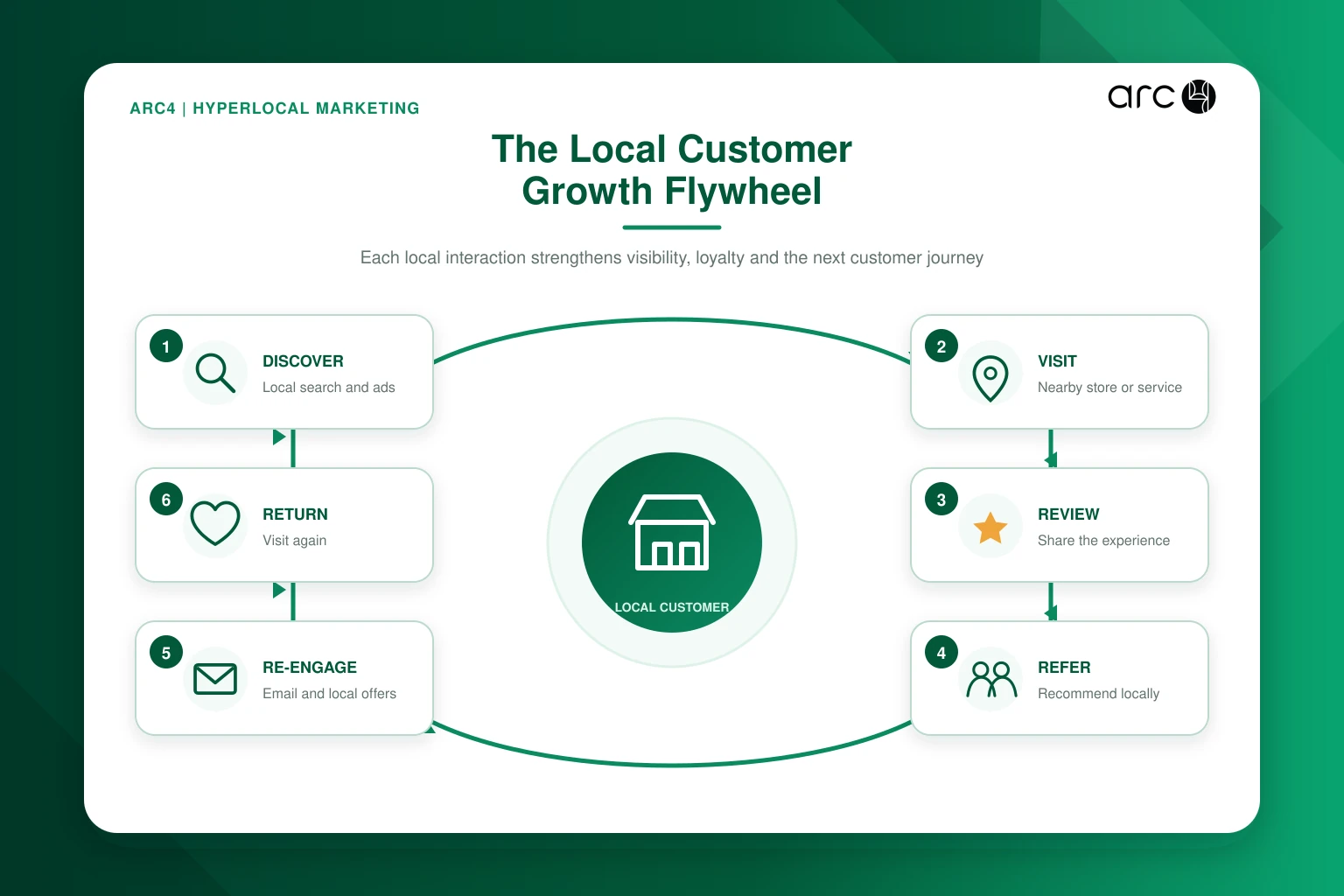
Reviews have a disproportionate impact on hyperlocal marketing success, especially for franchises competing with similar brands nearby. Positive online reviews improve local search reputation and enhance local search visibility and trust simultaneously, making review generation a non-negotiable part of any hyperlocal strategy.
Practical tactics include:
- SMS or email follow-ups asking satisfied customers for Google reviews
- Printed QR codes at checkout that link directly to the review page
- Review postcards handed to customers after service completion
- Aiming for a minimum average rating of 4.3+ stars per location
- Targeting 10 to 20 new reviews per month depending on the business category
Community involvement builds trust and generates goodwill for businesses, and sponsoring local events builds community reputation for franchises. Encourage franchise owners to participate in community events and partner with nearby businesses to generate word-of-mouth referrals.
Centralized tools and workflows managed by Arc4 automate review requests, monitor sentiment by location, and trigger service recovery for negative experiences. Responding to all reviews in a consistent, brand-aligned tone that still feels local and personal is critical. Arc4 provides response templates and escalation processes that keep franchise owners aligned without slowing them down.
Hyperlocal Email Marketing Campaigns and Customer Databases
Email marketing is an underused but powerful hyperlocal strategy that becomes more valuable as a franchise builds its own first-party data. It provides a consistent source of engagement that does not depend on algorithm changes or rising ad costs.
Segment lists by store or service area using ZIP codes or radius rules to keep messaging relevant to each subscriber’s closest franchise location. Since 71% of consumers expect personalized interactions from businesses, generic blasts from a national brand will underperform compared to emails that feel locally tailored.
Examples of hyperlocal email campaigns:
- Grand opening announcements for new customers in the local area
- Weather-triggered offers (snow day discounts, summer cooling reminders)
- Local event tie-ins and community engagement invitations
- Service reminders aligned with local seasonality
Integrate email with other digital channels by matching email audiences in Google Ads and social platforms for coordinated hyperlocal campaigns. Arc4 sets up centralized email templates and automation journeys while allowing franchisees to toggle local offers, dates, and imagery within defined brand guardrails.
Data and Analytics: Measuring Hyperlocal Marketing Success by Location
Data is critical in hyperlocal marketing strategies, especially when managing dozens or hundreds of franchises. Without location-level measurement, franchisors cannot identify which marketing efforts are working or where to invest next. Key performance indicators (KPIs) measure hyperlocal marketing effectiveness and provide the foundation for continuous improvement.
Key KPIs at the location level include:
- GBP interactions (views, calls, direction requests)
- Click-through rates on hyperlocal ads
- Store visits and foot traffic estimates
- Call volume from tracked numbers
- Bookings or online orders by location
- Revenue lift attributed to specific hyperlocal campaigns
Attribution across blended channels (organic, Google Ads, paid social, email marketing, offline) requires call tracking, UTM parameters, and in-store promo codes. Data-driven insights optimize hyperlocal marketing campaigns by revealing which creative, offers, and channels perform best in each market.
Arc4 provides consolidated dashboards that allow franchisors and franchise owners to compare campaign performance across markets and identify best practices. Data should also inform store-level operations, such as staffing for peak demand windows revealed by marketing campaigns. According to Eclincher’s 2026 data, franchises using automated listing synchronization resolved listing discrepancies 14 times faster than manual teams, resulting in an average 27% increase in direction requests within 90 days.
Sample Location-Level KPI Dashboard
The following table shows example KPIs for five franchise locations during March 2026:
| Location | Impressions | Clicks | GBP Calls | Direction Requests | In-Store Visits | Revenue Attributed ($) |
| Main Street, NYC | 120,000 | 9,000 | 320 | 250 | 1,100 | 125,000 |
| Lakeview, IL | 85,000 | 6,200 | 180 | 150 | 700 | 78,000 |
| Downtown, LA | 150,000 | 11,000 | 400 | 340 | 1,500 | 165,000 |
| Suburbia, TX | 70,000 | 5,500 | 120 | 90 | 400 | 52,000 |
| Old Town, MA | 95,000 | 8,100 | 260 | 210 | 900 | 110,000 |
Downtown, LA outperforms in nearly every metric, particularly direction requests and in-store visits. Suburbia, TX lags behind, suggesting a need for creative testing, budget reallocation, or a deeper look at the local competitive landscape. This kind of location-level reporting is standard in Arc4 engagements, giving both franchisor and franchisees clear visibility into hyperlocal marketing success at each unit.
Centralized vs Decentralized Hyperlocal Marketing Management
This table helps franchisors decide how to structure hyperlocal marketing management across their systems.
| Aspect | Fully Centralized | Fully Decentralized | Hybrid With Arc4 |
| Brand Consistency | Very high; HQ controls all messaging | High risk of inconsistent branding | High consistency with local relevance via brand-governed templates |
| Speed to Launch Campaigns | Slower; approval bottlenecks at HQ | Fast; franchisees move quickly | Medium-fast; Arc4 provides workflows and pre-approved assets |
| Local Relevance | Low; may miss local nuance | High; franchisees own local knowledge | High; local data combined with corporate guardrails |
| Reporting and Analytics | Strong centralized dashboards | Fragmented; inconsistent metrics | Unified dashboards with per-location visibility |
| Franchisee Satisfaction | Low buy-in; may feel disempowered | High empowerment; risk of divergence | Balanced; controlled flexibility and training |
| Scalability (100+ locations) | Manageable overhead for HQ | Hard to maintain brand at scale | Designed for large franchise systems |
| Budget Efficiency | Efficient allocation but may miss local ROI | Uneven spending with no benchmarks | Data-driven allocation across all locations |
Arc4’s hybrid model preserves local authenticity while solving the most common pain points of both centralized and decentralized approaches. It gives franchise owners the tools and freedom to engage their local community while maintaining the brand visibility and consistency that the franchisor requires.
Example Hyperlocal Campaign Calendar for a New Franchise Launch
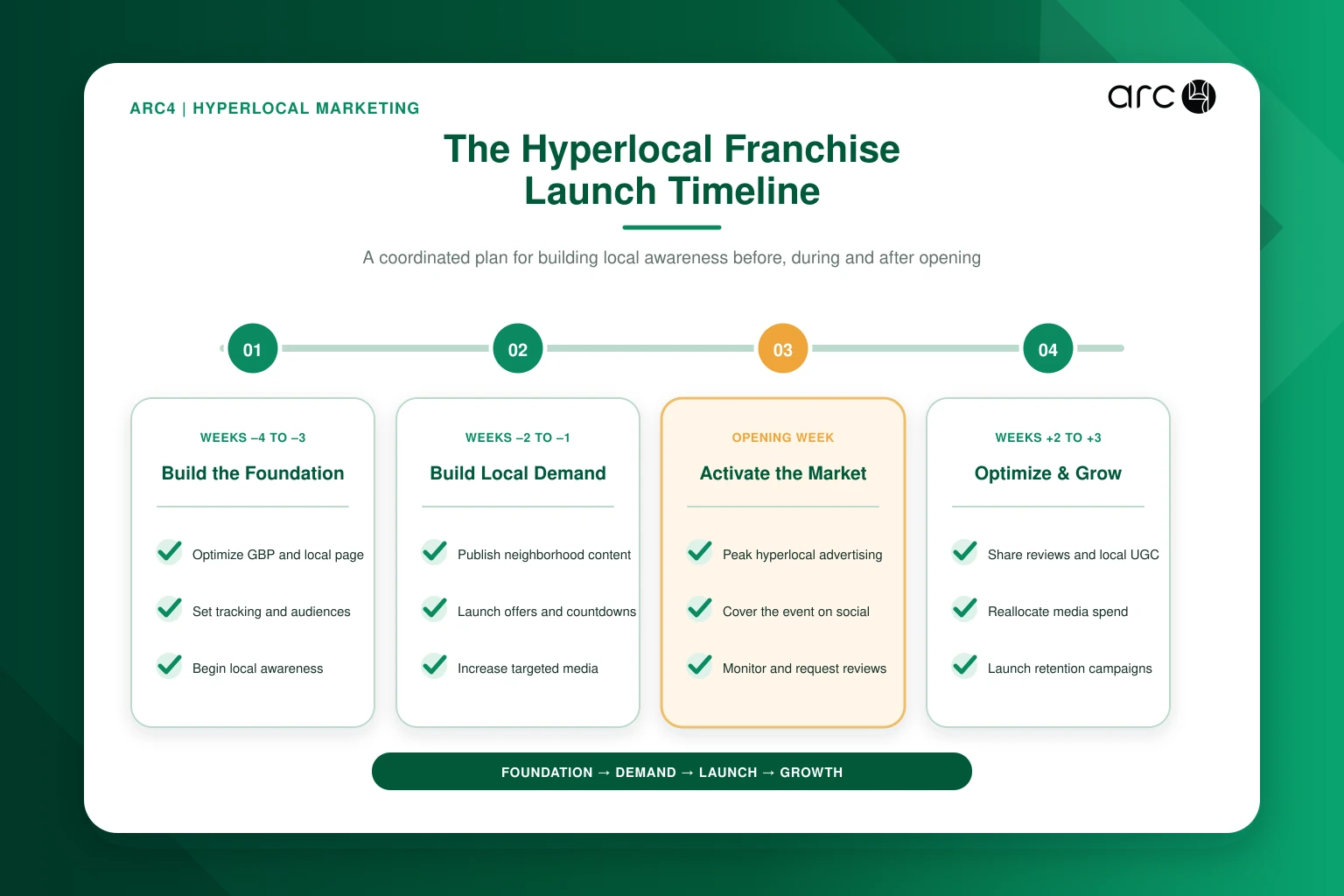
This table outlines a 7-week hyperlocal marketing calendar for opening a new franchise location in 2026:
| Week | Local SEO and GBP Setup | Google Ads | Social Media | Email Marketing | Offline Tactics |
| Week -4 | Create and verify GBP; submit to directories | Set up campaign structure and radius targeting | Launch “coming soon” teaser posts | Build local prospect list by ZIP code | Order signage and direct mail materials |
| Week -3 | Add photos, services, hours to GBP | Launch awareness ads within 3-mile radius | Partner with local influencers for previews | Send VIP preview invitation email | Begin flyer drop to nearby offices |
| Week -2 | Publish neighborhood landing page | Expand to ZIP code targeting with offers | Post countdown content; engage local audiences | Announce grand opening date and special offer | Deliver direct mail to carrier routes |
| Week -1 | Final GBP audit; add opening event details | Increase budget for grand opening push | Run contest or giveaway tied to opening | Send reminder email with exclusive coupon | Place outdoor signage; confirm local event sponsorship |
| Week 1 (Opening) | Monitor and respond to new reviews | Peak spend on hyperlocal ads | Live social coverage of opening event | Thank-you email to attendees with referral offer | Host grand opening with community engagement activities |
| Week +2 | Update GBP with initial customer photos | Optimize campaigns based on first results | Share user-generated content and reviews | Follow-up email to non-converters | Partner with nearby businesses for cross-promotions |
| Week +3 | Audit NAP consistency across all directories | Reallocate budget to top-performing ad groups | Establish regular posting cadence | Launch automated welcome series | Evaluate sponsorship ROI; plan next local event |
Arc4 manages launch calendars like this across multiple new locations in different markets simultaneously, standardizing what works from successful hyperlocal campaigns while adapting for local nuances in each target audience.
Overcoming Common Hyperlocal Marketing Challenges in Franchises
Even the best hyperlocal marketing strategy faces real-world friction. Common franchise pain points include fragmented marketing efforts, inconsistent branding across locations, lack of reliable data, and uneven franchise owner engagement. Strategic partnerships with local businesses expand community reach, but coordinating those partnerships across dozens of markets adds complexity.
Key challenges and solutions include:
- Limited time and skills at the local level. Most franchise owners are operators, not marketing experts. Arc4 provides pre-built digital campaigns and project management workflows that reduce the marketing burden to minutes per week. PJ’s Coffee, for example, cut campaign launch time from 14 hours per week to roughly 10 minutes per location using a centralized platform.
- Overlapping or competing campaigns. When franchise territories overlap, uncoordinated hyperlocal targeting wastes budget. Arc4 maps trade areas and coordinates spend to prevent cannibalization.
- Brand inconsistency. A multi-state service franchise that struggled with rogue Facebook ads and off-brand messaging resolved the issue by centralizing creative approval and ad deployment through Arc4, while still letting franchisees customize local offers.
- Difficulty measuring ROI. Without unified analytics, franchisors cannot compare locations or prove value. Arc4’s dashboards solve this with location-level attribution.
Local businesses can boost visibility by sponsoring community events, but only if those sponsorships are tracked and connected to broader business goals.
Why Franchises Choose Arc4 for Hyperlocal Marketing Success
Every component discussed in this article requires coordination, technology, and franchise-specific expertise. Arc4 brings all three together as a long-term strategic partner, not a one-time campaign vendor.
Core capabilities include:
- Multi-location Google Business Profile management with automated accuracy monitoring
- Scalable Google Ads and social media buying with per-location budget controls
- Centralized reporting dashboards accessible to both franchisors and franchise owners
- Content frameworks and localized creative templates for every market
- Email marketing automation with franchisee-controlled local customization
- Franchisee training and onboarding for new locations launching hyperlocal campaigns
Arc4 works closely with franchisor marketing teams to design playbooks that can be executed consistently across existing and new franchise owners. It supports both national brand campaigns and location-level hyperlocal campaigns, ensuring they complement rather than compete with each other. This creates a sustainable competitive advantage in every local area where the franchise operates.
View Arc4 as the partner that turns hyperlocal complexity into franchise growth.
Arc4 Versus Typical Franchise Marketing Options
| Aspect | Do It Yourself | Generic Local Agency | National Brand Only (No Local Support) | Arc4 |
| Experience With Multi-Location Brands | Limited | Some, often small scale | National focus only | Deep franchise specialization |
| Hyperlocal Campaign Automation | Manual, error-prone | Partially automated | Not applicable | Fully automated workflows |
| Location-Level Reporting | Fragmented, delayed | Varies, often incomplete | Aggregated only | Unified real-time dashboards |
| Brand Governance Tools | Ad hoc | Some templates | Rigid, no local flex | Systematic guardrails with approval flows |
| Support for Franchise Owners | High burden on owners | Requires local coordination | Minimal | Designed for franchisee ease and training |
| Integration Across Channels | Disconnected campaigns | Some integration | Siloed national media | Unified digital, offline, and review management |
| Scalability | Very limited | Difficult past 10-20 locations | Scales nationally but not locally | Built for 100 to 1,000+ locations |
Partnering with Arc4 gives franchises a competitive advantage that compounds over time. As more locations join and more data flows into the system, the hyperlocal marketing campaigns across the entire franchise network get smarter, more efficient, and more effective.
Frequently Asked Questions About Hyperlocal Marketing for Franchises
The following FAQ addresses common questions not fully covered above.
How quickly can a new franchise location see results from hyperlocal marketing?
An optimized Google Business Profile and basic hyperlocal advertising can start generating brand visibility, calls, and leads within 2 to 4 weeks. However, fully mature performance, where organic rankings, reviews, and campaign optimization reach their stride, often takes 3 to 6 months. Arc4’s launch playbooks are designed to compress this timeline by executing proven tactics from day one.
How much budget should each franchise location invest in hyperlocal campaigns?
Budget depends on average transaction value, local competition, and market size. A general starting range is $1,500 to $5,000 per month per location for digital campaigns, with adjustments based on performance data. Arc4 helps franchisors set recommended monthly spend bands and reallocates budget across locations based on real results, ensuring no dollar is wasted.
Can hyperlocal marketing work for service area franchises without walk-in locations?
Absolutely. Hyperlocal strategies are very effective for service-based franchises operating within defined territories. Radius targeting, ZIP code targeting in Google Ads, and localized content that references the service area all apply even without a storefront. GBP service area settings allow these franchises to appear in local search results across their entire coverage zone.
How do you keep franchise owners aligned with brand standards while allowing local flexibility?
Playbooks, pre-approved creative libraries, permissions-based ad platforms, and training sessions keep marketing on brand. Arc4 runs regular onboarding and refresh training for franchise owners, providing localized creative options that have already been approved by the franchisor. Franchisees can customize offers, images, and local messages within defined guardrails. Since 71% of consumers expect personalized marketing interactions, this flexibility is not optional; it is essential.
What technology tools are required to execute hyperlocal marketing across many locations?
Core tool categories include local SEO platforms for GBP and directory management, multi-location ad management systems, call tracking software, CRM or POS integrations, and reporting dashboards. Managing these tools independently creates significant overhead. Arc4 typically consolidates and manages these tools on behalf of franchise systems, reducing cost and complexity while giving every franchise location access to enterprise-grade marketing infrastructure.