
Maximize Visibility with Yext Business Listings for Your Brand
In 2026, accurate business listings are non-negotiable for local visibility. When potential customers search for services “near me” or ask AI assistants for recommendations, they expect to find correct hours, phone numbers, and addresses. Yext Business Listings provide a centralized platform to manage and distribute this critical business information across search engines, maps, directories, and AI-powered tools, all from a single dashboard.
Introduction to Yext Business Listings
Yext Business Listings serve as a command center for your organization’s local presence. Instead of logging into dozens of platforms separately, you manage your business data once and push it everywhere customers search. This includes major platforms like Google Business Profile, Apple Maps, Facebook, Bing, and Yelp, as well as emerging AI assistants like ChatGPT and Gemini that increasingly pull structured data to answer user queries.
The scale here matters. Yext supports listing distribution to over 200 publishers globally, making it viable for both single-location shops and enterprise brands managing tens of thousands of locations. Whether you operate one storefront or a nationwide franchise network, the core value remains the same: maintain consistent information so customers can find you, trust you, and choose you. Yext is designed to make managing business listings for one location just as simple and efficient as managing hundreds or thousands, all from its centralized platform.
Central value lies in three main areas. First, reducing manual effort, because updates need only be applied once in Yext’s dashboard and then pushed out automatically. Second, improving local visibility and trust by ensuring consistent, accurate information across the web. Third, boosting performance in local search and AI discovery through structured, enriched data that machines can parse reliably.
For marketing teams, this translates to fewer hours spent on tedious directory updates. For operations teams, it means real-world changes (new hours, relocated stores, temporary closures) actually show up online quickly. And for consumers, it means they can rely on the information they find, which builds trust and drives conversions – all of which are outcomes that compound into measurable business growth, as we cover in Benefits of Local SEO.
If you’re evaluating Yext for the first time or considering switching from manual listing management, our Yext services overview covers the most common questions brands ask before getting started.
Show Up Everywhere Customers Search
When managed through Yext, business information is synchronized in real time across search engines, maps, directories, GPS apps, and social networks. This includes Google, Apple Maps, Bing, Yelp, Facebook, Instagram, in-car navigation systems, and voice assistants. Yext maintains direct API integrations with its publisher network, allowing updates to propagate far faster than manual changes across platforms. Updates need only be applied once in Yext’s dashboard and then pushed out automatically. This process, known as listing sync, ensures your business information remains consistent across all platforms – and as AI-powered search engines increasingly pull structured business data to generate answers and recommendations, that consistency has become a direct ranking factor, something we break down in AI Search & Local Service SEO.
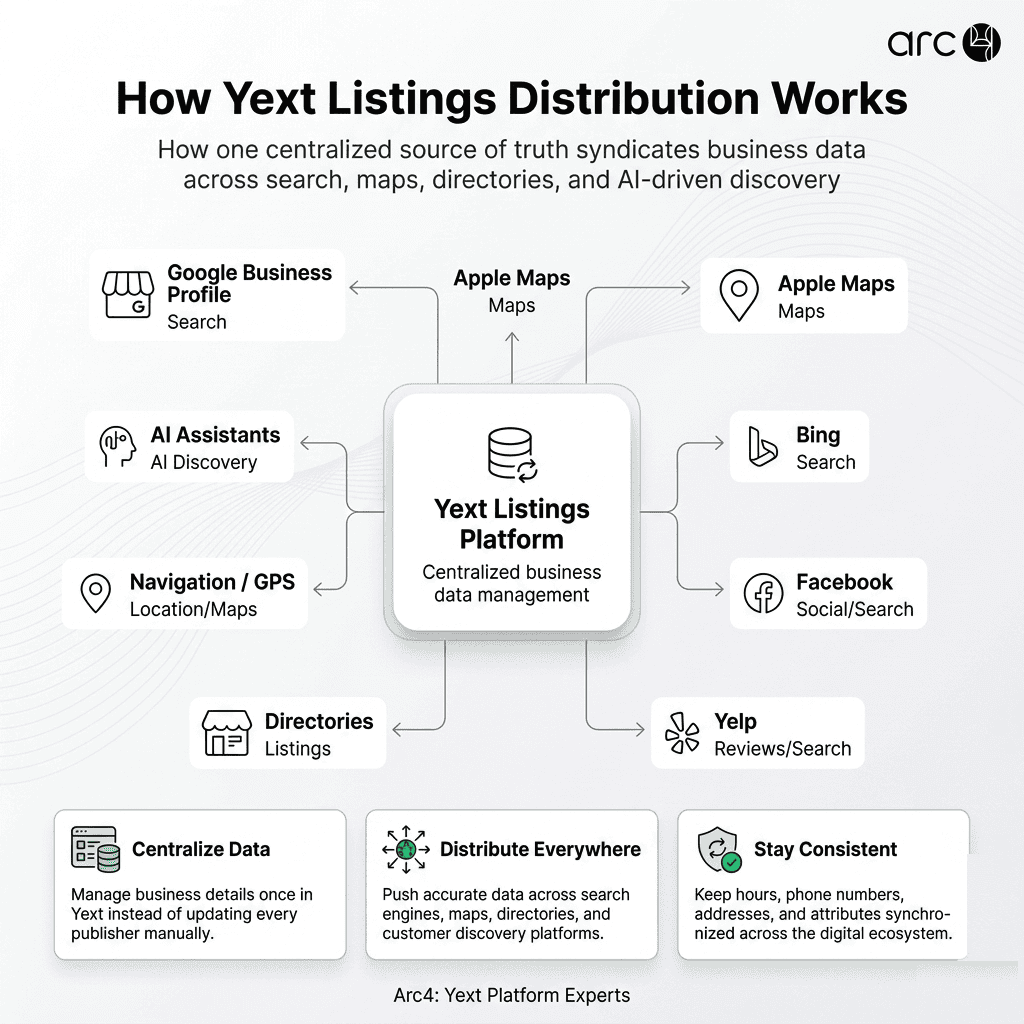
Consistent NAP (Name, Address, Phone) and hours data directly influences ranking in local search results. Search algorithms cross-reference listings across publishers for consistency; discrepancies can erode credibility and push your listings lower in search results. When your business name, address, and phone number match everywhere, algorithms reward that consistency with better visibility.
The operational benefit becomes clear during high-stakes moments. When businesses have seasonal or holiday hours, or unplanned events like weather closures, updating once in Yext can push those changes to dozens of directories instantly. Many changes show up in minutes to hours rather than over several days.
In a specific experiment between August and October 2025, approximately 1,200 businesses that implemented suggested profile updates saw impressions rise by 3.5% and engagement (clicks) grow by 21%. These aren’t abstract improvements. They translate directly to more customers finding and interacting with your locations.
Additional benefits include enhanced trust with customers who are more likely to rely on accurate listings, reduced friction from wrong addresses or unexpected closed hours, and decreased manual maintenance burden. The result is more reliable online visibility, especially during critical decision moments like “Is this store open right now?”
What Yext Business Listings Actually Are?
Unlike manually logging into each directory, Yext enables businesses to manage descriptions, categories, photos, services, and specialized attributes from one interface. It handles publisher-specific formatting and mapping, so different platforms display data correctly and consistently. Yext also helps protect your listings from conflicting or outdated information that can be introduced by third-party data aggregators.
Managing Google Business Profile and Other Key Channels in One Place
Yext has direct, official integrations with many major platforms, including Google Business Profile, Apple Business Connect, Meta (Facebook and Instagram), Bing, and Yelp.
Because of these direct connections, changes made in Yext often push out the same day to many platforms. For example, updating Sunday hours across 50 locations can show up in Google Business Profile and Apple Maps within hours or less than 24 hours under optimal conditions. Compare this to the days or weeks it might take to manually update each platform.
Central management allows brands to ensure that listed primary category (especially for Google), service area settings, offering attributes, and descriptions are consistent across platforms. This reduces penalties for mismatch and maximizes ranking in local pack and map-based searches.
For multi-location brands, this centralized control saves considerable operational costs and reduces errors. When hours of operation change across stores, whether due to holidays or emergencies, Yext lets administrators push changes universally rather than logging into each platform separately. That same principle of centralized control extends to the location pages themselves – keeping content, hours, and service information accurate at the page level is just as important as accurate listings, which is why Local Pages Are Critical for SEO Success is a natural next step for any brand managing at scale.
How do customers search for Businesses?
When customers are looking for a business, whether it’s a restaurant, retail store, or service provider, they typically turn to search engines like Google or Apple Maps. Most searches start with specific keywords, such as the business name, location, or the type of service they need. Customers rely on accurate business listings to make quick decisions, especially when they’re searching on mobile devices and need information fast.
According to Yext, 76% of local mobile shoppers use their smartphones to search for local business information, and a staggering 75% of users never scroll past the first page of search results. This means that if your business information (address, phone number, hours of operation) is missing or outdated, you risk losing out on valuable traffic and potential customers. Customers expect to find up-to-date details across the web, and even a small inconsistency can lead them to choose a competitor instead.
Effective management of business listings ensures that your business appears accurately wherever customers search, from Google to Apple Maps and beyond. By keeping your listings current and consistent, you not only improve your local visibility but also drive more traffic to your website and physical locations. Ultimately, accurate business information across the web helps you attract more customers and grow your business. For a deeper look at how Yext fits into a broader search strategy, see our Yext SEO guide.
Why Accurate, Consistent Listings Matter for Local SEO?
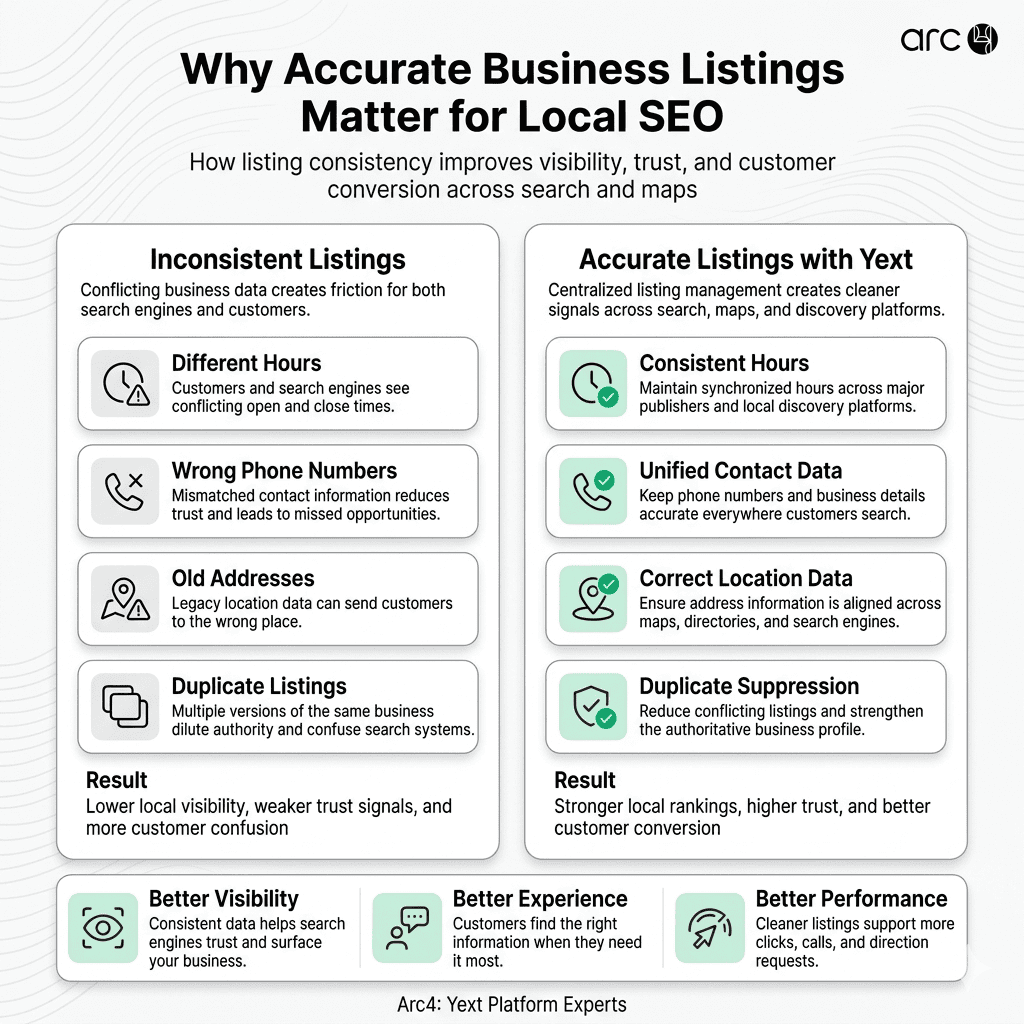
Maintaining accurate business information isn’t just about avoiding embarrassing mistakes. It’s foundational for how search algorithms and AI systems evaluate your business. Accurate listings are a cornerstone of any effective local SEO strategy. Search engines cross-check data across dozens of directories, review sites, your business website, and offline data. If data points like address or phone number conflict, it signals low trust, which can push listings lower in search results.
Consistent NAP across third-party sites is a well-known local ranking factor. Industry studies show that businesses with high completeness (filling many core fields) and consistency across multiple publishers see significantly higher impressions and clicks. According to Yext data from 620,000 locations, those syncing 50 to 75% of the 200+ publisher network saw a 95% average increase in website clicks from Google. Those syncing more than 75% saw a 186% increase.
Duplicate or outdated profiles (old addresses, former phone numbers) create competing signals that dilute ranking power, split reviews, confuse users, and reduce conversions. When algorithms see conflicting information, they can’t confidently surface your business in local search results.
Businesses using systematic listing management tools like Yext often see measurable growth over 6 to 12 months: lift in impressions, clicks, calls, and direction requests. In the Listings Recommendations study, engagement lift was 21% compared to the control group after recommended profile updates.
Yext and AI-Powered Search & Assistants
AI assistants, including chat tools, voice assistants like Siri and Alexa, and newer models such as ChatGPT and Gemini, draw on multiple data sources when generating responses. These sources include official business listings, knowledge graphs, review websites, and website content. Accurate, up-to-date listings increase the chance AI systems return correct information when users ask queries like “Is this store open on Sunday?” or “Which dentist takes my insurance?”
Yext structures data in its Knowledge Graph so it is “AI-ready.” Entities, standardized fields, relationships, and attributes are defined in ways machines can parse reliably. This reduces what engineers call “schema drift,” where different locations have conflicting hours or categories that confuse AI systems.
In 2025 research, Yext found that 86% of AI citations (from platforms like ChatGPT, Gemini, and Perplexity) stem from brand-managed sources: websites, listings, and local pages that brands can control. This underscores the value of maintaining controlled, structured, and accurate data across all touchpoints.
Consider a specific scenario: a national restaurant chain updates its winter menu in the Knowledge Graph. Those menu changes then reflect across Google, Yelp, UberEats, and wherever supported. AI models picking up those listings will deliver correct menu items for queries like “restaurants nearby with winter specials.” Without universal sync, some channels would show outdated offerings, leading to confusion or poor customer experience.
NAP Consistency and Duplicate Suppression
NAP consistency means that the business name, address, and phone number are identical across hundreds of directory listings. Consistency in these core data points heavily influences map rankings and local pack results, particularly in “near me” queries. Even small variations (Street vs. St., Suite vs. #) or mismatched phone numbers can degrade trust with search algorithms.
Yext scans publishers at least monthly to detect potential duplicate listings. These duplicates might be old addresses, former phone numbers, or slight name variations that create competing profiles. A core feature of Yext is the ability to suppress duplicate listings, allowing users to flag, confirm, and suppress outdated or redundant profiles via the platform.
Here’s how it works at a high level: Yext identifies potential matches during scans, presents them for review, and enables suppression at the publisher level. This means the duplicate listing’s visibility is reduced or eliminated in the publisher’s database. For enterprise clients, Yext sometimes performs managed suppression for high-profile or widespread duplicate issues.
For example, one chain discovered that locations that had moved years ago still had legacy addresses in directory listings. Yext flagged those listings as potential duplicates. After suppression, the business reduced conflicting citations and saw cleaner representation in search results. In a dining chain case study, suppressing over 8,000 duplicates across 37 publisher sites improved local search presence by approximately 20% across tracked keywords.
Consequences of Duplicate Listings
Duplicate listings can create significant challenges for businesses trying to maintain a strong online presence. When search engines encounter multiple listings for the same business with conflicting information, such as different addresses, phone numbers, or business hours, it can confuse both algorithms and potential customers. This confusion often leads to lower rankings in local search results, making it harder for your business to be found when customers search for your services.
Beyond harming your local SEO, duplicate listings can damage your reputation management efforts. Customers who encounter inconsistent business information across the web may lose trust in your brand, especially if they show up at the wrong location or find outdated business hours. Incorrect or conflicting listings can also result in missed opportunities, as potential customers may choose a competitor with more reliable information.
Yext’s duplicate suppression feature is designed to tackle this problem head-on. By identifying and removing duplicate listings, Yext helps ensure that your business information is accurate and consistent everywhere it appears online. This not only improves your online visibility and search rankings but also builds customer trust and supports your reputation management strategy. With clean, authoritative listings, your business is better positioned to attract and retain customers, drive more sales, and maintain a positive presence across the web.
Core Features of Yext Business Listings
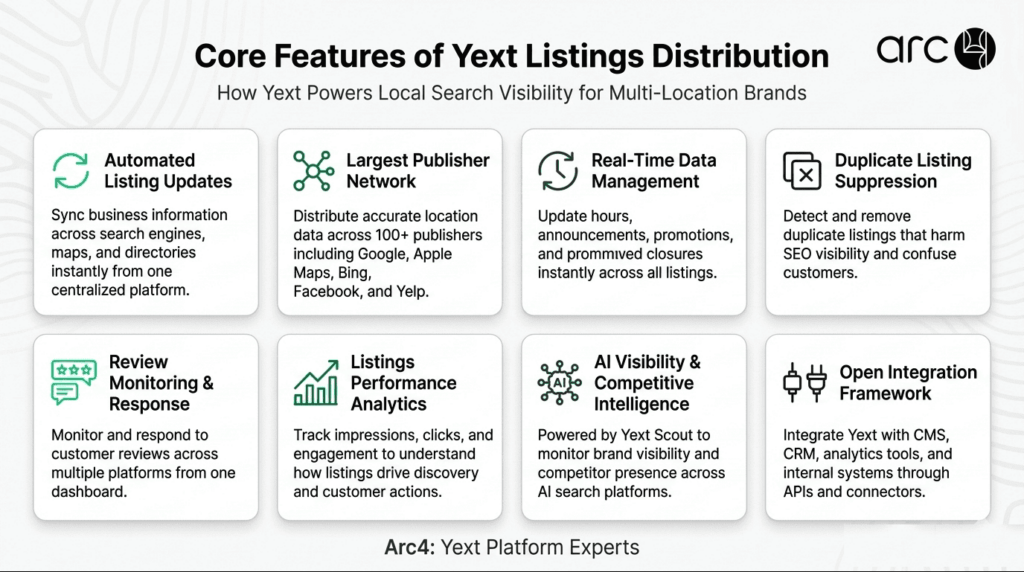
The most important capabilities of Yext Business Listings include automation (real-time updates), broad network reach (200+ publishers), duplicate detection and suppression, centralized governance with role-based permissions, and analytics with actionable insights. Yext provides valuable performance data through its analytics, helping businesses improve their local visibility by understanding their online presence and customer engagement. These features combine to deliver improved local visibility, operational efficiency, and higher conversion from listings.
The following subsections break down each feature and explain how it contributes to visibility, accuracy, and efficiency. Whether you’re on a marketing team trying to scale local campaigns or an operations lead ensuring data accuracy, these capabilities address real daily challenges.
The tone here is practical. You don’t need to be a technical specialist to understand these features. They’re designed for business owners and marketing professionals who need results without complexity.
Automated, Real-Time Listing Updates
Any field change in Yext’s dashboard (hours, phone number, address, or special attributes) updates downstream publisher listings automatically through direct integrations. Yext runs real-time scans whenever an entity is updated, plus backup scans to ensure data integrity.
Consider this scenario: a weather-related store closure in January 2025 is entered in Yext once. Within minutes to a few hours, Google, Apple Maps, Yelp, Facebook, and other major publishers reflect the closure. Another example: holiday hours updated corporation-wide in November 2024 became live across Google and Apple Maps within the same day.
This automation dramatically reduces manual work compared to logging into each directory separately. It also lowers the risk of typographical errors, missed locations, and outdated hours that frustrate customers. Businesses with many locations benefit especially, since manual updates across dozens of platforms would be error-prone and painfully slow.
The time savings compound quickly. If you manage 50 locations and need to update hours across 20 directories each, that’s 1,000 individual updates. Or one change in Yext.
Wide Network Reach Across 200+ Publishers
Yext’s publisher network includes major search engines, maps, voice assistants, GPS systems, vertical-specific directories (healthcare, hospitality, restaurants), and social media platforms. This breadth means your business data can appear correctly across Google Maps, Apple Maps, Bing, navigation systems, and niche sites relevant to your industry.
Coverage differs by country and plan level. Not all publishers support all fields or immediate update speeds; some have slower refresh schedules or stricter content formats. Yet, appearing correctly across many platforms increases discovery opportunities beyond just Google search. Additionally, being present on more platforms helps improve and monitor your business rankings in local search results, allowing you to track performance geographically and optimize your local SEO strategy.
One multi-location retailer reported that traffic from non-Google sources (Apple Maps, niche directories) rose significantly after enabling broader publisher syncing in Yext. In the global sample of 620,000 locations, non-Google publishers contributed over 17% of a typical location’s website traffic. That’s traffic many businesses miss entirely when focusing only on Google.
For businesses where customers rely on navigation systems, voice search, or industry-specific directories, this broad reach matters. A hospital network, for example, might see significant traffic from healthcare directories that general retailers wouldn’t prioritize.
Duplicate Detection and Suppression
Yext periodically scans its publisher network for listings that closely match a given entity. It flags potential duplicates (called Matches) for user review. Users can suppress duplicates or mark them as not duplicates. For enterprise clients, Managed Suppression services may automate much of the suppression work.
Duplicate listings are harmful for several reasons:
| Problem | Impact |
| Split reviews | Ratings spread across multiple profiles, diluting social proof |
| Algorithm confusion | Search engines can’t determine which listing is authoritative |
| Customer confusion | Users may find conflicting hours or addresses |
| Wasted marketing spend | Efforts to optimize listings are fragmented |
After consolidating or suppressing duplicates, brands often see improvement in search visibility. The previously cited dining chain saw a 20% improvement in presence in Google’s local results after suppressing 8,115 duplicates across 37 publishers.
For a franchise with rebranded locations, this cleanup is essential. Legacy listings under old names can persist for years, confusing both algorithms and customers.
Centralized Control and Data Governance
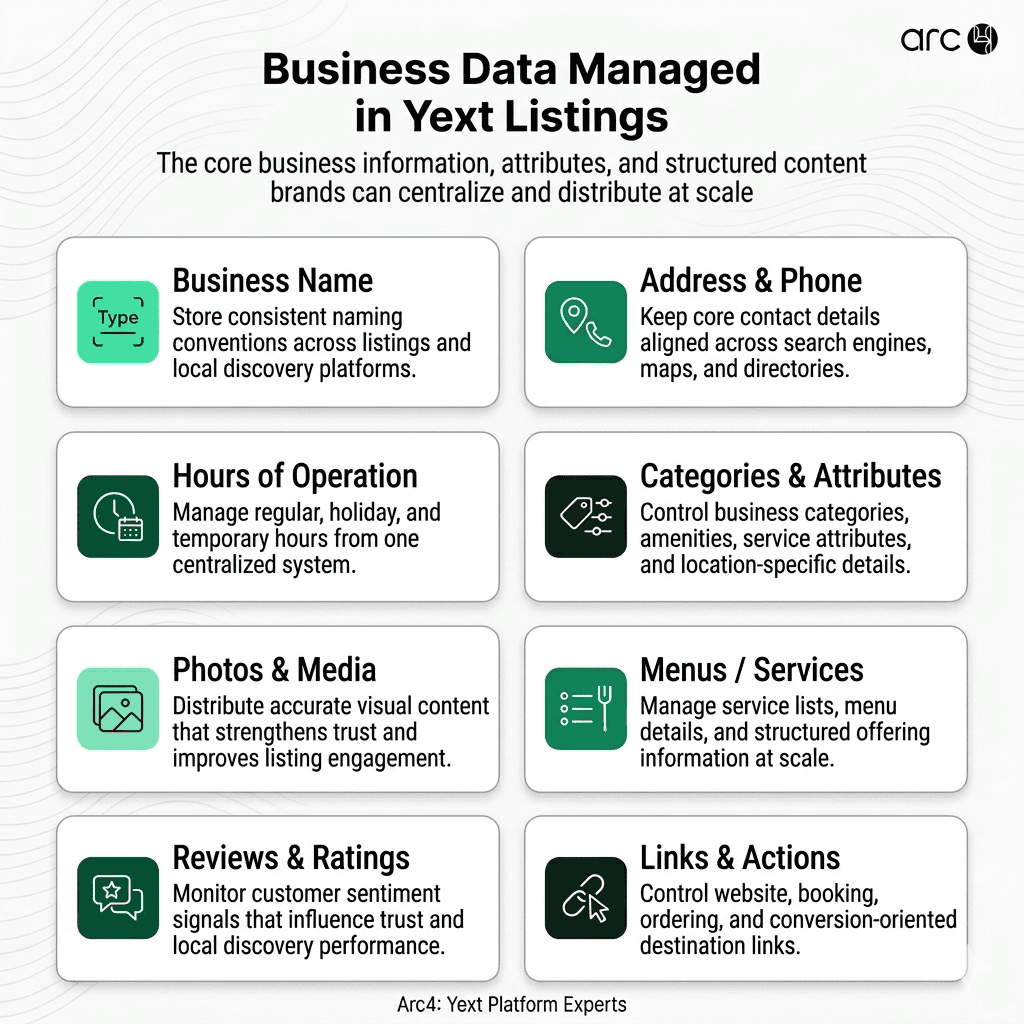
Yext provides one source of truth for business data that can be governed by corporate teams, regional managers, or franchise owners via role-based permissions. This means headquarters can control critical fields like categories, legal names, and primary phone numbers, while local managers update photos, descriptions, or special announcements.
Role-based access protects critical data fields from unauthorized edits. Audit logs and change histories help large organizations track who changed what and when, which is useful for compliance and troubleshooting. If something goes wrong, you can trace it back and fix it quickly.
For brands operating across multiple regions or countries, Yext supports multi-language and multi-region content via its Knowledge Graph. With scheduled changes (like holiday promotions) and field-visibility control, brands avoid inconsistent messaging or unintended mistakes.
Consider a brand with 200 locations: corporate controls categories and hours centrally, regional managers adjust descriptions for local relevance, and store managers upload location-specific photos. Everyone works within their scope, and consistency is maintained. Agencies and marketing firms can also leverage Yext to monitor and enhance their client’s business visibility across multiple locations.
Analytics, Insights, and Performance Tracking
Yext Analytics aggregates data such as impressions, listing views, clicks for directions, website visits, and calls originating from listings. Marketers can monitor performance by location, region, or publisher to see where listings drive the most engagement. Yext Analytics also enables tracking of the search terms customers use to find your business, helping you understand which keywords are driving visibility and engagement.
The ability to correlate listing metrics with business outcomes is valuable. For example, you might compare Q2 2025 performance against Q2 2024 and see how improved listing completeness correlates with increased store visits or appointment bookings.
In an experiment of approximately 1,200 businesses, implementing AI-powered recommendation suggestions led to a 21% increase in engagement (clicks) and a 3.5% increase in impressions over a 10-week period versus those who didn’t act on the suggestions.
Over longer periods (6 to 12 months), businesses often see uplift in Google Customer Actions and increased traffic. These reports help justify continued investment in listing management and identify locations that need attention.
Advanced Yext Capabilities Beyond Basic Listings
Yext is more than just NAP management. It offers advanced features for structured content, system integrations, and reputation management that extend its value significantly.
These tools matter most for multi-location brands, franchises, and regulated industries needing scalable, accurate digital footprints. A healthcare network, for example, needs to manage provider bios and insurance information alongside basic location data. A restaurant chain needs menu management integrated with their listings.
The following subsections cover integrations, richer content types, and review management capabilities.
Structured Content: Menus, Services, Bios, and Inventory
Yext’s Knowledge Graph can hold detailed objects beyond basic business details: restaurant menus, service lists, practitioner bios, product catalogs, and event details. This structured data feeds compatible publishers, ensuring that menus, services, and specialties stay up to date across relevant sites.
For restaurants, this means updating a 2026 winter menu in Yext and distributing changes to Google, Yelp, UberEats, and other food platforms. No more logging into each delivery app separately to update items and prices.
For healthcare providers, it means maintaining accurate provider bios (specialties, credentials, insurance accepted) that appear correctly across health directories. Patients searching for “dermatologist who takes Blue Cross” get accurate results.
Structured content also supports richer search results and AI answers. Queries like “Italian restaurants nearby with gluten-free options” or “urgent care clinics open on Sunday” rely on accurate attributes. Without such structured data, businesses miss being surfaced in filtered or attribute-based discovery.
Integrations with CRM, POS, and Booking Systems
Yext can connect via APIs to CRM systems, point-of-sale platforms, and appointment or booking tools. These integrations allow automated updates, such as auto-adjusting store hours from POS data or syncing service availability from a booking system.
Integrations reduce manual work and help ensure real-world changes are reflected online quickly. If telephone numbers or addresses change internally after an office moves or rebrands, having syncs in place reduces the risk that published listings lag behind reality.
Consider a healthcare provider opening a new clinic. With proper integrations, the address, phone number, and appointment booking links can be pulled from a central system into Yext and then distributed to all publishers. The alternative, manually updating dozens of directories, introduces delays and errors.
For retailers, inventory integrations can show product availability at specific locations. When customers search for “store near me with [product] in stock,” accurate inventory data becomes a competitive advantage.
Review Monitoring and Reputation Management
Yext aggregates reviews from multiple sites (Google, Facebook, and some vertical platforms) into a single dashboard for monitoring. The Yext dashboard serves as the central hub for managing reviews and reputation, consolidating customer feedback from various platforms, providing real-time insights, and enabling quick responses to enhance brand reputation. This centralized view lets teams see incoming reviews across all locations without logging into separate platforms.
Responding quickly to reviews, especially negative ones, demonstrates responsiveness and care. Research consistently shows that businesses responding to reviews see improved customer perception. Systematic responses over a 6-month period may raise average star ratings and improve visibility or click-through rates.
Reviews and ratings displayed on key listings influence click-through rates and conversion. When potential customers see a 4.5-star rating versus a 3.5-star rating, they’re more likely to choose the higher-rated option. Making online reputation management a core part of your listing strategy amplifies the impact of accurate information.
Best practices include tracking review frequency and recency, ensuring responses are timely and personalized, and identifying patterns in negative feedback that indicate operational issues.
Security, Compliance, and Enterprise-Scale Management
Yext uses industry-standard security practices, with data encrypted in transit and at rest, to protect business data flowing between systems and publishers. For enterprises handling sensitive information, this baseline security is non-negotiable.
Role-based access controls and approval workflows help large organizations manage thousands of locations safely and consistently. Critical fields can require approval from designated administrators before going live. This prevents well-intentioned but unauthorized changes from causing problems.
Multi-language and multi-region support enables global brands to maintain listings in different countries with localized content and regulatory compliance. Address formats, phone number conventions, and even required disclosures vary by country, and Yext handles these variations within a unified platform.
Secure APIs and audit logs support compliance requirements common in regulated industries. Healthcare organizations subject to HIPAA, financial services firms with regulatory oversight, and legal practices with confidentiality obligations all benefit from comprehensive change tracking.
For IT and compliance stakeholders, Yext provides the controls and documentation needed to satisfy internal policies and external audits.
Measuring the Impact of Yext Business Listings
Businesses should track before-and-after metrics when implementing Yext. Key measurements include impressions, website clicks, calls, direction requests, and store visits where measurable. Establishing a baseline before implementation makes improvement quantifiable.
Realistic timeframes matter here. Local search improvements often appear gradually over several months as data stabilizes and duplicates are cleaned up. Immediate updates for critical fields happen quickly once synced, but the cumulative impact on search rankings and customer actions builds over 3 to 12 months.
Consider a multi-location business that ensures complete profiles and broad publisher coverage. In studies Yext has published, syncing more than 75% of the publisher network resulted in a 186% increase in website clicks from Google compared to the pre-sync period. Those syncing 50 to 75% saw a 95% increase.
The connection between listing accuracy and revenue becomes clearer when you track appointment bookings, phone calls, and direction requests alongside listing metrics. Improved visibility leads to more traffic, and more traffic leads to more customers. These improvements also help your business rank higher in local search results.
Key KPIs and Optimization Loops
The most important KPIs to monitor include:
| KPI | What It Measures |
| Impressions | How often your listings appear in search results |
| Profile views | How often users view your full listing |
| Website clicks | Traffic driven from listings to your site |
| Calls | Phone calls initiated from listings |
| Direction requests | Users seeking navigation to your location |
| Conversions | Actions tied to location pages (bookings, purchases) |
Use these KPIs for continuous improvement. Identify underperforming locations and check listing completeness. Are all fields filled? Are photos recent? Are categories accurate? Refine descriptions and test richer attributes to see what drives engagement.
Quarterly reviews work well for most organizations. Every 3 months, compare performance, adjust strategy, and clean up any new issues that appear.
A simple optimization workflow looks like this:
- Audit current listing accuracy and completeness
- Update data in Yext to fill gaps and fix errors
- Monitor KPIs over the following weeks
- Optimize fields, photos, and content based on performance
- Repeat the cycle
Is Yext Business Listings Right for Your Organization?
Organizations that benefit most from Yext include multi-location retail or restaurant chains, franchises, service-area businesses (plumbers, healthcare providers), and regulated industries requiring strict data control. Businesses with many specialized attributes (menus, provider bios, insurance specialties) or frequent location changes also see strong value.
Key considerations include:
- Budget: Enterprise plans cost more, with licensing typically per location
- Number of locations: The more locations you manage, the greater the time savings
- Internal resources: Do you have staff to govern roles and maintain data quality?
- Existing tech stack: Integration with your CRM, POS, or booking systems adds value
- International presence: Multi-region support matters for global brands
Practical triggers for considering listing management include recent rebrands, frequent openings or relocations, holiday or seasonal hour complexity, fragmented current listings, high dependence on local foot traffic, or negative customer feedback due to incorrect listing info.
A phased approach works best. Start by auditing existing listings to identify duplicates, incorrect data, and gaps. Pick a pilot group of 5 to 50 locations to get early wins. Once you see results, scale to the entire footprint. This reduces risk and builds internal buy-in.
Next Steps: Getting Started with Yext Business Listings
Getting started requires a clear path: conduct a listings audit, define locations and data fields, onboard into Yext, connect major publishers, and set up reporting.
Step one is a business listings audit. Collect current core data across locations (NAP, hours, categories, services, photos) and check existing publisher listings for consistency, duplicates, and gaps. Then define what fields will be managed centrally versus locally. Set governance policy and decide roles and permissions.
Gathering accurate source data before pushing updates is critical. Maintaining up-to-date information across all business listings is essential to ensure accuracy and build trust with customers and search engines. Current addresses, phone numbers, hours, categories, and photos must be verified. Pushing incorrect data at scale creates new problems rather than solving existing ones.
Set clear goals for the first 6 to 12 months. For example: eliminate identified duplicates, achieve full coverage across key publishers, raise listing completeness scores to 90%+, and improve impressions and clicks by a target percentage.
Involve both marketing and operations teams. Operations must feed accurate data: hours, addresses, phone numbers, services. Marketing must maintain descriptions, attributes, and photos. Establish processes so real-world changes flow into Yext promptly, with approvals as needed.
Managing business listings at scale doesn’t have to drain your team’s resources. With centralized control, automated updates, and a comprehensive range of publisher connections, Yext turns a fragmented, error-prone process into a streamlined operation. The result: more customers finding accurate information, better search rankings, and a foundation ready for the AI-powered discovery that’s already reshaping how consumers search.
Why Brands Work with Arc4 for Yext Implementation
Yext is a powerful platform, but getting the most out of it requires more than flipping the switch. From initial data cleanup and duplicate suppression to Knowledge Graph structuring, publisher strategy, and ongoing optimization, the implementation details are where most brands either gain or lose ground.
That’s where Arc4 comes in. We’re a digital agency built around local digital experiences, and Yext is one of our core competencies. We work with multi-location brands to plan, implement, and manage Yext from day one, including listing audits, data governance setup, structured content strategy, and performance reporting.
What makes working with Arc4 different:
- Hands-on Yext expertise: We don’t just resell the platform. We build the strategy, configure the Knowledge Graph, and manage the rollout.
- Local SEO knowledge: Listings are one piece. We tie Yext into a broader local search strategy that includes on-page optimization, location pages, and review management.
- Scalable implementation: Whether you’re onboarding 10 locations or 10,000, we’ve built processes that keep rollouts clean and efficient.
- Ongoing optimization: We don’t set it and forget it. Our team monitors listing performance, suppresses duplicates, and refines content on a recurring basis.
If you’re exploring Yext or looking to get more from your current setup, request a complimentary local SEO audit and we’ll show you exactly where your listings stand today.
Frequently Asked Questions About Yext Business Listings
What are Yext Business Listings?
Yext Business Listings is a platform that lets businesses manage their name, address, phone number, hours, categories, photos, and other details from a single dashboard. That data is then distributed to over 200 publishers, including Google, Apple Maps, Bing, Yelp, Facebook, and AI assistants, through direct API integrations. Instead of updating each platform manually, you update once and Yext pushes the changes automatically.
How does Yext listing distribution work?
Yext connects to publishers through direct API integrations. When you update a field in the Yext dashboard, such as store hours or a phone number, those changes are pushed to connected publishers automatically. Most major platforms reflect updates within hours to a day. Yext also runs periodic scans to ensure data remains accurate over time.
Does Yext help with local SEO?
Yes. Consistent NAP (Name, Address, Phone) data across directories is a well-established local ranking factor. Yext helps maintain that consistency at scale, which strengthens your visibility in local pack results, map searches, and “near me” queries. According to Yext data, businesses syncing more than 75% of the publisher network saw a 186% increase in website clicks from Google.
What is duplicate suppression in Yext?
Duplicate suppression is the process of identifying and deactivating outdated or redundant business listings across publishers. Yext scans its publisher network for potential duplicates, such as old addresses, former phone numbers, or name variations, and presents them for review. You can then confirm and suppress those listings to prevent them from competing with your accurate profiles.
Is Yext worth it for multi-location businesses?
For businesses managing more than a handful of locations, the time savings and consistency benefits are substantial. Updating 50 locations across 20 directories manually means 1,000 individual edits. With Yext, it’s one update. The platform is especially valuable for franchises, healthcare networks, restaurant chains, and any brand where location data changes frequently.
Can Yext help my business appear in AI search results?
Yes. AI assistants like ChatGPT, Gemini, and Perplexity pull data from structured sources including business listings and knowledge graphs. Yext structures your data in its Knowledge Graph so it is machine-readable and consistent, improving the likelihood that AI systems return accurate information about your business. Yext research found that 86% of AI citations come from brand-managed sources.
How long does it take to see results from Yext?
Individual listing updates can propagate within hours. However, the cumulative impact on local search rankings, impressions, and customer actions typically builds over 3 to 12 months as data stabilizes, duplicates are suppressed, and profile completeness improves across the publisher network.
What types of businesses benefit most from Yext?
Multi-location brands, franchises, healthcare providers, restaurants, service-area businesses, and regulated industries see the strongest ROI from Yext. Any business where location data changes frequently, where NAP consistency is critical, or where customers rely on directories and maps to find you will benefit from centralized listing management.