
Yext Listings vs Manual Citation Management: Which Approach Delivers Better ROI?
If you are weighing Yext listings against manual citation building to decide where your marketing budget goes furthest, the answer depends on how many locations you manage, how often your business information changes, and how much your team’s time is worth.
For most businesses with five or more locations managed, Yext (implemented and run through a strategic partner like Arc4) delivers significantly better ROI because it eliminates the labor, error costs, and slow propagation that drain returns from manual work. For very small businesses with one to three stable locations and minimal updates, manual citation management can be the more cost-effective path, at least until growth or frequent changes tip the balance.
The short answer: ROI is heavily dependent on business scale and frequency of data changes. Yext delivers better ROI for multi-location businesses due to labor savings, broader coverage across 200+ publishers, and centralized reporting. Manual citation building can be more cost-effective for small businesses with stable details and tight budgets.
The choice between Yext and manual management should consider labor costs, visibility benefits, and long-term scalability. For many businesses, effective ROI strategies may involve a hybrid approach combining both methods.
What Is Yext Business Listings Management
Yext is an API-based listings management platform that centralizes your business information into a single knowledge graph and syncs it in real time to a global network of directories, maps, apps, and search engines. Yext manages over 12 million locations across 200+ publishers, pushing accurate data through direct API connections rather than relying on slower aggregator feeds. But the Yext platform alone is just a tool. Arc4 is the strategic and technical partner that turns Yext into measurable ROI by handling setup, optimization, monitoring, and reporting.
Here is what defines Yext listings management in 2026 and beyond:
- 200+ direct publisher integrations. Yext operates through direct API integrations with publishers like Google, Apple Maps, Bing Places, Alexa, and hundreds of industry specific directories. Yext updates listings instantly across all connected publishers, so your data reaches customers within seconds of a change.
- Real time updates and duplicate suppression. A built-in Listings Verifier checks live publisher data, identifies incorrect data, and helps resolve errors and conflicting entries automatically, reducing the risk of duplicate listings confusing search engines.
- Structured data for AI and voice search. Yext supports 50+ rich fields (hours, FAQs, photos, services, attributes) that feed AI assistants like ChatGPT, Gemini, and voice platforms, ensuring customers find your business wherever they search.
- Analytics and insight dashboards. Yext offers centralized reporting on impressions, clicks, calls, and direction requests, broken down by publisher and location. Arc4 layers on custom dashboards and attribution models to connect these metrics to actual revenue.
- Typical pricing. Yext costs approximately $200 to $500 per year per location depending on tier and features. Yext pricing varies by plan, with Essentials starting around $199 per location per year and premium tiers reaching $449 or more.
Yext alone gives you a powerful sync engine. Arc4 provides the strategy, ongoing optimization, and reporting that improve ROI year over year, turning a subscription into a revenue-generating system.
What Is Manual Citation Building and Management?
Manual citation management means claiming, editing, and maintaining business listings one directory at a time. You or your team logs into Google Business Profile, Bing Places, Apple Maps, Yelp, and relevant industry specific directories individually, creating or updating each profile by hand. Manual submissions can be handled in-house or outsourced to citation building vendors who do the same work on your behalf.
Core benefits of manual citation building:
- Full control per listing. You decide exactly how each description reads, which photos appear, and how categories are set. Manual management allows businesses to claim their own listings and retain direct account ownership.
- Permanent ownership. Once a listing is claimed and verified, it remains under your control even if you stop paying any third-party vendor. Listings remain accurate as long as someone maintains them.
- No recurring software cost. There is no ongoing Yext subscription or platform fee. Manual citation services can cost from $20 to $999 for a one-time package, depending on scope.
- Flexibility in directory choice. You can target hyper-local or niche sites that larger platforms might not prioritize.
Core drawbacks:
- Manual citation management is generally time-consuming and labor-intensive. Building or cleaning listings across 50+ directories takes many hours per location.
- Human error risk. Inconsistencies like “St.” vs “Street” or missed category updates can confuse search engines and dilute authority, harming local rankings.
- Slow change propagation. Updating holiday hours or a new phone number means logging into dozens of sites, each with its own verification process.
- No unified analytics. You may see Google Business Profile insights and Yelp metrics separately, but there is no central dashboard to tie citation work to leads and revenue.
For a single location business with very stable NAP (name, address, phone) and rare changes, manual can be cost-effective. But as soon as you add locations or need to change details frequently, ROI shifts toward automation.
Yext vs Manual Citations: ROI At a Glance
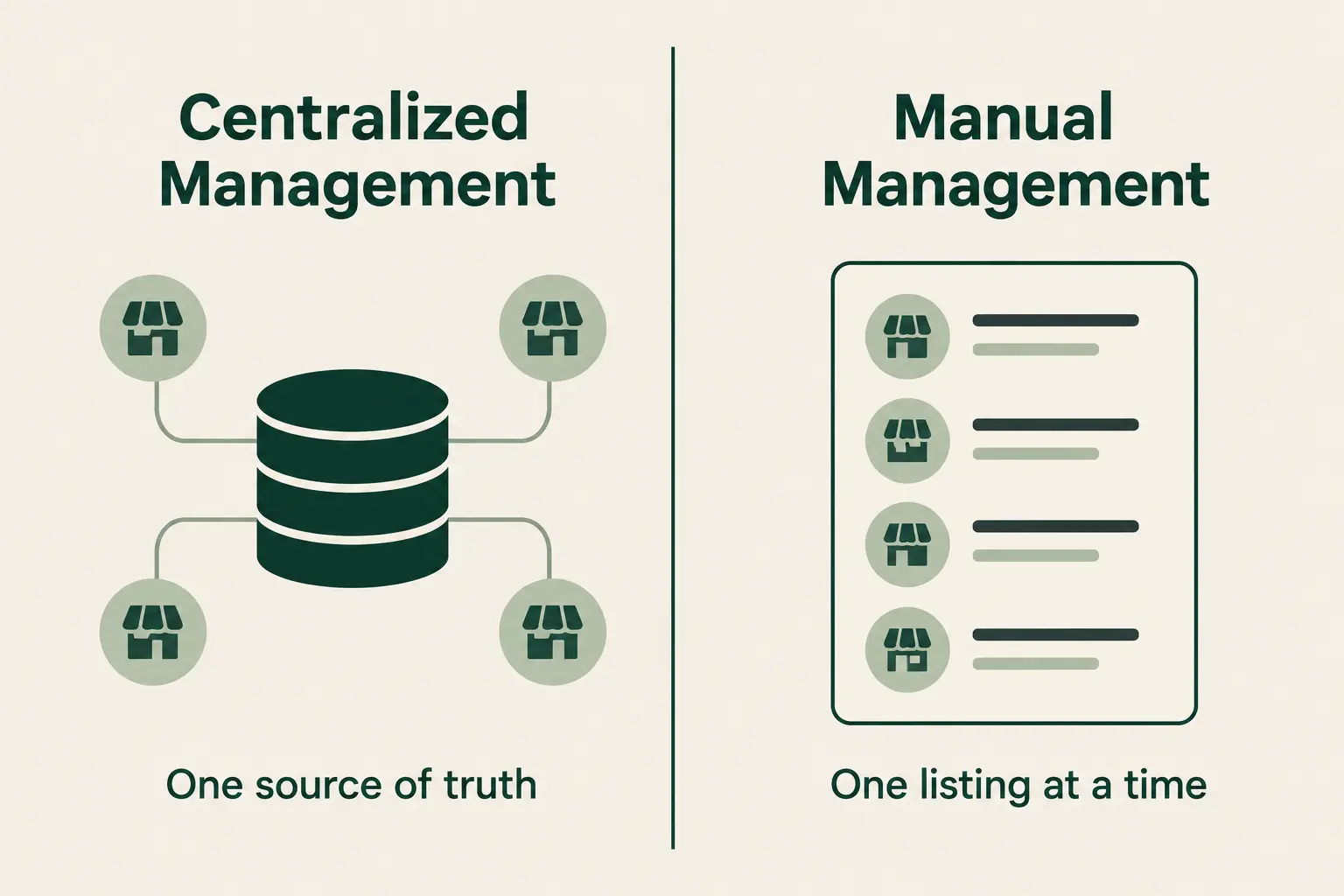
Before diving into each decisive factor, here is a side-by-side snapshot comparing the key ROI drivers. The table below uses concrete example numbers to keep the comparison grounded.
High-Level ROI Comparison Table
Yext Listings (With Arc4) vs Manual Citations — ROI Snapshot
| Factor | Yext Listings managed by Arc4 | Manual citation management |
| Best fit | 5+ locations, frequent changes, growth-oriented businesses needing analytics | 1-3 locations, rare changes, stable data, tight budget |
| Annual cost example (10 locations) | ~$2,000 to $4,500 (platform) + Arc4 management fees | ~$1,250 to 2,500initialbuild+~4,000 to $8,000/year in labor for updates |
| Time to update hours across 50 directories | Minutes (one central change, instant push via API integrations) | 30 to 60+ hours of manual work across logins and verifications |
| Data coverage per location | 200+ direct publisher integrations including maps, apps, AI assistants | 10 to 25 hand-picked key sites |
| Reporting depth | Centralized ROI reporting via Yext + Arc4 custom dashboards | Scattered across individual platforms; often Google-only |
| Duplicate detection | Automated suppression via Listings Verifier | Manual audit with spreadsheets; duplicates often go unnoticed |
Decisive Factor 1: Total Cost of Ownership Over 3-5 Years
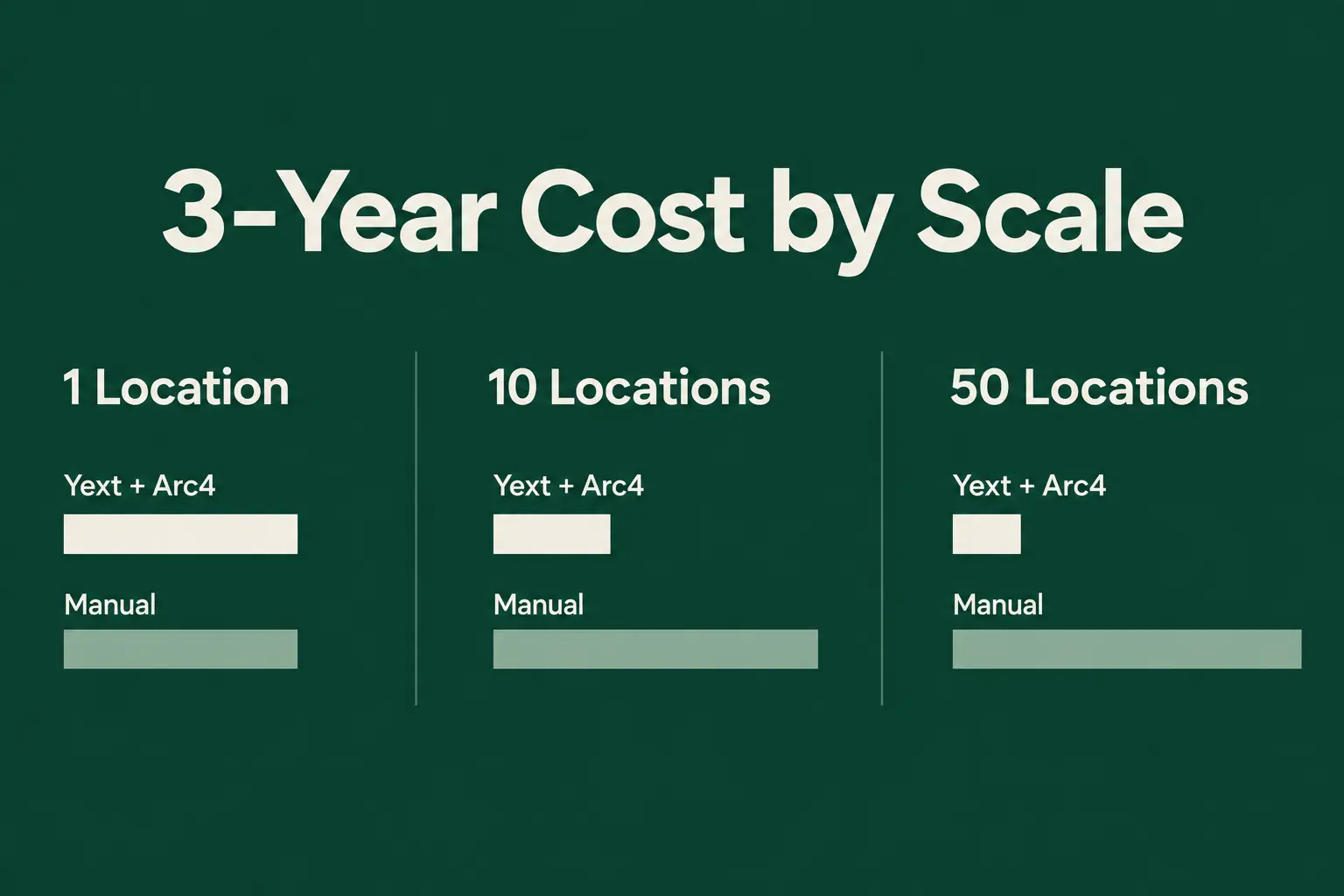
Comparing subscription price to a one-time citation build misses the point. True ROI requires looking at total cost of ownership: software fees, labor hours, error correction, missed opportunities from incorrect data, and the cost of lost calls or bad directions reaching customers over years.
Yext’s cost model is a recurring cost tied to your Yext subscription, typically $200 to $500 per location per year. Yext’s subscription model can lead to significant long-term costs if not managed strategically. Arc4 reduces wasted spend by focusing optimization on the publishers that actually drive leads for your industry and geography, rather than treating all 200+ sites equally.
Manual costs break down differently:
- Initial citation build: one-time packages range from $20 to $999 depending on directory count and vendor.
- Ongoing in-house labor: every update (phone change, holiday hours, new service category) costs staff time at $30 to $50 per hour.
- Hidden costs: outdated data leads to lost calls, bad directions, and confused customers. Inconsistencies can confuse search engines and dilute authority, quietly eroding local rankings.
3-Year Cost Comparison by Business Size
| Scenario | Yext + Arc4 estimated 3-year cost | Manual citations estimated 3-year cost | Main cost drivers |
| 1 location, stable details (rare changes) | ~1,560(399/yr platform + ~$120/yr management) | ~1,480(~1,000 initial build + ~$160/yr maintenance) | Labor vs subscription; nearly even |
| 10 locations, moderate changes | ~15,600(399/yr x 10 x 3 + ~30% management premium) | ~64,600(50,000 build + $9,600 updates + $5,000 error fixes) | Manual labor explodes at scale |
| 50 locations, frequent seasonal updates | ~77,750(399 x 50 x 3 + management premium) | ~400,000+(250,000 build + $120,000 updates + $30,000 corrections) | Scale makes manual unmanageable |
In the smallest scenario, manual slightly edges out on pure cost ($1,480 vs $1,560). But once you reach 10 locations, Yext plus Arc4 costs roughly one-quarter of what manual work demands over three years. At 50 locations, the gap is enormous.
Winner: Yext + Arc4. The total cost of ownership favors Yext decisively for any business with more than three to five locations or frequent changes. Manual citation management is more cost-effective for single-location businesses with stable data, but only in that narrow scenario.
Decisive Factor 2: Time, Operational Efficiency and Error Risk
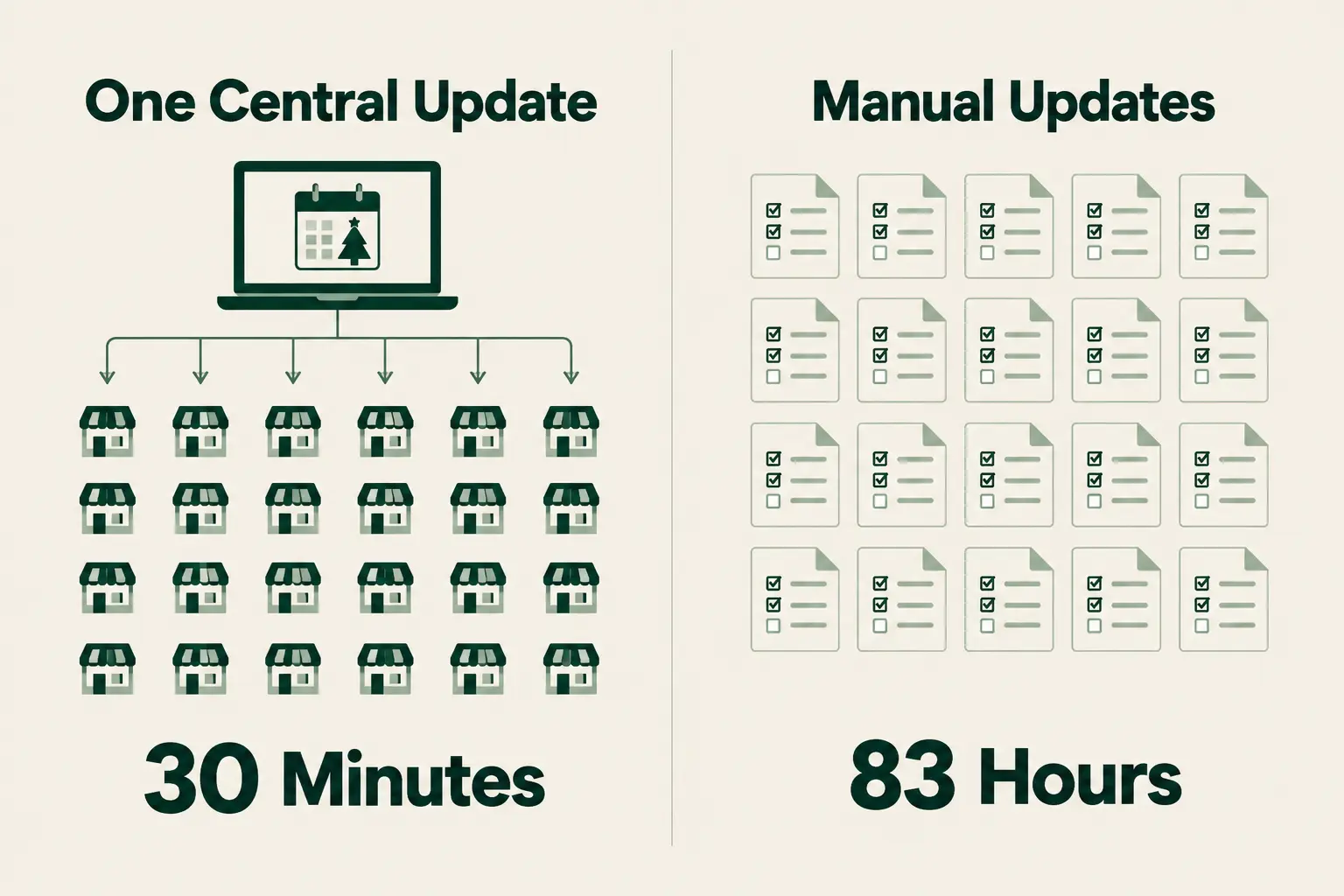
Time spent on manual work is money that cannot be spent on strategy, review monitoring, content, or customer experience. Every hour your team spends logging into directories, resetting passwords, and formatting addresses is an hour not spent on activities that grow revenue.
With Yext plus Arc4, a marketer can update fields once and manage listings across multiple sites, pushing changes instantly across 200+ publishers. Yext updates listings instantly across its network of publishers, whether it is an emergency closure, a rebranding, or a seasonal hours change. Arc4 reviews the data before rollout and handles exceptions, so the business gets speed without sacrificing accuracy.
Manual workflows look very different. Spreadsheets track which directories have been updated. Logins are scattered across dozens of sites. Verification processes vary by publisher. Over months and years, inconsistencies creep in: a wrong phone number here, an outdated category there. These small errors compound into real revenue loss because inconsistent NAP information is crucial for local SEO and directly affects whether customers find your business.
Operational Efficiency — Yext + Arc4 vs Manual
| Task | Yext + Arc4 (approx. time and process) | Manual management (approx. time and process) |
| Update hours for 25 locations before a holiday weekend | ~30 minutes: central update, review, instant push to all publishers | ~83 hours: 25 locations x 40 directories x ~5 min per update |
| Roll out a new primary category to all listings (10 locations) | ~15 to 30 minutes: change master category, push, review exceptions | ~10 to 20 hours: login to each directory per location, request editorial changes |
| Identify and fix duplicate listings across major directories | Minutes to surface via Listings Verifier; Arc4 handles suppression | Days of manual audit: spreadsheet comparison, claiming, merging across sites |
Winner: Yext + Arc4. The speed and error prevention generate substantial ROI. The trade-off is some loss of granular manual control over individual listings, but the time savings and accuracy gains far outweigh that for most businesses.
Decisive Factor 3: Coverage, Consistency & Impact on Local SEO / AI Search
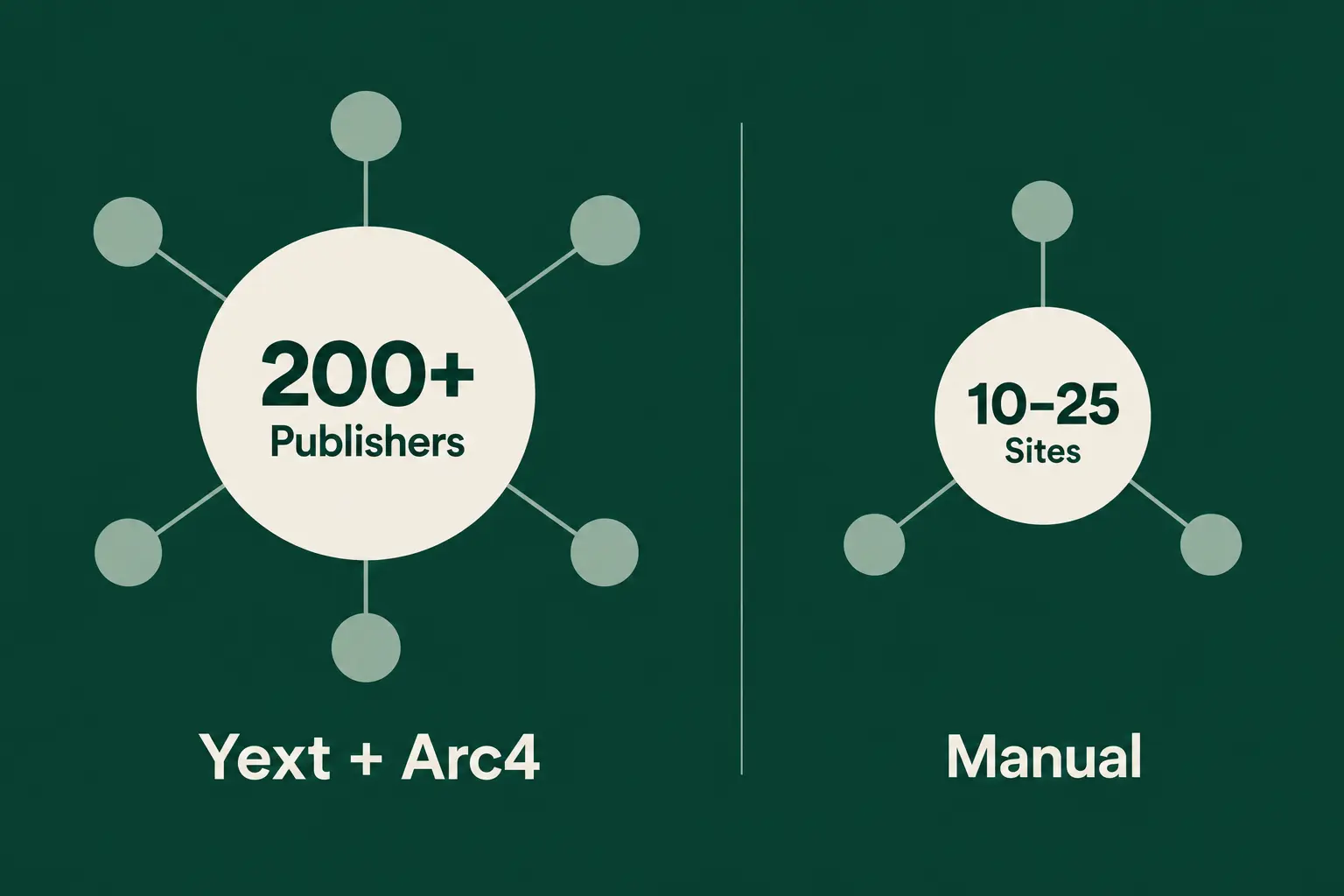
Modern local SEO ROI is not just about Google. Customers find businesses through Apple Maps, Bing Places, voice assistants, AI-powered search tools, and dozens of niche directories. If your business information only lives on 10 to 25 key sites, you are invisible on the platforms where a growing share of discovery happens.
Yext supports over 200 direct publisher integrations. Yext works by pushing structured, AI-ready data to maps, apps, and search engines simultaneously. Arc4 leverages this network to strengthen structured data across channels, ensuring that rich fields like photos, FAQs, service attributes, and hours are consistent everywhere. But buying a listings management platform does not guarantee higher rankings on its own; the lift comes from broader, consistent, rich data execution that helps businesses perform better in local search and appear reliably in AI assistant responses.
Manual citation strategies should prioritize high-value profiles over quantity, and that is a reasonable approach for very small businesses. But it means accepting limited reach. Most manual efforts cover Google Business Profile, Yelp, Bing Places, Apple Maps, and perhaps a handful of industry specific directories. AI assistants, voice search ecosystems, and long-tail directories are typically left uncovered.
Directory & AI Coverage Comparison
| Dimension | Yext + Arc4 | Manual citations |
| Number of publishers typically updated | 200+ direct integrations via API | 10 to 25 hand-picked sites |
| Inclusion in AI assistants and voice search | High: structured data feeds ChatGPT, Gemini, Alexa, Siri via direct connections | Low to moderate: only if individual directories are indexed by AI tools |
| Rich fields (photos, FAQs, attributes) across network | Managed centrally; Arc4 optimizes content for each field | Highly variable; often only NAP on most directories |
| Consistent structured data across all publishers | Enforced via master record and automated push; duplicate suppression | Prone to drift, inconsistent formatting, and data lag |
Local citations help Google verify your business’s legitimacy. A robust citation profile signals trustworthiness to Google. Local citations improve visibility in local search results. When that profile spans 200+ publishers with consistent, rich data instead of 15 sparse listings, the impact on local rankings and customer actions is measurable.
Winner: Yext + Arc4. Broader, consistent coverage translates directly into more impressions, clicks, calls, and directions, which is the financial ROI that matters.
Decisive Factor 4: Control, Ownership & Vendor Risk
Many marketers worry about “renting” their listings through a platform. It is a legitimate concern: Yext’s subscription model can lead to vendor lock-in for businesses that do not plan carefully. Understanding the trade-offs here is essential for calculating long-term ROI, including what happens if you cancel your Yext subscription.
With Yext, listings are pushed via API as long as the Yext subscription is active. Choosing between automated platforms and manual citation management depends on speed and ownership priorities. If you stop paying, many publishers retain the data already published, but updates halt. Some corrected information may revert over time, and publisher overwrites could introduce incorrect data.
Arc4 mitigates this risk through contracts that clarify data portability, backup account access for critical publishers, and exit planning that protects your important listings if circumstances change. Some businesses specifically look for a Yext replacement service when they want to avoid an ongoing subscription and rebuild control manually.
Manual management allows full control over each listing’s ownership, with permanent ownership and no ongoing fees. Every account login belongs to you. Listings tend to persist regardless of vendor relationships. But this control comes with fragmented logins, no unified change history, and heavier operational burden. If a key staff member leaves, passwords and spreadsheets may vanish with them.
Control & Risk — Yext + Arc4 vs Manual
| Aspect | Yext + Arc4 | Manual citations |
| Account ownership and access | Partially in Yext; Arc4 ensures you retain access to critical publisher accounts | You own all credentials; direct control of every listing |
| What happens if you stop paying | Listings persist but updates halt; some data may revert; Arc4 helps plan transitions | Listings remain; you maintain existing citations indefinitely |
| Audit trails and version history | Built into Yext dashboard; Arc4 adds monitoring and tracking | Manual logs or spreadsheets; risk of losing history with staff turnover |
| Internal dependency | Less reliance on specific people; fewer credentials to manage | Dispersed across team members; single points of failure |
Winner: Manual for direct ownership. But for businesses that value both control and scalability, Yext plus Arc4 closes most of the gap. The winner shifts to Yext plus Arc4 for mid market and larger organizations where operational simplicity and consistent data matter more than holding individual account passwords.
Decisive Factor 5: Measurement, Reporting & Proving ROI
Proving ROI to leadership or clients requires measurable data, not just “we built citations.” If you cannot show that listings management drives calls, visits, or revenue, the investment looks like a cost center rather than a growth driver.
Yext’s reporting capabilities include impressions, clicks, calls, and direction requests broken down by publisher and location. Listings Insights provides trend data month over month, competitive benchmarking, and publisher-level performance. For more details, see Yext services FAQs on pricing and capabilities. Arc4 layers on custom dashboards, attribution models, and actionable recommendations, connecting listing metrics to leads and revenue in a format leadership trusts.
Manual approaches typically rely on Google Business Profile Insights for one slice of data, maybe Yelp analytics for another, but most directories share little or no performance data. Tying manual work to actual business outcomes means piecing together screenshots and spreadsheets. Comparing ROI involves weighing Yext’s subscription cost against labor and error costs, and without unified reporting, the labor and error side is nearly invisible.
Reporting & ROI Proving Power
| Reporting capability | Yext + Arc4 | Manual |
| Multi-location performance overview | Centralized dashboard; compare locations, spot outliers, identify opportunities | Compile separate reports from each platform; difficult to see trends |
| Publisher-level performance breakdown | Available per publisher: impressions, clicks, errors, trends | Limited to Google and Yelp; most directories offer no data |
| Ability to tie listing updates to changes in calls or clicks | Arc4 maps updates (hours, photos, categories) to customer action changes over time | Hard to isolate impact; many variables; seldom attempted |
| Ease of generating executive-ready reports | Exportable dashboards, predictable reporting cadence, Arc4 custom decks | Manual screenshots, Excel compilations, ad hoc assembly |
Winner: Yext + Arc4. The ability to tie listings performance to business outcomes makes the investment defensible. Manual citation management struggles to prove its own value, which ironically makes it harder to justify even when it is the right choice.
Realistic ROI Scenarios: When Yext Wins, When Manual Wins
The best way to decide is to map your situation onto concrete examples. Here are three scenarios with estimated costs and outcomes under each approach.
Scenario 1: Solo-location downtown boutique (1 location, stable details, rare changes)
- Manual: ~1,250initialbuildacross50directories,~200/year maintenance. Three-year total around $1,800. Manageable with in-house effort.
- Yext + Arc4: ~$600/year (platform + management). Three-year total around $1,800. Better analytics and AI coverage, but higher recurring cost for a business that rarely needs updates.
- Verdict: Nearly even on cost. Manual slightly higher ROI unless the market is highly competitive or the business wants presence in AI assistants and voice search.
Scenario 2: Regional clinic group (8 locations, seasonal hour changes, category updates)
- Manual: ~8,000initialbuild,~1,920/year for updates and error correction. Three-year total around $13,760 before accounting for lost leads from incorrect data.
- Yext + Arc4: ~$4,150/year (platform + management). Three-year total around $12,450 with centralized control, faster updates, and measurable call/direction lift.
- Verdict: Yext plus Arc4 clearly wins. The revenue lift from consistent, broad coverage more than offsets the small cost difference, and staff time is freed for patient-facing work.
Scenario 3: Retail chain with 40+ locations, frequent promos, holiday hours, new services
- Manual: easily $200,000+ over three years in labor, error correction, and duplicate cleanup. Managing business listings manually at this scale becomes a full-time job for multiple people.
- Yext + Arc4: ~$60,000 to $65,000 over three years. Massive labor savings, consistent data, and strong analytics showing revenue impact.
- Verdict: Manual is unmanageable. Yext ROI compounds as scale increases.
Rule-of-thumb tipping points:
- Around 3 to 5 locations, Yext plus Arc4 starts delivering better ROI than manual.
- Any business with frequent changes (seasonal hours, new services, rebranding) benefits from Yext regardless of location count.
- If you need analytics to prove ROI to leadership or clients, Yext plus Arc4 is the clear choice.
Yext Listings vs Manual: Who Should Choose What?
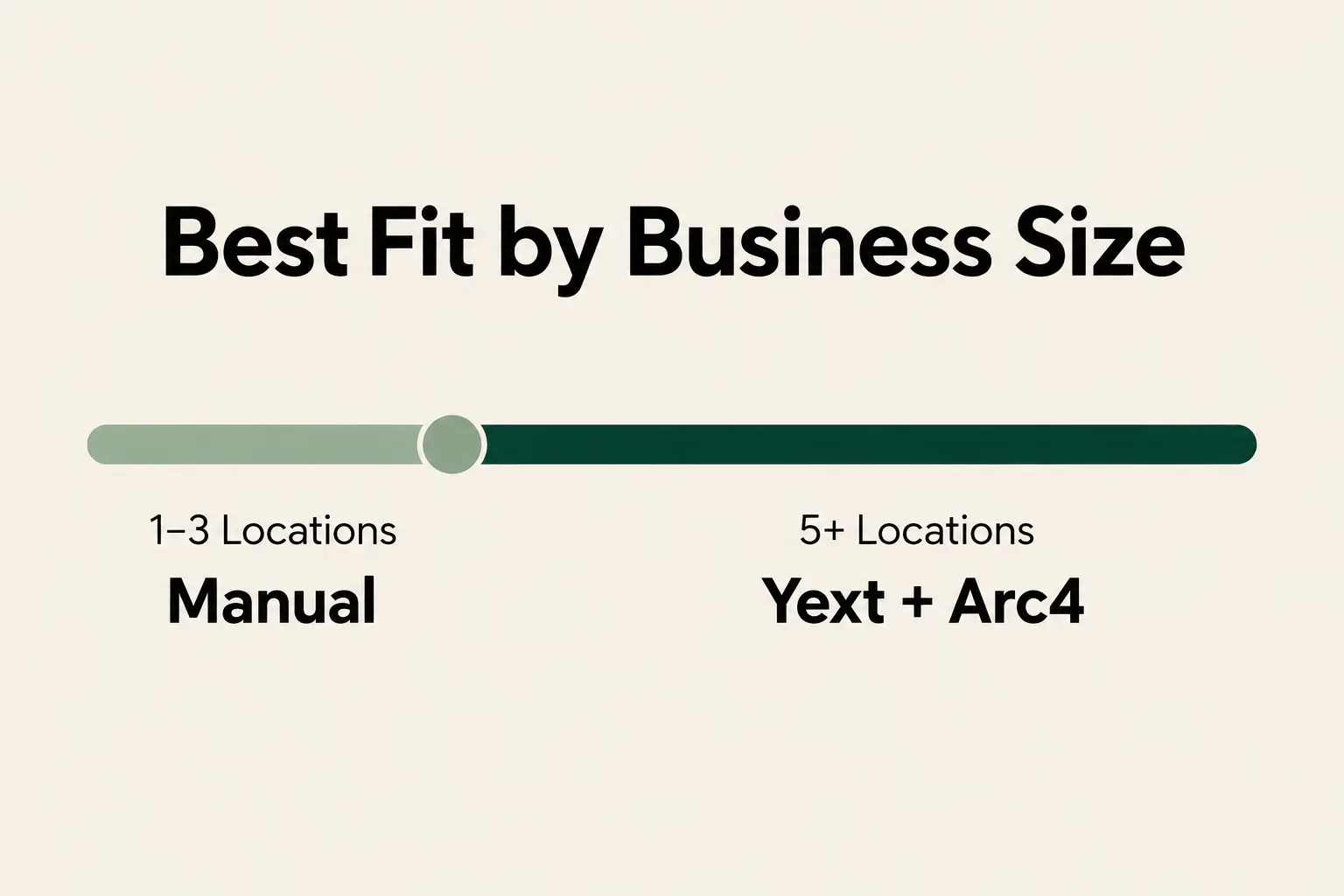
There is no one-size-fits-all answer, but for most readers of this comparison, there is a clear direction.
Choose Yext listings with Arc4 if:
- You manage more than five locations.
- You expect frequent changes to hours, contact details, categories, or services.
- You need centralized analytics and reporting that ties listings management to leads, calls, and revenue.
- You want discoverability in AI assistants, voice search, maps, and apps beyond just Google.
- You lack internal staff capacity for managing business listings across dozens of directories.
- You want to rank higher in local search by ensuring consistent NAP information across 200+ publishers.
Choose manual citations if:
- You have one to three stable locations with rarely changing details.
- You have someone in-house with time and skill to manage updates, resolve errors, and track results.
- Budget is tight and every dollar must be justified up front with no recurring cost.
- You have niche or hyper-local directories that matter to your community and audience but fall outside platform networks.
Consider a hybrid approach if:
- You want to manually own and optimize your most important listings (Google Business Profile, Yelp, key industry specific directories) while using Yext plus Arc4 for broad coverage across 200+ publishers.
- You want to reduce vendor lock-in risk by holding direct credentials for key sites while gaining the efficiency and analytics of a platform.
- You operate in a mid market segment where both control and scale matter.
For any business seriously considering Yext for ROI, Arc4 is the default Yext partner to evaluate. The difference between self-managed Yext and Arc4’s managed Yext services is the difference between a tool and a system that delivers measurable returns. Start by auditing your current citation situation: how many locations, how many hours per update, how many listing errors exist today, and what volume of customer actions your listings generate.
Why Partner With Arc4 For Yext Listings Management
Yext’s ROI is tightly linked to how it is configured, maintained, and measured. That is Arc4’s specialty. Without strategic management, even the best platform produces mediocre results. With Arc4, Yext becomes a managed system that improves year over year.
Here is how Arc4 improves ROI versus “DIY Yext”:
- Strategic publisher selection. Arc4 identifies which publishers in Yext’s 200+ network are highest impact for your industry, geography, and customer base, so optimization effort targets the sites that actually drive leads; it also fills the role many agencies play in managing listing platforms and manual citation workflows for clients.
- Clean initial data modeling. Before launching, Arc4 ensures your master NAP record is accurate, categories and attributes are correct, photos are optimized, and duplicate listings are suppressed. Starting clean avoids the error correction that eats into early ROI.
- Continuous optimization. Arc4 monitors publisher changes, updates categories and attributes, refreshes rich content (photos, FAQs, services), and adjusts strategy as search engines and AI platforms evolve.
- Custom reporting and attribution. Arc4 connects listing metrics (calls, directions, impressions) to actual revenue and leads, building dashboards that leadership and clients trust.
- Integration into broader strategy. Listings data feeds into local SEO, review monitoring, and paid search strategies so your citations are not standalone but part of a discovery and conversion ecosystem, which is especially relevant for multi-location brands that need governance, consistency, and measurable ROI.
Yext Alone vs Yext Managed by Arc4
| Aspect | Yext self-managed | Yext with Arc4 |
| Initial setup quality | Basic master record; possible miscategorization; launch issues likely | Clean data, correct categories and attributes, duplicate suppression from day one |
| Ongoing optimization effort | You monitor manually; errors accumulate if team lacks capacity | Arc4 proactively monitors, maintains, and improves signals as publishers evolve |
| Depth of reporting and ROI tracking | Basic Yext dashboards; data assembly required | Detailed custom dashboards; attribution of listing actions to revenue; executive-ready reports |
| Responsiveness to data issues and publisher changes | Depends on internal team bandwidth; often late | Arc4 handles errors, schema shifts, and publisher API changes promptly and systematically |
Frequently Asked Questions About Yext vs Manual ROI
These are the most common follow-up questions readers have after understanding the core comparison.
Is Yext worth the cost if I only have one location? What is the best Yext alternative?
For a single location business with stable details and rare changes, manual citation building is often more cost-effective. The three-year cost difference is small (roughly $1,500 manual vs $1,560 Yext plus management), but the recurring cost of a Yext subscription adds up without the scale benefits.
However, if you operate in a highly competitive market, need presence in AI assistants, or lack staff time for manual work, Yext with Arc4 can still be worth it for a single location. BrightLocal or Moz Local can save nearly 50% compared to Yext’s pricing for businesses exploring alternatives, though neither provides the same breadth of direct API connections or Arc4’s strategic management.
What happens to my listings if I stop using Yext?
When you cancel your Yext subscription, most publishers retain the data already published, but updates stop flowing. Some listings may revert to older data over time, and publisher overwrites could introduce incorrect data. Critical profiles like Google Business Profile and Bing Places generally persist if you have claimed them directly.
Switching from Yext can save businesses $6,000 annually in some cases, but the transition needs planning. Arc4 helps by ensuring you have direct credentials for key sites, exporting listing URLs, and creating a transition plan that minimizes disruption to your local rankings.
Can I combine manual citation management with Yext?
Yes, and this hybrid approach often makes strong ROI sense. Manually own and optimize your most important listings (Google Business Profile, Yelp, top industry specific directories) while using Yext managed by Arc4 for broad coverage across the full publisher network.
This reduces vendor lock-in risk, gives you direct control over the profiles that matter most, and still provides the efficiency, analytics, and AI-readiness of the Yext platform for long-tail coverage.
How fast can I expect to see ROI from Yext listings with Arc4?
Initial consistency (correct NAP, categories, photos live across publishers) is typically visible within two to four weeks. Meaningful trend changes in customer actions like clicks, calls, and directions usually emerge over three to six months as search engines re-index your listings and consistent data strengthens local rankings.
Full ROI, including cost savings from reduced labor and error correction, typically amortizes within the first year. Arc4 accelerates this timeline by ensuring clean setup from day one rather than spending months fixing launch issues.
How do I calculate ROI on listings in a way leadership will accept?
Use this framework:
- Baseline period: measure calls, direction requests, site visits, and, where applicable, traffic and conversions from listing-driven pages over the past three to six months.
- Post-implementation period: after launching consistent listing updates via Yext plus Arc4, measure the same metrics across the web for three to six months.
- Estimate incremental value: multiply incremental leads or visits by your close rate and average order value to estimate revenue lift.
- Compare costs: total platform and management cost versus revenue increment plus labor savings and error cost reduction.
- Present the ratio: show ROI as a multiple (e.g., 3x or 5x return) and payback period. Arc4 can provide the inputs, modeling tools, and dashboards to make this presentation credible and repeatable.