Yext vs SOCI – Comparing Local SEO Vendors

Table of Contents

Yext vs SOCI – Comparing Local SEO Vendors

SOCi vs Yext comparison of local marketing platforms in 2026

When it comes to digital marketing solutions, choosing between Yext and SOCi can be a common and pivotal decision for marketing managers and business owners.

Both platforms offer distinct features tailored to various needs, from listings and reviews management to locators, location pages, advisor pages, content creation and social capabilities.

In this comparison, we’ll explore what sets Yext and SOCi apart, providing digital marketers with insights to choose the solution best suited to their needs. Our goal is to guide you toward a platform that aligns with your digital marketing strategy, driving both efficiency and impactful results.
Yext vs. SOCi in 2025

A Digital Marketers Decision

Editors Note: This analysis was updated in December 2025 to account for Yext’s recent acquisition of Places Scout along with additional AI advancements from SOCi. These updates are now reflected in our review.

Local digital marketing is a crucial yet sometimes overlooked aspect of a company’s overall strategy. For multi-location brands, optimizing local listings, managing reviews, and creating location-specific content are essential to building a strong online presence where it matters most, close to the customer. However, navigating the tools to manage these efforts at scale can be challenging.

Yext and SOCi are two of the most recognized platforms in this space, each offering robust solutions that cater to the varying needs of brands based on their size and scale. Marketers often find themselves choosing between these two due to their market reach and reputation.

Yext, known for its enterprise-level capabilities, provides a comprehensive, integrated platform, while SOCi stands out for its social management tools. For digital marketers, this decision is pivotal: selecting the right platform can amplify local visibility, drive customer engagement, and ultimately support long-term growth in the digital marketplace.

Yext vs SOCi: Complete Platform Comparison for Multi-Location Businesses

Managing a business’s digital presence across multiple locations presents challenges that single-location businesses never have to solve. From maintaining accurate listings across hundreds of directories to coordinating social campaigns across thousands of profiles, multi-location brands need platforms that can operate at true enterprise scale.

Two platforms come up often in these conversations: Yext and SOCi. Both serve brands with multiple locations and both touch local search and reputation. But they come from very different product philosophies.

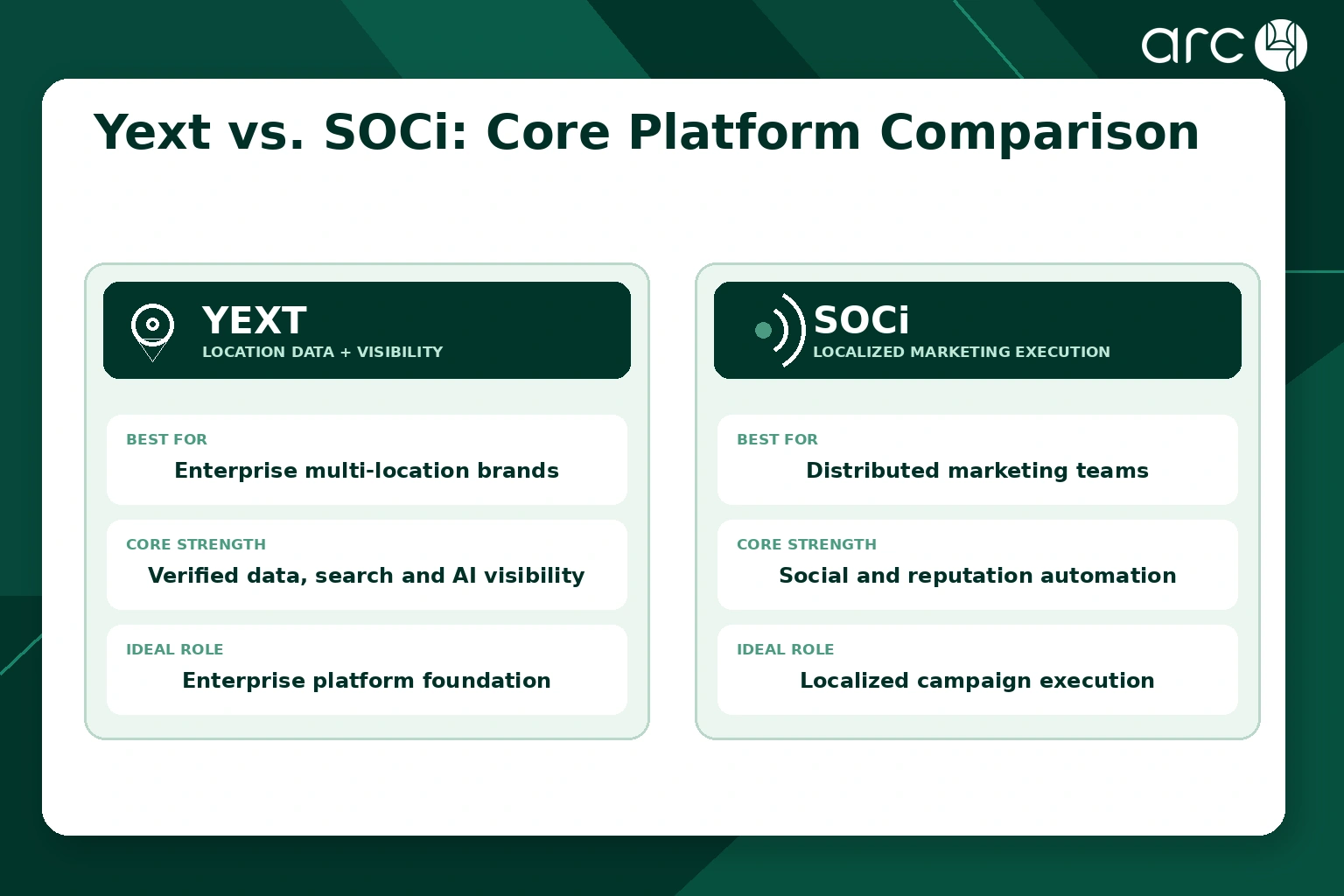
  • Yext is built as an enterprise-grade source of truth for location data, local SEO, and listings accuracy.
  • SOCi is built first as a social and engagement platform, with lighter listings capabilities layered in.

This comparison walks through capabilities, pricing, integrations, and typical use cases so you can decide which platform best aligns with your growth strategy. It also reflects Arc4’s experience implementing Yext and related stacks for complex multi-location brands.

By the end, you should have a clear framework for when Yext is the right backbone, when SOCi makes sense, and where they may fit together.

Quick Comparison Overview

The right choice between Yext and SOCi starts with understanding which parts of local marketing are the most important to your brand.

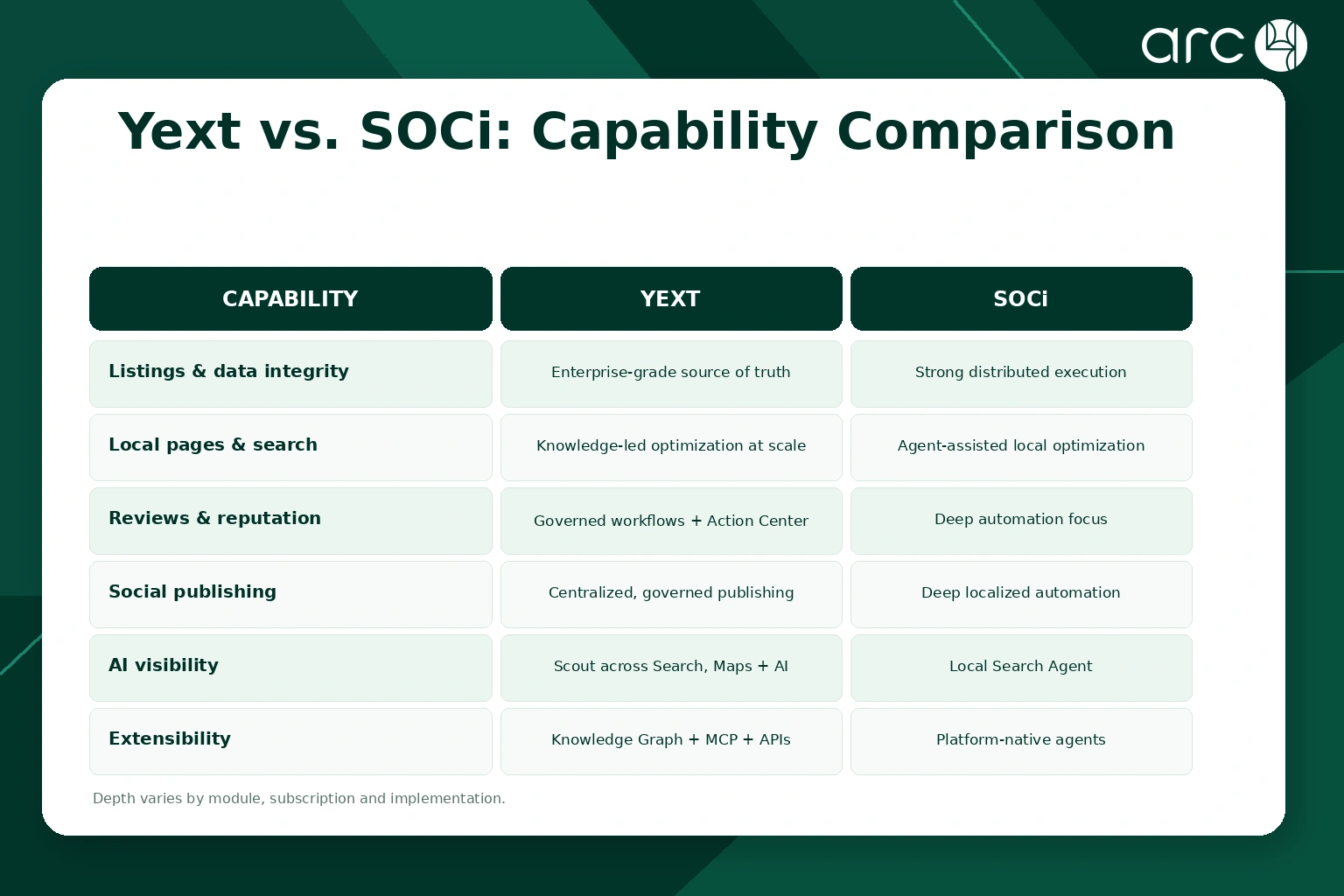
  • Yext specializes in comprehensive listings management, local SEO optimization, and maintaining accurate data across 200+ directories and search platforms. Its Knowledge Graph is designed to be the single source of truth for your locations so search engines, maps, and voice assistants all pull from consistent data.
  • SOCi focuses on social media management, localized content creation, and review response workflows. Its strengths sit squarely in campaign execution and local engagement for brands that treat social as a primary marketing channel.

Bottom Line:

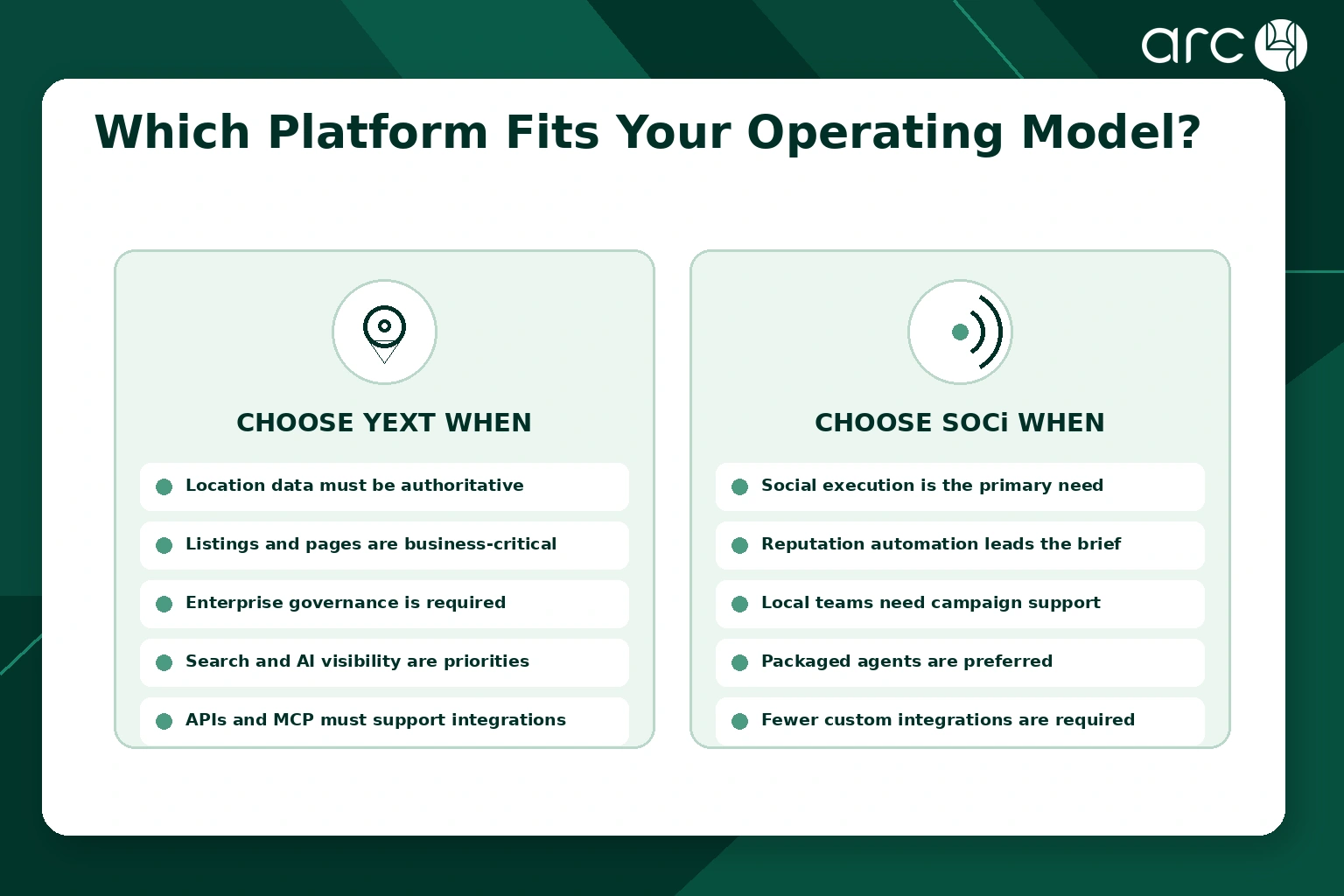
  • If your biggest risk is being wrong, missing, or inconsistent in search and maps, Yext is the platform built for that problem.
  • If your biggest gap is local posting cadence, social campaigns, and franchise-level workflows, SOCi steps in as a social layer, especially for small to mid-market chains that don’t already have enterprise social tools and aren’t focused on accurate information at scale.

Both platforms can serve multi-location businesses, but for enterprise brands that care about accuracy, governance, and integration across hundreds or thousands of locations, Yext is usually the backbone. SOCi is better considered a specialized social layer rather than a full replacement for enterprise-grade listings and local SEO.

 Yext
Local SEO & data
SOCi
Social & engagement
Core focusSource of truth for locations and listings.Local social, campaigns, and reputation.
Best for
  • Enterprise and regulated brands
  • Hundreds or thousands of locations
  • Strict data governance needs
  • Small to mid-market brands
  • Social-led local marketing teams
  • Franchise groups focused on posting
Local SEO & listings
  • Broad global directory coverage
  • Strong structured data and schema
  • Ties queries and conversions to locations
  • Coverage on major profiles
  • Listings live inside workflow tools
  • Good enough accuracy for core surfaces
Social & reviews
  • Keeps profiles accurate for social and search
  • Pairs well with a dedicated social tool
  • Connects reviews back to SEO performance
  • Full social calendar and templates
  • AI-assisted posts and review replies
  • Location-level workflows and approvals
When to chooseChoose Yext when accuracy and coverage are non-negotiable, you need a single source of truth, and you want local SEO and site experiences to scale.Choose SOCi when local posting and reputation are the main priority and listings needs are simpler and more limited.


Yext Platform Overview and Core Capabilities

Yext built its reputation as the industry leader in listings management and local SEO for multi-location brands. The central idea: you should have one authoritative place to manage all the knowledge about your business and locations.

Knowledge Graph as System of Record

Yext’s Knowledge Graph centralizes business data and syncs it across Google, Bing, Apple Maps, Facebook, and 200+ other directories. Instead of updating each destination individually, you update one structured data set and let Yext propagate changes everywhere.

That matters when you:

  • Change hours across regions or for a holiday
  • Rebrand a service line or add new offerings
  • Open, close, or relocate dozens of locations

Real-time Updates and Data Consistency

Because changes push in real time, customers are far less likely to see stale hours, wrong addresses, or outdated phone numbers, problems that directly impact revenue and CSAT.

Local SEO and Structured Data

Yext also goes beyond basic listings:

  • Schema markup and structured data for locations
  • Location-specific landing pages
  • Search query analytics tied to local performance

These features help search engines understand your brand’s footprint and improve your chances of appearing in local packs, map results, and rich snippets.

On-site Search with Yext Search

Yext Search brings AI-powered site search to your own domain. Visitors can ask natural-language questions and get direct answers sourced from your Knowledge Graph. For multi-location brands, that means faster access to store information, policies, and services without clicking around complex nav structures.

Review Management and Monitoring

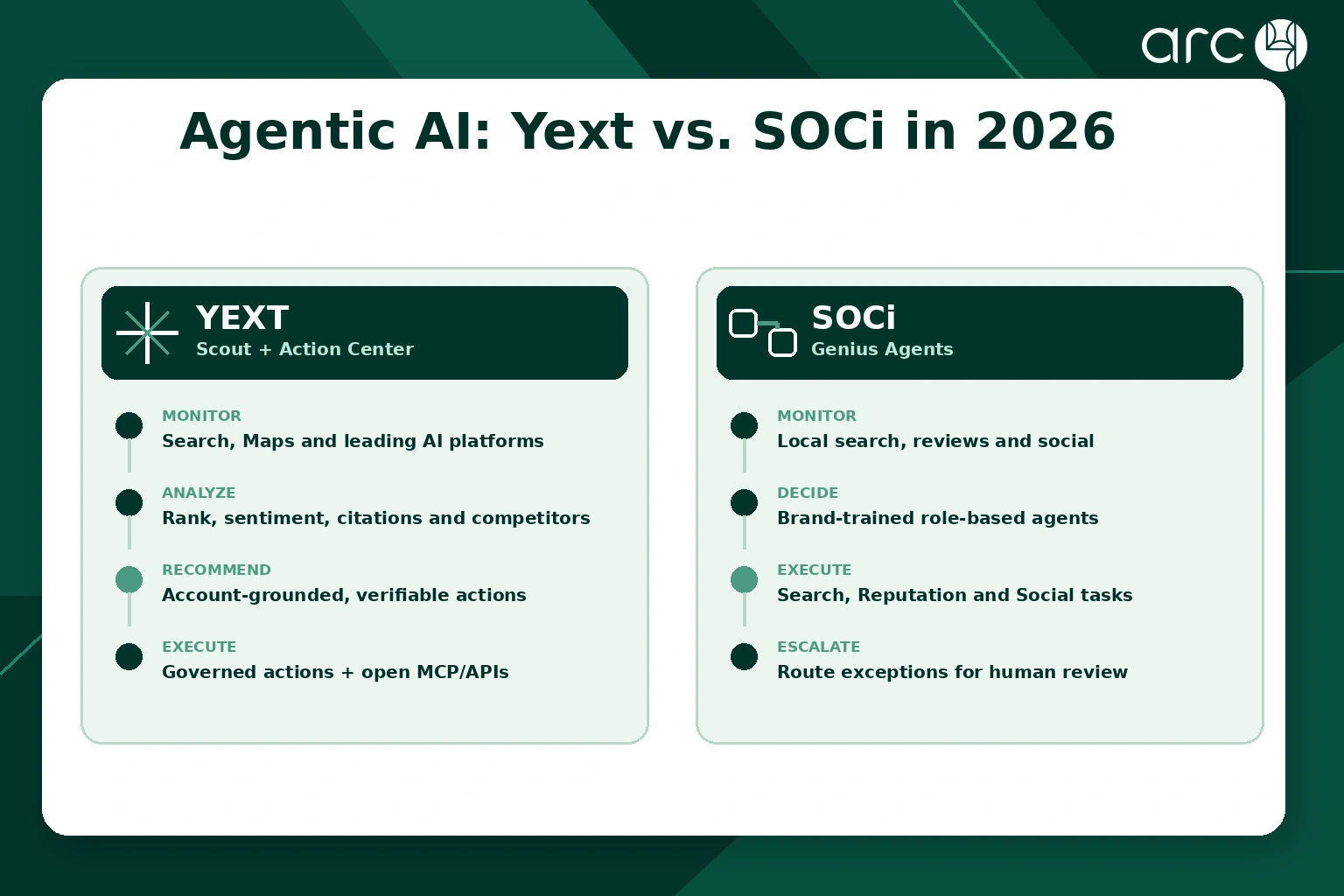
While Yext isn’t first and foremost a reputation platform, it does centralize reviews from major sources and offers workflows to monitor sentiment and respond efficiently. The key advantage is the connection between review data and local SEO metrics, which lets you see how improvements in rating and volume correlate with search visibility.


Struggling to rank locally across your markets?

For enterprise teams that want a single, structured layer of truth feeding everything else, from Google Business Profiles to voice assistants, Yext is built specifically for that role.

Yext’s Key Strengths

  • Unmatched directory coverage (200+ platforms) for maximum local search and map visibility.
  • Enterprise-grade Knowledge Graph as a centralized, structured data layer for every location, service, and attribute.
  • Open API architecture for deep integrations with CRMs, marketing automation, analytics, and custom tools.
  • Analytics designed for enterprises that connect search queries, impressions, and conversions back to location data.
  • Bulk editing at massive scale, so you can roll out changes across hundreds or thousands of locations in minutes.
  • Voice search optimization for Siri, Alexa, Google Assistant, and other voice surfaces.

For brands with governance, compliance, or complex organizational structures, this combination is difficult to replicate with lighter-weight tools.

SOCi Platform Overview and Core Features

SOCi approaches the multi-location challenge primarily through the lens of social and engagement rather than data governance.

Its sweet spot is brands that:

  • Need to drive more consistent posting at the location level
  • Want to localize content while keeping a central brand framework
  • Don’t have an existing enterprise social stack

Centralized Social Media Management

SOCi provides a dashboard for scheduling posts and campaigns across Facebook, Instagram, Google Business Profiles, and other social platforms. Corporate teams can build calendars, templates, and campaigns that local operators customize or simply approve.

AI-powered content and responses

SOCi’s “Genius” features auto-generated localized content, review responses, and posting schedules. For social heavy brands, this can reduce the time spent on day-to-day posting and basic reputation responses.

Franchise-Friendly Workflows

Approval flows, templates, and limited local customization give franchisors a way to control brand voice while letting local teams respond to their communities.

Social Advertising and Geo-Targeting

SOCi supports location-level paid promotion with geo-targeted audiences. This is valuable for consumer-facing brands that run ongoing local offers or seasonal campaigns.

However, SOCi’s listings and structured data capabilities are more limited, focusing on a smaller set of key directories. For multi-location enterprises whose reputations and revenue depend on clean data across a broad directory ecosystem, SOCi generally functions as a social add-on, not as the primary system of record.

SOCi’s Key Strengths

  • Strong social automation that lightens the load on local managers.
  • Hyper-local social campaigns with neighborhood-level targeting and localized messaging.
  • Integrated social listening for monitoring mentions and competitor activity.
  • Franchise-ready workflows that balance corporate control with local flexibility.
  • Social analytics that show reach, engagement, and conversions at the location level.

For brands whose main local lever is social media and whose listings needs are basic, SOCi can be a good fit, especially in the small to mid-market.

Listings and Directory Management Comparison

This is where the contrast between Yext and SOCi is clearest.

Yext: Built for depth and coverage

  • Partnerships with 200+ directories, including Google, Apple Maps, Yelp, TripAdvisor, and vertical-specific platforms (healthcare, legal, automotive, etc.).
  • The Knowledge Graph continuously monitors for duplicate records and conflicting information, automatically resolving or flagging issues.
  • Structured data and schema support help search engines interpret your locations and services accurately.

For enterprise brands, that breadth and automation translate into fewer data gaps, fewer manual fixes, and stronger local visibility.

SOCi: Coverage on Core Platforms Only

  • Focuses on a smaller set of 15–20 core directories, with an emphasis on Google Business Profiles and social profiles.
  • Listings tools are tightly integrated with its social workflows but lack the depth, automation, and industry-specific coverage Yext provides.

SOCi’s approach works reasonably well for simpler footprints where being correct on a handful of major platforms is “good enough.” But for complex enterprises or regulated industries, the narrower directory coverage and lighter automation can become a meaningful risk.

If listings accuracy, breadth of coverage, and ongoing local SEO performance are critical, Yext is the appropriate platform to anchor that strategy.

Social Media Management Capabilities

On the social side, SOCi is more feature-rich out of the box, while Yext intentionally keeps a lighter footprint and relies on integrations with dedicated social tools.

SOCi’s Social Strengths

  • Advanced content calendars and multi-platform publishing workflows
  • AI-generated, location-specific content and review responses
  • Support for stories, events, and format-specific content across platforms
  • Campaign templates that can be cloned and localized across hundreds of locations

For brands that don’t already have an enterprise social platform and want a single place for social publishing, SOCi is attractive.

Yext’s Social Role

Yext focuses on maintaining accurate profile data, hours, addresses, attributes across social destinations and directories. It is not built as a full social publishing or engagement suite, and most enterprise Yext customers pair it with:

  • A dedicated social platform (for example Sprinklr, Sprout Social, Khoros)
  • An internal social stack and workflows they already trust

This separation is often intentional for enterprises:

  • Yext owns data quality and search discovery.
  • A social solution of choice owns creative, campaigns, and community management.

If you are primarily seeking a social posting engine, SOCi may be a better fit. If you already have a social solution or plan to choose one independently, Yext doesn’t get in the way and instead ensures those social profiles stay accurate and aligned with your broader location data.

Review and Reputation Management Features

Both platforms understand that reviews drive both perception and local SEO.

Common Ground

  • Aggregation of reviews from major platforms into a single dashboard
  • Monitoring and filters for rating, sentiment, and volume
  • Workflows to assign, respond, and escalate

SOCi

SOCi leans into AI-driven responses and bulk handling of reviews, especially for multi-location consumer brands that receive high review volume. The goal is to make it fast and manageable for local or regional teams to stay on top of daily review activity.

Yext

Yext connects review performance more tightly with search and listing data:

  • Sentiment trends across locations
  • Correlations between rating improvements and local visibility
  • First-party review generation tools that plug into your own properties

For enterprises, this linkage back to SEO and search performance helps quantify the impact of reputation work beyond just star ratings.

Pricing Structure and Cost Analysis

Pricing details vary by deal, but the general dynamics look like this:

Yext

  • Subscription-based, starting around the low hundreds per month for small to medium sized businesses and scaling up for enterprises.
  • Pricing typically reflects:
    • Number of locations
    • Directory coverage
    • Additional products like Pages, Search, and Scout Analytics.

Yext often looks more expensive on paper, but for enterprise brands, it is often replacing manual processes, data inconsistency risk, and fragmented tools, costs that rarely show up in a simple line-item comparison.

SOCi

  • Customized pricing based on location count and feature bundle.
  • Tends to be more affordable if your primary need is social plus basic listings rather than deep directory coverage and structured data.
  • Clear tiers (Starter, Professional, Enterprise) with incremental features.

Both generally operate on annual contracts, with longer commitments unlocking better pricing for larger deployments.

If you are an enterprise brand whose revenue depends on accurate, consistent, and compliant location data, Yext usually delivers greater long-term ROI, even at a higher subscription cost. If you are a smaller chain looking mainly to upgrade local social execution, SOCi can be a cost-efficient way to do that.

Integration and API Capabilities

For enterprise brands, integration is often where platforms win or lose.

Yext

  • Extensive API documentation and pre-built integrations with Salesforce, HubSpot, WordPress, and other major CRMs and CMSs.
  • Open architecture supports custom development, white-label use cases, and complex governance models.
  • Data can be pushed and pulled programmatically, making Yext a true data layer inside your broader martech stack.

SOCi

  • Integrates tightly with social platforms (Facebook Business Manager, Google Business Profiles, etc.) and popular franchise systems.
  • Offers webhooks and an app marketplace to tie social signals into other tools.
  • Well-suited to automating workflows tied to posts, reviews, and other engagement events.

Both work with Zapier and similar connectors, but Yext is typically the better fit when you need deep, bidirectional data sync with existing enterprise systems.

For deeper integrationsArc4 often builds around Yext as the central location data layer, then layers in social, analytics, and bespoke tools via API so brands get a cohesive but flexible stack.

Best Use Cases and Target Businesses

A helpful way to decide is to look at who each platform really serves best.

Yext is ideal for:

  • Enterprise and upper-mid-market brands with 50+ locations, especially into the hundreds or thousands
  • Industries where accuracy and compliance are non-negotiable (healthcare, financial services, legal, automotive, multi-brand retail)
  • Organizations that need:
    • Strong governance and permissions
    • Consistent data across many internal and external systems
    • Support for expansion into new markets and directories

SOCi is ideal for:

  • Small to mid-market chains and franchises where social is the primary growth lever
  • Restaurant, fitness, personal services, and retail concepts that rely heavily on local engagement and promotions
  • Brands that:
    • Don’t yet have an enterprise social solution
    • Have relatively straightforward listings needs limited to major platforms

Many sophisticated brands end up in a hybrid pattern:

  • Yext as the authoritative data and listings layer
  • SOCi or another social platform for local content, campaigns, and community management

For enterprises, that combination is far more common than trying to force SOCi to act as a full replacement for an enterprise-grade listings and local SEO solution.

Platform Limitations and Considerations

Every platform has trade-offs. It is better to go in with eyes open.

Yext limitations

  • Higher pricing can be hard to justify for very small or early-stage businesses.
  • The platform is deep; teams need training and a clear owner to fully unlock value.
  • It expects to be treated as a core system of record, not a “set it and forget it” tool.

SOCi limitations

  • Limited directory coverage compared to Yext, especially for vertical-specific and international platforms.
  • Listings and structured data capabilities are basic relative to enterprise local SEO needs.
  • Social-first design means it may leave gaps in technical SEO, schema, and deep data governance that large organizations care about.

For enterprise and complex multi-location environments, these limitations often tip the scale toward Yext as the default backbone, with SOCi considered only if there is a clear, social-first use case.

Real World Performance Results

Examples from brands using these platforms help illustrate where each shines.

  • SOCi has published case studies like Sport Clips, which reported an 18 percent sales increase in four months after enhancing review management, and Kumon, which improved social response rates from 29 percent to 57 percent across thousands of locations. These wins are directly tied to better social and reputation workflows.
  • Yext customers commonly report 15 to 25 percent improvements in local search rankings within 3 to 6 months when they fully implement listings, structured data, and review features. Increased map impressions, calls, and direction requests typically follow.

For enterprise brands working with partners like Arc4, Yext implementations often unlock gains not just in search performance, but also in operational efficiency: fewer manual updates, fewer inconsistencies, and less time spent reconciling conflicting data across systems.

The lesson: both platforms can produce ROI, but the type of ROI differs, social engagement versus discoverability, data quality, and operational resilience.

Final Recommendation and Decision Framework

If you are an enterprise or rapidly scaling multi-location brand:

  • Default to Yext as your primary platform when:
    • You need authoritative, structured location data across 200+ directories and platforms
    • Local SEO, map visibility, and data accuracy are core to your revenue
    • You require robust integrations, permissions, and governance
  • Consider SOCi when:
    • You are a small to mid-market chain without an enterprise social solution
    • Social posting, localized campaigns, and basic review workflows are your biggest gaps
    • You can live with narrower directory coverage and lighter SEO tooling

For many enterprise brands, the realistic stack looks like:

  1. Yext as the system of record for locations and listings
  2. A social platform layered on for engagement, campaigns, and community management
  3. Analytics and CRM tools tied into Yext’s Knowledge Graph so performance is measurable end to end


If you want to go deeper on how Yext fits into a mature enterprise stack, you can review our complete guide to Yext SEO, and our Yext services.

Where Arc4 Fits In

Even the right platform can underperform if it is not implemented strategically. That is where Arc4 comes in.

Arc4 works with enterprise and multi-location brands to:

  • Evaluate whether Yext, SOCi, or a hybrid stack best fits your current and future needs
  • Design a data model and governance approach that matches your real-world org structure
  • Implement and integrate Yext or SOCi as a central data layer alongside your existing CRM, analytics, and social tools
  • Build workflows so local teams, agencies, and corporate stakeholders all operate from the same source of truth

If you are evaluating Yext vs SOCi and want a strategy that prioritizes enterprise-grade capabilities, data integrity, and long-term scalability, partnering with Arc4 ensures you get a stack that is not just “turned on,” but actually aligned with how your business grows.

Want Expert Guidance on Your Next Steps?

Choosing the right local SEO platform can feel like a big decision, and Arc4 is here to guide you every step of the way. As experts in local SEO and digital experience optimization, we bring extensive industry knowledge and a deep understanding of both Yext and SOCi. Whether you are looking to scale your listings management, enhance local engagement, or future-proof your digital strategy, our team will help you find the best solution to meet your needs.

Contact us today for a consultation and discover how our local SEO and digital experience services can elevate your brand’s online presence.


SOCi vs Yext comparison of local marketing platforms in 2026

When it comes to digital marketing solutions, choosing between Yext and SOCi can be a common and pivotal decision for marketing managers and business owners.

Both platforms offer distinct features tailored to various needs, from listings and reviews management to locators, location pages, advisor pages, content creation and social capabilities.

In this comparison, we’ll explore what sets Yext and SOCi apart, providing digital marketers with insights to choose the solution best suited to their needs. Our goal is to guide you toward a platform that aligns with your digital marketing strategy, driving both efficiency and impactful results.

Yext vs. SOCi in 2025

A Digital Marketers Decision


Editors Note: This analysis was updated in December 2025 to account for Yext’s recent acquisition of Places Scout along with additional AI advancements from SOCi. These updates are now reflected in our review.

Local digital marketing is a crucial yet sometimes overlooked aspect of a company’s overall strategy. For multi-location brands, optimizing local listings, managing reviews, and creating location-specific content are essential to building a strong online presence where it matters most, close to the customer. However, navigating the tools to manage these efforts at scale can be challenging.

Yext and SOCi are two of the most recognized platforms in this space, each offering robust solutions that cater to the varying needs of brands based on their size and scale. Marketers often find themselves choosing between these two due to their market reach and reputation.

Yext, known for its enterprise-level capabilities, provides a comprehensive, integrated platform, while SOCi stands out for its social management tools. For digital marketers, this decision is pivotal: selecting the right platform can amplify local visibility, drive customer engagement, and ultimately support long-term growth in the digital marketplace.

Yext vs SOCi: Complete Platform Comparison for Multi-Location Businesses

Managing a business’s digital presence across multiple locations presents challenges that single-location businesses never have to solve. From maintaining accurate listings across hundreds of directories to coordinating social campaigns across thousands of profiles, multi-location brands need platforms that can operate at true enterprise scale.

Two platforms come up often in these conversations: Yext and SOCi. Both serve brands with multiple locations and both touch local search and reputation. But they come from very different product philosophies.

  • Yext is built as an enterprise-grade source of truth for location data, local SEO, and listings accuracy.
  • SOCi is built first as a social and engagement platform, with lighter listings capabilities layered in.

This comparison walks through capabilities, pricing, integrations, and typical use cases so you can decide which platform best aligns with your growth strategy. It also reflects Arc4’s experience implementing Yext and related stacks for complex multi-location brands.

By the end, you should have a clear framework for when Yext is the right backbone, when SOCi makes sense, and where they may fit together.

Quick Comparison Overview

The right choice between Yext and SOCi starts with understanding which parts of local marketing are the most important to your brand.

  • Yext specializes in comprehensive listings management, local SEO optimization, and maintaining accurate data across 200+ directories and search platforms. Its Knowledge Graph is designed to be the single source of truth for your locations so search engines, maps, and voice assistants all pull from consistent data.
  • SOCi focuses on social media management, localized content creation, and review response workflows. Its strengths sit squarely in campaign execution and local engagement for brands that treat social as a primary marketing channel.

Bottom Line:

  • If your biggest risk is being wrong, missing, or inconsistent in search and maps, Yext is the platform built for that problem.
  • If your biggest gap is local posting cadence, social campaigns, and franchise-level workflows, SOCi steps in as a social layer, especially for small to mid-market chains that don’t already have enterprise social tools and aren’t focused on accurate information at scale.

Both platforms can serve multi-location businesses, but for enterprise brands that care about accuracy, governance, and integration across hundreds or thousands of locations, Yext is usually the backbone. SOCi is better considered a specialized social layer rather than a full replacement for enterprise-grade listings and local SEO.

 Yext
Local SEO & data
SOCi
Social & engagement
Core focusSource of truth for locations and listings.Local social, campaigns, and reputation.
Best for
  • Enterprise and regulated brands
  • Hundreds or thousands of locations
  • Strict data governance needs
  • Small to mid-market brands
  • Social-led local marketing teams
  • Franchise groups focused on posting
Local SEO & listings
  • Broad global directory coverage
  • Strong structured data and schema
  • Ties queries and conversions to locations
  • Coverage on major profiles
  • Listings live inside workflow tools
  • Good enough accuracy for core surfaces
Social & reviews
  • Keeps profiles accurate for social and search
  • Pairs well with a dedicated social tool
  • Connects reviews back to SEO performance
  • Full social calendar and templates
  • AI-assisted posts and review replies
  • Location-level workflows and approvals
When to chooseChoose Yext when accuracy and coverage are non-negotiable, you need a single source of truth, and you want local SEO and site experiences to scale.Choose SOCi when local posting and reputation are the main priority and listings needs are simpler and more limited.

Yext Platform Overview and Core Capabilities

Yext built its reputation as the industry leader in listings management and local SEO for multi-location brands. The central idea: you should have one authoritative place to manage all the knowledge about your business and locations.

Knowledge Graph as System of Record

Yext’s Knowledge Graph centralizes business data and syncs it across Google, Bing, Apple Maps, Facebook, and 200+ other directories. Instead of updating each destination individually, you update one structured data set and let Yext propagate changes everywhere.

That matters when you:

  • Change hours across regions or for a holiday
  • Rebrand a service line or add new offerings
  • Open, close, or relocate dozens of locations

Real-time Updates and Data Consistency
Because changes push in real time, customers are far less likely to see stale hours, wrong addresses, or outdated phone numbers, problems that directly impact revenue and CSAT.
Local SEO and Structured Data

Yext also goes beyond basic listings:

  • Schema markup and structured data for locations
  • Location-specific landing pages
  • Search query analytics tied to local performance

These features help search engines understand your brand’s footprint and improve your chances of appearing in local packs, map results, and rich snippets.

On-site Search with Yext Search

Yext Search brings AI-powered site search to your own domain. Visitors can ask natural-language questions and get direct answers sourced from your Knowledge Graph. For multi-location brands, that means faster access to store information, policies, and services without clicking around complex nav structures.

Review Management and Monitoring

While Yext isn’t first and foremost a reputation platform, it does centralize reviews from major sources and offers workflows to monitor sentiment and respond efficiently. The key advantage is the connection between review data and local SEO metrics, which lets you see how improvements in rating and volume correlate with search visibility.


Struggling to rank locally across your markets?

For enterprise teams that want a single, structured layer of truth feeding everything else, from Google Business Profiles to voice assistants, Yext is built specifically for that role.

Yext’s Key Strengths

  • Unmatched directory coverage (200+ platforms) for maximum local search and map visibility.
  • Enterprise-grade Knowledge Graph as a centralized, structured data layer for every location, service, and attribute.
  • Open API architecture for deep integrations with CRMs, marketing automation, analytics, and custom tools.
  • Analytics designed for enterprises that connect search queries, impressions, and conversions back to location data.
  • Bulk editing at massive scale, so you can roll out changes across hundreds or thousands of locations in minutes.
  • Voice search optimization for Siri, Alexa, Google Assistant, and other voice surfaces.

For brands with governance, compliance, or complex organizational structures, this combination is difficult to replicate with lighter-weight tools.

SOCi Platform Overview and Core Features

SOCi approaches the multi-location challenge primarily through the lens of social and engagement rather than data governance.

Its sweet spot is brands that:

  • Need to drive more consistent posting at the location level
  • Want to localize content while keeping a central brand framework
  • Don’t have an existing enterprise social stack

Centralized Social Media Management

SOCi provides a dashboard for scheduling posts and campaigns across Facebook, Instagram, Google Business Profiles, and other social platforms. Corporate teams can build calendars, templates, and campaigns that local operators customize or simply approve.

AI-powered content and responses

SOCi’s “Genius” features auto-generated localized content, review responses, and posting schedules. For social heavy brands, this can reduce the time spent on day-to-day posting and basic reputation responses.

Franchise-Friendly Workflows

Approval flows, templates, and limited local customization give franchisors a way to control brand voice while letting local teams respond to their communities.

Social Advertising and Geo-Targeting

SOCi supports location-level paid promotion with geo-targeted audiences. This is valuable for consumer-facing brands that run ongoing local offers or seasonal campaigns.

However, SOCi’s listings and structured data capabilities are more limited, focusing on a smaller set of key directories. For multi-location enterprises whose reputations and revenue depend on clean data across a broad directory ecosystem, SOCi generally functions as a social add-on, not as the primary system of record.

SOCi’s Key Strengths

  • Strong social automation that lightens the load on local managers.
  • Hyper-local social campaigns with neighborhood-level targeting and localized messaging.
  • Integrated social listening for monitoring mentions and competitor activity.
  • Franchise-ready workflows that balance corporate control with local flexibility.
  • Social analytics that show reach, engagement, and conversions at the location level.

For brands whose main local lever is social media and whose listings needs are basic, SOCi can be a good fit, especially in the small to mid-market.

Listings and Directory Management Comparison

This is where the contrast between Yext and SOCi is clearest.

Yext: Built for depth and coverage

  • Partnerships with 200+ directories, including Google, Apple Maps, Yelp, TripAdvisor, and vertical-specific platforms (healthcare, legal, automotive, etc.).
  • The Knowledge Graph continuously monitors for duplicate records and conflicting information, automatically resolving or flagging issues.
  • Structured data and schema support help search engines interpret your locations and services accurately.

For enterprise brands, that breadth and automation translate into fewer data gaps, fewer manual fixes, and stronger local visibility.

SOCi: Coverage on Core Platforms Only

  • Focuses on a smaller set of 15–20 core directories, with an emphasis on Google Business Profiles and social profiles.
  • Listings tools are tightly integrated with its social workflows but lack the depth, automation, and industry-specific coverage Yext provides.

SOCi’s approach works reasonably well for simpler footprints where being correct on a handful of major platforms is “good enough.” But for complex enterprises or regulated industries, the narrower directory coverage and lighter automation can become a meaningful risk.

If listings accuracy, breadth of coverage, and ongoing local SEO performance are critical, Yext is the appropriate platform to anchor that strategy.

Social Media Management Capabilities

On the social side, SOCi is more feature-rich out of the box, while Yext intentionally keeps a lighter footprint and relies on integrations with dedicated social tools.

SOCi’s Social Strengths

  • Advanced content calendars and multi-platform publishing workflows
  • AI-generated, location-specific content and review responses
  • Support for stories, events, and format-specific content across platforms
  • Campaign templates that can be cloned and localized across hundreds of locations

For brands that don’t already have an enterprise social platform and want a single place for social publishing, SOCi is attractive.

Yext’s Social Role

Yext focuses on maintaining accurate profile data, hours, addresses, attributes across social destinations and directories. It is not built as a full social publishing or engagement suite, and most enterprise Yext customers pair it with:

  • A dedicated social platform (for example Sprinklr, Sprout Social, Khoros)
  • An internal social stack and workflows they already trust

This separation is often intentional for enterprises:

  • Yext owns data quality and search discovery.
  • A social solution of choice owns creative, campaigns, and community management.

If you are primarily seeking a social posting engine, SOCi may be a better fit. If you already have a social solution or plan to choose one independently, Yext doesn’t get in the way and instead ensures those social profiles stay accurate and aligned with your broader location data.

Review and Reputation Management Features

Both platforms understand that reviews drive both perception and local SEO.

Common Ground

  • Aggregation of reviews from major platforms into a single dashboard
  • Monitoring and filters for rating, sentiment, and volume
  • Workflows to assign, respond, and escalate

SOCi

SOCi leans into AI-driven responses and bulk handling of reviews, especially for multi-location consumer brands that receive high review volume. The goal is to make it fast and manageable for local or regional teams to stay on top of daily review activity.

Yext

Yext connects review performance more tightly with search and listing data:

  • Sentiment trends across locations
  • Correlations between rating improvements and local visibility
  • First-party review generation tools that plug into your own properties

For enterprises, this linkage back to SEO and search performance helps quantify the impact of reputation work beyond just star ratings.

Pricing Structure and Cost Analysis

Pricing details vary by deal, but the general dynamics look like this:

Yext

  • Subscription-based, starting around the low hundreds per month for small to medium sized businesses and scaling up for enterprises.
  • Pricing typically reflects:
    • Number of locations
    • Directory coverage
    • Additional products like Pages, Search, and Scout Analytics.

Yext often looks more expensive on paper, but for enterprise brands, it is often replacing manual processes, data inconsistency risk, and fragmented tools, costs that rarely show up in a simple line-item comparison.

SOCi

  • Customized pricing based on location count and feature bundle.
  • Tends to be more affordable if your primary need is social plus basic listings rather than deep directory coverage and structured data.
  • Clear tiers (Starter, Professional, Enterprise) with incremental features.

Both generally operate on annual contracts, with longer commitments unlocking better pricing for larger deployments.

If you are an enterprise brand whose revenue depends on accurate, consistent, and compliant location data, Yext usually delivers greater long-term ROI, even at a higher subscription cost. If you are a smaller chain looking mainly to upgrade local social execution, SOCi can be a cost-efficient way to do that.

Integration and API Capabilities

For enterprise brands, integration is often where platforms win or lose.

Yext

  • Extensive API documentation and pre-built integrations with Salesforce, HubSpot, WordPress, and other major CRMs and CMSs.
  • Open architecture supports custom development, white-label use cases, and complex governance models.
  • Data can be pushed and pulled programmatically, making Yext a true data layer inside your broader martech stack.

SOCi

  • Integrates tightly with social platforms (Facebook Business Manager, Google Business Profiles, etc.) and popular franchise systems.
  • Offers webhooks and an app marketplace to tie social signals into other tools.
  • Well-suited to automating workflows tied to posts, reviews, and other engagement events.

Both work with Zapier and similar connectors, but Yext is typically the better fit when you need deep, bidirectional data sync with existing enterprise systems.

For deeper integrations, Arc4 often builds around Yext as the central location data layer, then layers in social, analytics, and bespoke tools via API so brands get a cohesive but flexible stack.

Best Use Cases and Target Businesses


A helpful way to decide is to look at who each platform really serves best.

Yext is ideal for:

  • Enterprise and upper-mid-market brands with 50+ locations, especially into the hundreds or thousands
  • Industries where accuracy and compliance are non-negotiable (healthcare, financial services, legal, automotive, multi-brand retail)
  • Organizations that need:
    • Strong governance and permissions
    • Consistent data across many internal and external systems
    • Support for expansion into new markets and directories

SOCi is ideal for:

  • Small to mid-market chains and franchises where social is the primary growth lever
  • Restaurant, fitness, personal services, and retail concepts that rely heavily on local engagement and promotions
  • Brands that:
    • Don’t yet have an enterprise social solution
    • Have relatively straightforward listings needs limited to major platforms

Many sophisticated brands end up in a hybrid pattern:

  • Yext as the authoritative data and listings layer
  • SOCi or another social platform for local content, campaigns, and community management

For enterprises, that combination is far more common than trying to force SOCi to act as a full replacement for an enterprise-grade listings and local SEO solution.

Platform Limitations and Considerations

Every platform has trade-offs. It is better to go in with eyes open.

Yext limitations

  • Higher pricing can be hard to justify for very small or early-stage businesses.
  • The platform is deep; teams need training and a clear owner to fully unlock value.
  • It expects to be treated as a core system of record, not a “set it and forget it” tool.

SOCi limitations

  • Limited directory coverage compared to Yext, especially for vertical-specific and international platforms.
  • Listings and structured data capabilities are basic relative to enterprise local SEO needs.
  • Social-first design means it may leave gaps in technical SEO, schema, and deep data governance that large organizations care about.

For enterprise and complex multi-location environments, these limitations often tip the scale toward Yext as the default backbone, with SOCi considered only if there is a clear, social-first use case.

Real World Performance Results

Examples from brands using these platforms help illustrate where each shines.

  • SOCi has published case studies like Sport Clips, which reported an 18 percent sales increase in four months after enhancing review management, and Kumon, which improved social response rates from 29 percent to 57 percent across thousands of locations. These wins are directly tied to better social and reputation workflows.
  • Yext customers commonly report 15 to 25 percent improvements in local search rankings within 3 to 6 months when they fully implement listings, structured data, and review features. Increased map impressions, calls, and direction requests typically follow.

For enterprise brands working with partners like Arc4, Yext implementations often unlock gains not just in search performance, but also in operational efficiency: fewer manual updates, fewer inconsistencies, and less time spent reconciling conflicting data across systems.

The lesson: both platforms can produce ROI, but the type of ROI differs, social engagement versus discoverability, data quality, and operational resilience.

Final Recommendation and Decision Framework

If you are an enterprise or rapidly scaling multi-location brand:

  • Default to Yext as your primary platform when:
    • You need authoritative, structured location data across 200+ directories and platforms
    • Local SEO, map visibility, and data accuracy are core to your revenue
    • You require robust integrations, permissions, and governance
  • Consider SOCi when:
    • You are a small to mid-market chain without an enterprise social solution
    • Social posting, localized campaigns, and basic review workflows are your biggest gaps
    • You can live with narrower directory coverage and lighter SEO tooling

For many enterprise brands, the realistic stack looks like:

  1. Yext as the system of record for locations and listings
  2. A social platform layered on for engagement, campaigns, and community management
  3. Analytics and CRM tools tied into Yext’s Knowledge Graph so performance is measurable end to end


If you want to go deeper on how Yext fits into a mature enterprise stack, you can review our complete guide to Yext SEO, and our Yext services.

Where Arc4 Fits In

Even the right platform can underperform if it is not implemented strategically. That is where Arc4 comes in.

Arc4 works with enterprise and multi-location brands to:

  • Evaluate whether Yext, SOCi, or a hybrid stack best fits your current and future needs
  • Design a data model and governance approach that matches your real-world org structure
  • Implement and integrate Yext or SOCi as a central data layer alongside your existing CRM, analytics, and social tools
  • Build workflows so local teams, agencies, and corporate stakeholders all operate from the same source of truth

If you are evaluating Yext vs SOCi and want a strategy that prioritizes enterprise-grade capabilities, data integrity, and long-term scalability, partnering with Arc4 ensures you get a stack that is not just “turned on,” but actually aligned with how your business grows.

Want Expert Guidance on Your Next Steps?

Choosing the right local SEO platform can feel like a big decision, and Arc4 is here to guide you every step of the way. As experts in local SEO and digital experience optimization, we bring extensive industry knowledge and a deep understanding of both Yext and SOCi. Whether you are looking to scale your listings management, enhance local engagement, or future-proof your digital strategy, our team will help you find the best solution to meet your needs.

Contact us today for a consultation and discover how our local SEO and digital experience services can elevate your brand’s online presence.

CONTACT US

Get a consultation from our Local Digital experts